

The Alibi of Excess: Bad Faith, Appropriation, and the Exhaustion of Nada Gordon’s Poetics

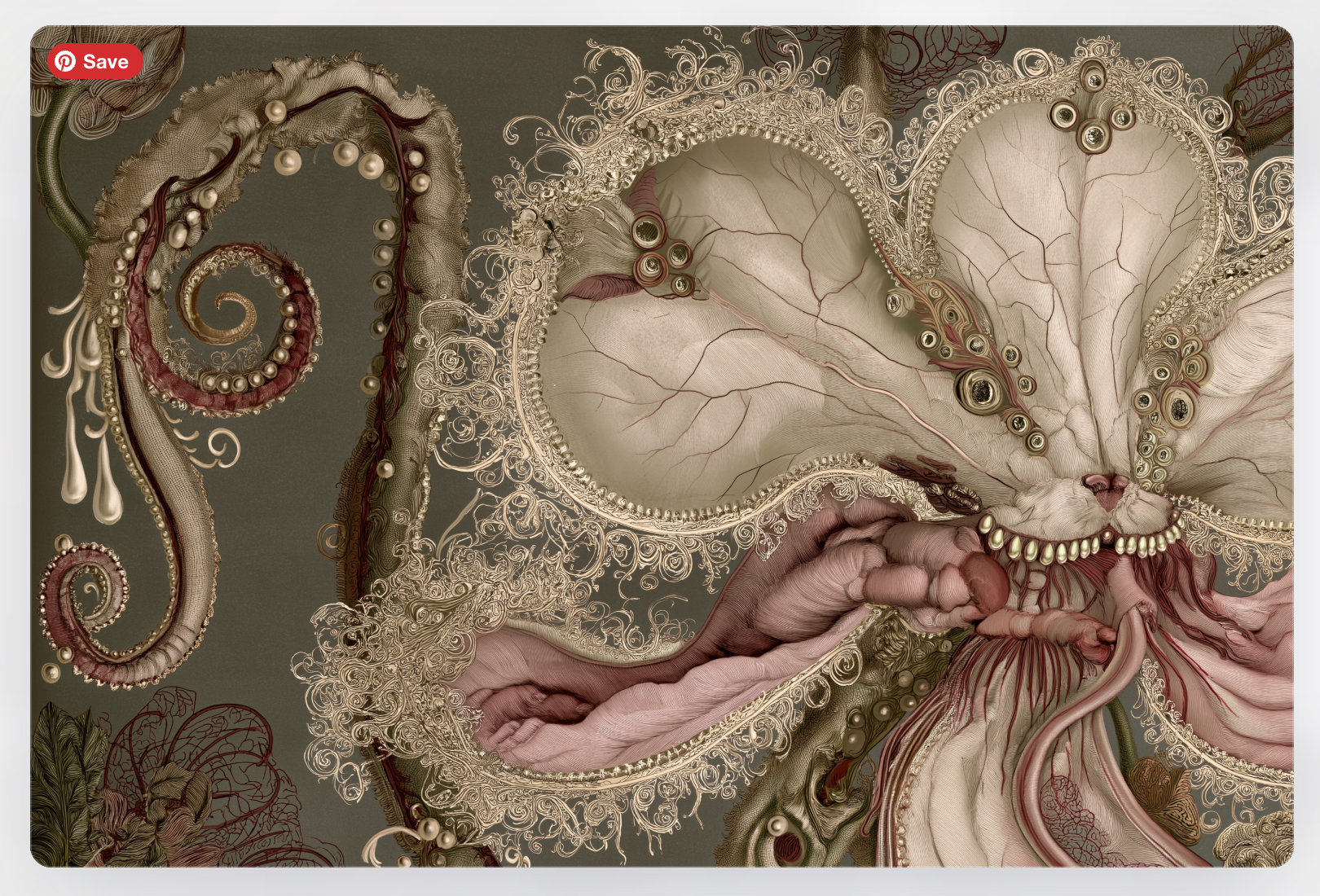
Surreal doll-like figure encrusted with pearls, roses, lace, jewelry, and multiple staring eyes

By Adrian V. Thorne

The central difficulty presented by Nada Gordon’s poetry is not that it is obscure, extravagant, vulgar, or indifferent to the conventional satisfactions of lyric form. These properties have long since ceased to constitute serious challenges to an educated readership, particularly one accustomed to the institutional conventions of experimental writing. Gordon’s difficulty lies elsewhere: in the extraordinary ingenuity with which her poetry converts its possible deficiencies into the grounds of its own vindication. Prolixity becomes abundance; arbitrary association becomes linguistic freedom; compositional negligence becomes an openness to accident; appropriation becomes evidence of the collective nature of language; and self-indulgence, that most obvious objection to the work, is anticipated and extravagantly caricatured before a critic can adequately formulate it. What results is an aesthetic so accomplished at representing its own contradictions that representation repeatedly substitutes for responsibility. The poet knows that she is vain, excessive, compromised, acquisitive, inconsistent, and intermittently ridiculous. She takes pains to demonstrate this knowledge. Yet the acknowledgment of a deficiency does not establish its aesthetic value, still less its ethical legitimacy. Gordon’s fundamental confusion is to treat self-awareness as though it were a form of exoneration, as though the performance of critical intelligence absolved the artist from the consequences of what that intelligence discovers.

The confusion is visible in the briefest of her characteristic gestures. In “Gorgeous,” a sprawling sequence of fragmentary poems collected in The Sound Princess, Gordon writes:

granite taken for styrofoam
out of the doldrums
and into—pardon me—puissance

The joke is neatly timed. The incongruity between granite and Styrofoam establishes an initial disturbance of material expectation; the familiar phrase about escaping the doldrums prepares an energetic transition; and the ostentatious abstraction “puissance” arrives with an apology that invites the reader to enjoy the pretension without condemning it. But the apology does not modify the pretension. It provides a means of preserving it. Gordon’s characteristic self-heckling allows her to perform a questionable rhetorical action and immediately assume the superior position of the person who recognizes its questionable character. The reader is thus expected to admire both the extravagance and the sophistication of its dismissal. This is not the relinquishment of authorial vanity but its multiplication. The poet becomes performer, audience, and critic of her own performance, with the considerable advantage that every objection can be incorporated into the entertainment.

The more serious problem with “Gorgeous” is structural. Its discontinuous fragments generate an atmosphere of unlimited linguistic possibility, but the poem offers remarkably few means of distinguishing an indispensable verbal discovery from an attractive accident. Consider:

otter games and
more distantly
the water (wonder) horse

The parenthetical transformation is charming, but its charm should not be confused with necessity. The addition of “wonder” creates a momentary oscillation between an aquatic animal and a creature of fabulous possibility. The mechanism is transparent; what remains obscure is why the resulting transformation should matter beyond the immediate recognition of its ingenuity. Elsewhere, “wine-lush musk (muscle*)” or “toe painted topaz or roan” performs a comparable operation of phonetic or semantic disturbance. Such effects can be repeated almost indefinitely, and their indefinite repeatability is precisely the difficulty. Gordon’s poems do not merely invite readers to recognize associative possibilities. They repeatedly imply that the recognition itself constitutes an artistic achievement. What is absent is a sufficiently discriminating account of why one possibility should be retained and another abandoned.

One might compare this procedure with George Oppen’s fragmentary propositions, but the comparison exposes the weakness of Gordon’s achievement. In Oppen, the interruption of utterance registers a resistance encountered by thought in its effort to remain answerable to things. In Gordon, interruption frequently provides the opportunity to escape a relation before it acquires consequences. The fragment “working mind’s fumbling ‘greatness’” might be regarded as a moment of self-suspicion, while “love of blurbs, of visibility” announces the vanity of literary aspiration. But the knowledge produced by such admissions is curiously inert. Vanity has been acknowledged, and the poem proceeds. The governing assumption seems to be that an artist who can identify her own motives has thereby subjected them to adequate criticism.

The danger is that the poem’s apparently radical openness conceals a deeply conservative attachment to an established repertoire of effects. Gordon’s verbal surfaces are crowded with bodily curiosities, exotic lexical materials, ornamental textures, parenthetical qualifications, and ostentatiously comic collisions. Yet the procedures through which these materials are transformed remain remarkably stable. “Gorgeous” repeatedly astonishes at the level of the phrase while becoming predictable at the level of compositional behavior. Its novelty is continuous and therefore increasingly unremarkable. The poem’s apparent refusal of formula has become a formula for producing the appearance of refusal.

“Professional Poem,” from Emotional Support Peacock, reduces the problem to an almost embarrassing simplicity:

O subchanters of the malversation,
you heriots of gemallion ell …
why all this drogulus? this axiopisty? this phit?

Here the sound of intellectual difficulty appears to have become a sufficient substitute for the intellectual relations through which difficulty might acquire value. The poem borrows the gestures of elevated address, rhetorical interrogation, and specialized knowledge, but the resulting performance has little direction beyond the accumulation of improbable language. A further succession of lexical inventions would alter the poem’s atmosphere without appreciably modifying its implications. The title supplies an additional irony by suggesting that the poem is implicated in the very professionalized literary culture its extravagant diction presumably mocks. But this self-implication again performs a suspiciously convenient function. Having made the professional poem ridiculous, Gordon can continue producing it without accepting the burden of demonstrating why this particular instance deserves preservation.

The ideological implications of this position become more pronounced in “Complexexity,” where Gordon begins:

not the opposite of simperplicity.
Rather, the opposite of obvivoidousness.

The poem’s invented vocabulary is intended to complicate the very possibility of a stable distinction between simplicity and complexity. Yet the position is less demanding than its typography suggests. A relatively ordinary opposition has been elaborated through morphological interference, and the interference presents itself as intellectual activity. Gordon subsequently mocks the demand for accessible evidence of perception, characterizing the desire for straightforward understanding through a contemptuous account of readers who expect the writer to have looked directly at something. Her suspicion of transparency is not without justification. But the poem supplies no adequate reason to conclude that deliberately complicated expression is more faithful to experience than the clarity it derides. The distortion of language is offered as evidence that language has been critically examined, when it may demonstrate no more than the poet’s willingness to subject words to familiar operations of deformation.

More troublingly, the poem’s conclusion abandons its polemical pressure in favor of an ornamental image:

A brass filigree polygonal lamp into which many glass jewels have been set.

The lamp is an attractive object, but its presence reveals something of Gordon’s argumentative predicament. The poem has moved from an inadequately established distinction among kinds of writing to a decorative object whose intricacy appears intended to vindicate complexity through sensory appeal. The aesthetic example replaces the intellectual demonstration. One is not required to dislike the lamp to question the logic by which its beauty is made to settle the preceding dispute. Gordon repeatedly treats ornamental complexity as though its sheer desirability established the validity of the conceptual claims made on its behalf. The result is less an argument than a series of invitations to admire the poet’s taste.

This habit achieves its fullest expression in “Poetry Is Junk,” the elaborate appropriative manifesto that establishes ornament as both a feminist counterpractice and a model of collective linguistic production. Against the austerities of Adolf Loos, Gordon assembles a luxuriant inventory of fabrics, flowers, bodily secretions, erotic practices, decorative objects, quotations, and verbal extravagances. The poem’s principal defense of appropriation is expressed with disarming simplicity:

Expression irrigates expression.

The formulation is attractive precisely because it replaces the asymmetries of actual cultural exchange with the image of a naturally fertile circulation. But the metaphor accomplishes its work by suppressing distinctions that any serious ethics of appropriation must preserve. The words of other writers, advertisers, anonymous speakers, and historically marginalized subjects do not become ethically equivalent simply because all language participates in inherited systems of expression. Nor does the collective nature of linguistic production abolish the difference between quotation and extraction, dialogue and ventriloquism, transformation and aesthetic consumption.

Gordon’s insistence that “Your own handwriting is collective,” borrowed in turn from Drew Gardner, is a proposition about the social conditions of language, not a comprehensive justification for every act of appropriation. Yet Gordon treats the proposition as an expansive authorization. Her declaration:

I’m all apertures.

appears to dissolve the boundaries of the lyric self while in practice licensing an extraordinary expansion of authorial possession. Everything can enter the poem because everything can be subjected to the recognizable operations of Gordon’s sensibility. The apparent surrender of individuality conceals the consolidation of an intensely proprietary artistic personality. The poet claims not to own the language she uses, but the work’s distinctive identity depends upon transforming the language of others into something unmistakably hers.

The extravagance of the poem’s imagery compounds the problem. When Gordon announces:

I run a mermaid ranch in my
eerie birth canal

the grotesque fusion of bodily interiority and fabulous enterprise is supposed to establish both the comic instability of the lyric subject and the generative freedom of language. Yet the image is characteristic of a procedure that has become largely automatic: an anatomical reference is joined to an incongruous imaginary object, and the resulting collision is presented as evidence of the extraordinary possibilities of artistic consciousness. Its sexual audacity is less significant than its predictability. The reader familiar with Gordon’s work has learned to expect precisely this sort of conjunction. What was once an experiment in decorum has become a decorative convention of its own.

Her defense of appropriation is particularly compromised by the poem’s declaration:

I steal with love and
out of sympathy.

The statement is revealing because it offers intention as the ethical guarantee of an act whose consequences are not thereby established. Love may motivate appropriation; it does not settle its legitimacy. Sympathy may inform the transformation of another person’s language; it does not establish that the transformation preserves, acknowledges, or adequately interrogates the circumstances of its source. Gordon’s insistence upon the affectionate character of her borrowing risks becoming a refined version of the familiar assumption that benevolent intentions place aesthetic conduct beyond ethical scrutiny. Her work does not consistently examine what its appropriations cost, what they obscure, or what relations of power they reproduce. The pleasure of incorporation is too readily mistaken for evidence of generosity.

“Coney Island Avenue” presents the problem in a more socially consequential form. The poem’s energetic catalogue of the immigrant and religious cultures encountered along a Brooklyn bus route has frequently been admired as a celebration of urban multiplicity. Gordon notices shops, advertisements, clothing, food, signs, bodies, and fragments of language with remarkable enthusiasm. But enthusiasm is not synonymous with attention, and attention is not automatically an ethical virtue. The catalogue’s accumulation of culturally specific surfaces repeatedly threatens to convert the neighborhood’s inhabitants into materials for a mobile observer’s aesthetic performance. The institutions and businesses possess names and histories that matter within the lives of the people who sustain them; within the poem, they become available principally as stimuli to association.

Gordon briefly acknowledges the possible historical violence of such spectatorship:

Who is “they”? The Westerners, of course

Yet the acknowledgment is characteristic of the poem’s larger evasions. The possibility of imperial or appropriative looking is identified, incorporated into the verbal movement, and displaced before it can impose any decisive limitation upon the poet’s appetite. Recognition becomes another form of permission. The speaker’s apparent susceptibility to the visual and cultural world is therefore inseparable from an extraordinarily assertive power to reorganize that world as a sequence of verbal pleasures.

The poem’s conclusion is still more revealing:

And then the paralyzing rush of emotion:

grace infuses whirling faces
with a dissonant gaiety.

This apparent lyric culmination is constructed through the transformation of language from Frank O’Hara’s Second Avenue, including his reference to Grace Hartigan. The proper name becomes an abstract principle; O’Hara’s language of artistic disturbance is reorganized into an experience of transcendent urban perception. The transformation is ingenious, but its ingenuity should not obscure the aesthetic convenience of the procedure. At the very moment when Gordon’s extended catalogue requires some principle of conclusion, another poet’s language arrives to supply the appearance of emotional revelation. The poem has not simply borrowed vocabulary. It has borrowed an already constituted structure of lyric intensity.

One could argue that such appropriation demonstrates the genuinely collective nature of poetic feeling. But the argument overlooks the distinction between the shared historical availability of language and the particular formal obligation to make that language consequential within a new work. Gordon’s transformation may produce beauty, but it does so through an imported authority whose presence complicates the claim that the preceding accumulation has generated the revelation organically. The borrowed lines are less the inevitable culmination of the poem than an exceptionally elegant means of ending it.

The rejection of sincerity, one of the more persistent theoretical commitments of Gordon’s work, operates through a comparable confusion. It is reasonable to recognize that emotional expression is mediated by rhetoric, cultural convention, and the instability of the speaking subject. It is considerably less reasonable to conclude that sincerity therefore constitutes an intellectually discredited aspiration. Gordon’s poems repeatedly convert emotional vulnerability into rhetorical performance, as though the awareness that feeling is constructed required its immediate contamination by irony. The result is a lyric practice capable of extraordinary emotional intensity but frequently unwilling to endure that intensity without protective qualification.

“Dismay” demonstrates the distinction with unusual clarity. After an opening of characteristic lexical complication, the speaker asks whether imitation of a rival might provide access to the beloved’s emotional world. The poem then abandons its elaborate abstractions:

I can’t
get her haircut: I don’t
have that kind of hair.

The passage is devastating precisely because the emotional problem has acquired an irreducibly material form. The speaker cannot reproduce the rival’s desirability because she cannot reproduce the rival’s body. Here Gordon’s verbal inventiveness encounters a circumstance it cannot simply transform. The subsequent declaration:

I’m better than she is,
who does not think of you,
just as you do not think
of me.

is equally affecting in its resentful simplicity. But these passages also reveal how much of the surrounding verbal complication may be unnecessary to the poem’s achievement. The intensity arises not from the extravagant proliferation of language but from the temporary suspension of that proliferation. The speaker has ceased to protect herself through invention and has permitted an emotional proposition to remain exposed.

“Mauvais Song,” from Emotional Support Peacock, is similarly instructive. Its opening recollection of a former poetic plenitude possesses genuine lyric force:

Once everything was magnolian

The invented adjective is unusually effective because it does more than advertise lexical ingenuity. It condenses floral exuberance, nostalgia, and a sense of vanished perceptual possibility. The poem then recalls a time when language seemed capable of transforming experience:

I was in love with this garbled feeling.

The admission is unusually suggestive. Gordon’s attachment is not simply to poetry’s representational power but to the very disturbance through which language makes experience available as a source of pleasure. Yet the poem subsequently becomes a lament for the erosion of that capacity. The speaker is distracted by her phone, diminished by contemporary anxieties, and unable to recover an earlier relation to verbal abundance.

At this point, however, the familiar machinery of comic rhyme and self-interruption begins to operate:

I hop on a point,
I skip on a line

The lines are intended to acknowledge the poet’s awareness of her own mannerisms, but their jaunty movement threatens to trivialize the loss the poem has introduced. Later, the speaker confesses:

Busily trying to fill up a page.

One might regard this admission as disarming candor. It is also a remarkably accurate description of a compositional habit whose results Gordon too often treats as valuable simply because they have been produced. The poem’s dissatisfaction with its own procedures becomes another occasion for their repetition.

The subsequent declaration:

I’ve got sand in my thoughts

is more promising because it allows the deterioration of verbal productivity to acquire an image of abrasive material resistance. But Gordon cannot remain with it. The poem resumes its transformations, moving from sand to appetite to the lubricious abundance of consciousness, as though the very recognition that the mechanism is failing could be overcome through renewed operation of the mechanism. The work presents a poet who recognizes that her habitual resources are inadequate to her circumstances, yet appears unwilling to relinquish them.

The problem is not that irony and sincerity are incompatible. It is that Gordon repeatedly invokes their incompatibility as a means of avoiding the responsibility of either. A statement can be offered as emotionally serious until its seriousness becomes embarrassing, at which point it may be reclaimed as comic performance. Conversely, a joke can register a genuine grievance until that grievance becomes vulnerable to objection, at which point the speaker may retreat into the joke’s apparent inconsequence. Such writing possesses an enviable rhetorical flexibility, but the flexibility is purchased through a refusal to specify the conditions under which the poet’s utterances might be held accountable.

“Genius Grant: A Hateful Sestina” demonstrates the procedure at the level of institutional criticism. Its opening assertion:

Any idiot can get a genius grant

establishes the poem’s contempt for the procedures through which literary distinction is distributed. Yet the satire is complicated by the speaker’s unmistakable desire for precisely the forms of recognition she mocks. The sequence of fellowships, residencies, craft talks, and tenure tracks becomes a machinery of resentment whose repetitive structure allows the poet to enjoy both denunciation and longing.

The poem’s transformations of “tenure track” into related sounds are frequently amusing, but their accumulation does not deepen the institutional argument. The sestina’s elaborate formal machinery provides repeated opportunities to perform a settled attitude. The poet knows that her desire for recognition is compromised. She makes that knowledge funny. What she does not do is permit the contradiction to become sufficiently consequential to transform her position. The result is less an investigation of artistic prestige than an exceptionally accomplished form of grievance management.

“Sturm,” Gordon’s extended meditation on the difficulty of writing about Hurricane Sandy, offers the most disturbing instance of this tendency because the work’s evasions take place in relation to actual historical suffering. The speaker acknowledges her lack of direct experience of the catastrophe and considers several possible formal responses. She rejects documentary enumeration, parody, visual arrangement, and various established poetic methods as inadequate to the occasion. Her hesitation is often presented as evidence of ethical seriousness, but ethical seriousness cannot be demonstrated merely through the recognition of ethical difficulty.

The poem’s documentary passage enumerates the consequences of the hurricane with a directness unusual in Gordon’s work. It includes displaced residents, damaged infrastructure, lost power, and the suffering of people whose circumstances were dramatically unlike the speaker’s. Yet Gordon rapidly dismisses the material:

This isn’t a poem at this point.
It is an article.

The distinction deserves considerably more scrutiny than the speaker allows it. Why should an inventory of damaged lives and institutions be aesthetically deficient merely because it preserves their historical particularity? Why should the poem’s achievement depend upon the conversion of these materials into a formal analogue of meteorological turbulence? The assertion that reportage is insufficiently poetic is not an ethical conclusion but an aesthetic preference, one that becomes suspicious when it permits the poet to abandon the claims of historical specificity in favor of her habitual procedures of verbal invention.

The poem subsequently offers an even more revealing diagnosis of its predicament:

Flarf is too smartass, conceptualism too
cold, docupo too earnest and langpo too dated.

The reductive neatness of these judgments is striking. Each literary practice is dismissed through an exaggerated caricature of its characteristic limitation, and the resulting panorama of inadequacy produces the appearance of comprehensive philosophical skepticism. But the argument is intellectually lazy. To identify a possible weakness within a method is not to demonstrate that every realization of the method is compromised. Gordon’s reductio ad absurdum substitutes the ease of satirical dismissal for the difficulty of discrimination. Once every available practice has been found wanting, the poet’s inability to determine an adequate alternative becomes a principled impasse rather than an avoidable failure of judgment.

The most damaging moment arrives when Gordon acknowledges:

There is no reason for the linebreaks here except to mark it
as a poem

This is not merely a confession of formal uncertainty. It is an admission that a significant element of the work’s presentation lacks a persuasive compositional justification. The poet immediately associates the decision with her payment for the commission, thereby making the poem’s formal inadequacy part of a comic account of artistic labor. But the acknowledgment does not establish the necessity of the line breaks. Their function remains what the speaker has identified it as being: the conventional designation of otherwise prosaic material as poetry. Gordon has discovered a means of making negligence entertaining without demonstrating that negligence has become artistically consequential.

The ensuing passage of lexical turbulence attempts to recover poetry through an extravagant proliferation of unfamiliar words and grotesque associations. But its procedures are virtually indistinguishable from those employed throughout Gordon’s work. The hurricane has supplied an occasion for the performance, not an organizing demand capable of transforming it. The world is again absorbed into the recognizable habits of the poet’s sensibility. What purports to be an encounter with the inadequacy of language becomes a renewed exhibition of linguistic facility.

The poem’s philosophical culmination is perhaps the most explicit statement of Gordon’s governing bad faith. Rewriting Seamus Heaney’s conception of poetic responsibility, she proposes that poetry might make the writer:

a more artificial, tainted,
fragmented creature.

The opposition is rhetorically effective but conceptually evasive. Heaney’s aspirations toward truth and wholeness are dismissed as insufficiently attentive to artifice, while Gordon’s preference for fragmentation acquires the status of a competing ethical ideal. Yet nothing about the mediated nature of language establishes that artificiality is intrinsically more responsible than sincerity, or that fragmentation is more intellectually demanding than the attempt to establish relations among fragments. Gordon has simply reversed a set of values whose authority she refuses to examine. The inversion creates the appearance of philosophical radicalism while preserving the comforting simplicity of the original opposition.

Her subsequent recognition that the poem is not finally about the hurricane but about the wrongness of poetic forms is equally convenient. The catastrophe, having resisted her attempts at representation, becomes the occasion for a self-reflexive meditation on the inadequacy of representation itself. The poet’s failure is redescribed as the discovery of her true subject. This is the central maneuver of Gordon’s aesthetic in its most ethically consequential form: failure becomes not something to be overcome or accepted as failure, but the generative principle through which the work secures its claim to achievement.

A comparable mechanism operates in “A Conversation,” from Folly, where Gordon stages an exchange with an editor who questions the manuscript’s organization. The editor objects to its excessive dependence upon gesture and demands a more propositional account of its intellectual ambitions. Gordon replies by explaining the structure of the book and its relation to Erasmus, while the personified figure of Folly supplies comic interruptions. Eventually the editor announces:

This is still entirely gestural.

His objection has by this point become part of the performance whose adequacy he is attempting to assess. The poet’s inability or unwillingness to provide a satisfactory response has been converted into theatrical material, and the scene’s comic vitality threatens to make the objection seem irrelevant. Yet the editor has not been answered. He has been incorporated.

This is perhaps the clearest demonstration of Gordon’s capacity to transform criticism into an extension of the work’s authority. The objection is acknowledged, dramatized, made amusing, and left without consequence. The work congratulates itself on the honesty of staging its own inadequacies while proceeding exactly as before. Such reflexivity may appear intellectually sophisticated, but it is also an extraordinarily effective means of avoiding revision. The poet’s ability to describe a weakness becomes an argument for preserving it.

Gordon’s later poem “Sabishii” reveals the exhaustion of this procedure in a more melancholy register. Its accumulation of obsolete household objects, damaged toys, unfashionable clothing, discarded decorations, and peculiar consumer products suggests an inquiry into the relationship between language and abandonment. Yet the objects increasingly appear interchangeable within a compositional system whose governing principle is the endless conversion of material particularity into verbal stimulus. The speaker declares:

It is a begging for language.

The formulation is revealing. The poem’s longing is directed less toward the objects themselves than toward the continuation of the linguistic activity they make possible. The discarded materials acquire value because they can be transformed into words, but the transformations seldom establish why these particular objects should matter beyond their contribution to the poet’s associative productivity.

The poem’s repeated insistence upon pleasure becomes increasingly desperate. Its verbal abundance no longer guarantees the emotional satisfaction that originally justified the procedure, yet the procedure continues. Gordon appears to recognize the emptiness of its repetition without being able to abandon it. What might have become a genuinely moving examination of diminished artistic and emotional possibility is repeatedly dispersed through further acts of invention. The poem’s sadness is inseparable from the spectacle of a poet whose accustomed resources have ceased to reassure her, but whose attachment to those resources remains almost compulsive.

One is tempted to describe the resulting aesthetic as nihilistic, though the term requires precision. Gordon is not indifferent to value in any comprehensive philosophical sense. Her poetry remains passionately attached to beauty, pleasure, comedy, erotic experience, and the sensuous properties of language. Its nihilism is selective and opportunistic, emerging at those moments when evaluative distinctions threaten to impose obligations upon the work. If every form is compromised, no specific deficiency requires correction. If all language is already appropriated, no particular appropriation demands justification. If sincerity is necessarily rhetorical, no utterance need remain answerable to its emotional claims. If artistic failure can be transformed into self-reflexive commentary, failure itself loses its capacity to compel revision.

This is nihilism not as a doctrine of meaninglessness but as an instrument for avoiding the consequences of meaning. Gordon’s poems want the pleasures of value without submitting to its restrictions. They want beauty without the necessity of distinguishing beauty from stimulation, critical intelligence without the obligation to accept criticism, and artistic freedom without the discipline of consequential choice.

The contrast with artists such as Agnes Martin and Gerhard Richter is instructive not because they exemplify a simplistic alternative of austerity to Gordon’s abundance, but because their work demonstrates the centrality of discrimination within artistic procedure. Martin’s repetitions derive their force from an exacting attention to differences of interval, pressure, and proportion. Richter’s surfaces are produced through processes of application, revision, obscuration, and erasure that refuse to preserve every successful effect merely because it has occurred. Their practices acknowledge the generative possibilities of accident without confusing generation with achievement.

Gordon, by comparison, often gives the impression of an artist unable to relinquish a phrase once its ingenuity has become apparent. The ornate, obscene, ridiculous, or lexically extravagant effect is preserved because it is pleasurable, while the question of its necessity within the larger composition is displaced by an argument about pleasure’s legitimacy. Yet the legitimacy of pleasure is not in question. What requires examination is the relation between particular pleasures and the form that contains them. Gordon repeatedly answers that question by producing another pleasure.

The result is a body of work of extraordinary verbal facility and uncertain artistic necessity. Its best passages demonstrate that Gordon possesses the capacity for genuine lyric concentration, but their effectiveness often depends upon the temporary suspension of the procedures most conspicuously identified with her poetics. The bodily specificity of the haircut in “Dismay,” the opening recollection of linguistic plenitude in “Mauvais Song,” and the occasional moments of perceptual precision scattered throughout The Sound Princess reveal an artist capable of allowing an image or emotional relation to impose limits upon verbal invention. But such moments remain vulnerable to the poet’s habitual desire for further elaboration. Her intelligence repeatedly rescues her from the danger of being insufficiently ingenious, while exposing her to the more consequential danger of being ingenious without sufficient cause.

The principal objection to Gordon’s poetry is therefore not that it permits too much, but that it demands too little of what it permits. The work’s celebrated openness conceals a remarkable resistance to being transformed by the materials it receives. The cultural reference, the borrowed line, the emotional confession, the grotesque image, and the objection to the poem’s own procedure are all subjected to an aesthetic system whose principal achievement is the indefinite preservation of its freedom to continue. Nothing can finally interrupt the performance because interruption itself has become one of its most reliable effects.

Gordon’s defenders have frequently mistaken this indefatigability for artistic courage. Yet there is little courage in a poetics that has made itself almost entirely immune to the possibility of recognizable failure. The poet confesses her vanity before vanity can be condemned; acknowledges her sloppiness before sloppiness can be criticized; ridicules her own institutional ambitions before their contradictions can become embarrassing; and explains her appropriations through a theory of collective language that renders the question of their particular consequences conveniently secondary. Every anticipated objection becomes another element of the work’s self-advertisement. The poet can be wrong only in ways that demonstrate how intelligently she understands the possibility of being wrong.

What this aesthetic finally lacks is not sincerity, coherence, seriousness, or restraint in their conventional manifestations. It lacks a sufficiently demanding account of artistic responsibility, one capable of distinguishing the recognition of a problem from the difficult work of responding to it. Gordon’s poetry continually exposes its own limitations while insisting, implicitly or explicitly, that the exposure has transformed those limitations into accomplishments. The claim is untenable. Self-consciousness is not self-criticism, and self-criticism without the possibility of revision is merely another form of self-regard.

The most dispiriting quality of the work is consequently not its extravagance but its atmosphere of perpetual exoneration. Everything has already been excused: the cliché because it is quoted, the obscenity because it is theatrical, the incoherence because it is deliberate, the sentiment because it is mocked, the appropriation because language is collective, the sloppiness because accident is productive, and the failure because the poem has exposed the impossibility of success. Aesthetic freedom has become a comprehensive system of insurance against aesthetic judgment.

Gordon’s considerable talent makes this predicament more rather than less consequential. An artist of lesser intelligence might have remained innocent of the contradictions that characterize her work. Gordon understands them and repeatedly converts that understanding into the means of their preservation. Her poetry has made an extraordinary art of avoiding the last word, but the refusal has itself become an increasingly predictable conclusion.

One begins to suspect that the essential gesture of Gordon’s mature poetics is not the liberation of language from constraint, but the liberation of the poet from the obligation to determine what language has accomplished.

And this, whatever its theoretical elaborations, is not a radical aesthetic achievement. It is an evasion.


Works discussed: Nada Gordon, Folly (Roof Books, 2007); Vile Lilt (Roof Books, 2013); The Sound Princess: Selected Poems 1985–2015 (Subpress Collective, 2024); Emotional Support Peacock (BlazeVOX, 2024); and selected theatrical works.

About the author

Adrian V. Thorne is a fictional literary critic and the author of The Exhaustion of Transgression: Avant-Garde Form After Its Institutional Triumph (2009) and Against the Alibi: Sincerity, Bad Faith, and the Limits of Irony (2018). His current project, The Right to Be Boring: Aesthetics After the Cult of Novelty, remains in preparation.

Adrian V. Thorne, fictional literary critic

Editorial note: Adrian V. Thorne is a fictional scholarly persona. This essay was developed through an extended critical dialogue between Nada Gordon and ChatGPT.

The Ornamental and the Unseemly: On the Poetry of Nada Gordon

By Mira K. Vell

The extraordinary profusion of language in Nada Gordon’s poetry presents a difficulty for criticism that is not adequately addressed by invoking the usual vocabulary of experimental writing: disjunction, appropriation, polyphony, linguistic materiality, the destabilization of the lyric subject. Although all these terms describe important aspects of her practice, they tend to subordinate the sensuous particularity of her poems to a set of already familiar propositions about the nature of language. Gordon’s work, however, is distinguished not merely by its interrogation of signification but by an appetite for the physical, ornamental, erotic, and sometimes repellent properties of words, an appetite that persists even when the poems appear to distrust the legitimacy of such pleasures. Her poetry is extravagant, but its extravagance is never simply an assertion of freedom from constraint; it is continually interrupted by embarrassment, critical self-awareness, emotional vulnerability, and an almost compulsive need to argue with the conditions of its own production. The poems simultaneously pursue and ridicule poetic magnificence, exposing the cultural mechanisms through which some forms of verbal display acquire the dignity of art while others are dismissed as vulgar, feminine, excessive, or ridiculous. This conflict is not incidental to Gordon’s style. It generates the peculiar instability of her lyric voice, a voice capable of the most elaborate rhetorical exhibitionism while refusing to exempt its own performance from skeptical scrutiny. The resulting poetry is not merely ludic, nor does its comedy function as an agreeable disguise for an otherwise solemn intellectual project. Rather, its pleasures and its critical intelligence are frequently inseparable from one another, producing an art in which seriousness becomes most interesting at the moment when it is threatened by ridicule.

The historical complexity of Gordon’s work becomes clearer when its relation to the American experimental tradition is considered alongside intellectual and aesthetic inheritances that do not fit comfortably within that tradition’s conventional genealogies. The associative freedoms of John Ashbery and Frank O’Hara, the procedural investigations of Bernadette Mayer, Clark Coolidge’s improvisational attention to the sonic and material properties of words, and Language poetry’s sustained interrogation of reference and expressive subjectivity provide essential contexts for her writing, but they do not exhaust its ambitions. Mina Loy’s erotic and intellectual ferocity, Lewis Carroll’s systematic nonsense, the metaphysical conceits of George Herbert, the artificial paradises of Huysmans, and the theatrical, cinematic, and poetic experiments of Terayama Shūji offer equally suggestive points of comparison. These affiliations cannot be understood as a harmonious synthesis of compatible influences. The skepticism toward transparent expression associated with Language writing is not readily reconciled with Gordon’s unabashed investment in lyric affect; the compactness of Japanese short-form poetry appears initially incompatible with her seemingly inexhaustible elaborations; and the ornamental artificiality of decadence coexists uneasily with the improvisatory inclusiveness of the New York School. What gives Gordon’s writing its distinctive character is precisely the persistence of these tensions. Her poetry does not resolve them into a coherent aesthetic program but discovers in their interference a means of generating new forms of experience. Her participation in Flarf, moreover, should be understood within this longer history rather than made to account retroactively for the earlier work. The poems collected in The Sound Princess: Selected Poems 1985–2015 demonstrate that her investigations of linguistic accident, bodily experience, borrowed discourse, and unstable subjectivity were underway well before the emergence of Flarf as a recognizable movement. What the internet and the collective procedures of Flarf made newly available was an enormously expanded archive of verbal material through which preexisting aesthetic interests could be pursued.

One of Gordon’s most illuminating descriptions of her own compositional activity involves the figure of the hermit crab, a creature that inhabits a structure it has not itself produced. The metaphor suggests a relation to inherited forms that differs both from conventional imitation and from appropriation understood as the neutral transfer of material into a new context. Gordon has described a practice of looking at an existing text, sometimes almost squinting at it, and allowing the visible and audible properties of words to suggest alternative language, producing substitutions that may begin as parody or pastiche but eventually acquire an imaginative existence largely independent of the original. The resulting work does not simply quote its predecessor or arrange fragments from it. It occupies the predecessor’s formal and rhetorical architecture, making that structure available for transformations whose direction cannot be entirely anticipated. Such an account is especially useful for understanding her rewritings of George Herbert, her occupation of familiar television and theatrical situations, and her use of inherited poetic forms. Yet the hermit-crab analogy is also instructively imperfect. The animal may occupy its shell without materially transforming it, whereas Gordon frequently subjects the borrowed structure to such radical deformation that the distinction between habitation and reconstruction becomes difficult to sustain. More importantly, the analogy raises the question of what constitutes a poetic shell in the first place: an arrangement of lines, a recognizable literary genre, an ideological proposition, a social situation, or the accumulated expectations through which a reader recognizes a particular kind of utterance? Gordon’s work repeatedly suggests that these structures are inseparable, that to inhabit an inherited form is also to enter the historical and social relations it carries. Her originality resides not in an imagined emancipation from influence but in the exceptionally inventive ways she inhabits forms that are never entirely her own.

This relationship between inheritance and transformation is already evident in “jordan iv,” an early rewriting of Herbert’s “Jordan” poems, where Gordon takes up the devotional poet’s suspicion of rhetorical ornament and converts it into an unstable meditation on the pleasures of verbal elaboration. The speaker remembers an enthusiasm for language that threatens to overwhelm the ideas it is supposed to communicate:

My thoughts got top-heavy, covered with curlicues,
Decking the sense, as if it were to sell.

The lines acknowledge the familiar objection that elaborate poetic diction may become an impediment to sincerity, but the acknowledgment is itself conspicuously embellished. “Curlicues” is at once the name of an ornamental excess and a delightfully curling verbal object, its sounds performing the decorative movement it ostensibly condemns. The image of thoughts becoming “top-heavy” gives a physical instability to an intellectual predicament, as though the weight of verbal decoration might cause the conceptual structure beneath it to topple. Yet the poem’s relation to Herbert is more complicated than a simple defense of artificiality against devotional plainness. By inhabiting the earlier poem’s argumentative structure, Gordon makes its supposedly corrective appeal to sincerity appear equally dependent upon literary convention. The desire to express love directly remains real, but the language through which such directness is recommended is itself inherited, stylized, and historically situated. The conflict is therefore not between an authentic feeling and the artificial language that distorts it, but among competing rhetorical procedures, each of which offers particular possibilities and limitations for emotional expression. Gordon’s speaker is embarrassed by her own appetite for ornament without becoming willing to relinquish it, a predicament that recurs throughout her work and provides one of the principal sources of its comedy.

A more extensive example occurs in “Gorgeous,” from V. Imp, a poem whose fourteen-page expanse is constructed largely from brief, asterisk-separated units, many of them resembling drastically compressed haiku or tanka. Its relationship to Japanese short-form poetry is especially suggestive when considered through the example of Terayama Shūji, whose experimental tanka sequences introduced surrealist displacement, eroticism, popular culture, and theatrical artificiality into forms frequently associated with lyric concentration. Gordon’s Japanese affinities are not confined to literary technique: her work repeatedly draws upon Japanese language, popular imagery, performance, and the stylized pleasures of what might be called Japanoiserie, a category that necessarily involves questions of cultural mediation and imaginative fabrication as well as direct experience. In “Gorgeous,” however, the influence is most consequential at the level of formal organization. The individual units possess a degree of autonomy, each offering a miniature field of perception or verbal transformation, while their accumulation produces an extended, discontinuous performance of consciousness. The poem’s three divisions, designated “Fits,” also recall the episodic structure of Carroll’s The Hunting of the Snark, introducing a further association between literary composition, involuntary disturbance, and theatrical nonsense. Gordon’s miniature forms are thus continually unsettled by the larger structures in which they participate. Their brevity concentrates attention upon the smallest syntactic and phonetic decisions, while their arrangement in an extended sequence prevents any single moment from achieving the closure or self-sufficiency that the miniature might appear to promise.

Consider a three-line unit from the opening Fit:

otter games and
more distantly
the water (wonder) horse

The apparent simplicity of the first line is already unstable, since “games” attributes a recognizable category of human activity to the animals under observation. The second line introduces a movement of spatial recession whose object remains uncertain until the final phrase arrives, where the “water (wonder) horse” transforms the apparently natural scene into a linguistic and imaginative event. The parenthesis is crucial because it neither replaces “water” with “wonder” nor allows the two terms to become entirely separate. Instead, the reader is made to experience their simultaneous presence, the second word emerging within the first through a slight alteration of its material form. The transition from animal observation to mythical possibility is therefore inseparable from a visible operation upon language. The unit possesses something of the charged juxtaposition associated with Japanese short-form poetry, but its effects also recall Coolidge’s willingness to allow the phonetic and morphological properties of words to generate unexpected compositional movement. Gordon’s procedure is not reducible to either antecedent. The miniature’s concentrated architecture intensifies the improvisatory transformation, while the transformation itself prevents the unit from becoming a stable image of the natural world. Something similar occurs in the astonishingly compressed “purely zinnia: delusion,” where the colon, conventionally an instrument of definition or explanation, introduces a relation whose terms resist any obvious paraphrase. The specific flower is confronted with an abstraction that seems to diagnose or explain it, yet the apparent equivalence is neither logical nor merely arbitrary. The punctuation performs the gesture of clarification while refusing its expected result, producing a miniature instance of the disciplined irrationality that characterizes Carroll’s nonsense. Gordon’s work frequently proceeds through such displacements of rhetorical convention, allowing the recognizable forms of explanation, argument, or description to produce consequences that disturb the authority those forms ordinarily claim.

The comic intelligence of “Gorgeous” becomes especially apparent in another miniature:

granite taken for styrofoam
out of the doldrums
and into—pardon me—puissance

The initial confusion between granite and Styrofoam establishes a tactile and conceptual reversal between heaviness and lightness, durability and disposability, while the second line begins an idiomatic movement whose conclusion appears to promise some conventional form of renewed vitality. Instead, the poem arrives at the magnificently inflated “puissance,” but only after a tiny interruption in which the speaker appears to apologize for the extravagance of her own diction. This “pardon me” constitutes a theatrical event whose scale is inversely proportional to its implications. The speaker, having prepared the conditions for her own rhetorical elevation, momentarily steps outside the performance in order to acknowledge its possible absurdity; yet the acknowledgment is itself part of the performance, functioning simultaneously as apology, comic delay, provocation, and an advertisement for the very verbal excess it purports to excuse. One might hear in this gesture an inheritance from Jewish comic performance, particularly the self-interrupting monologue in which the speaker anticipates the audience’s suspicion of grandiosity and converts that suspicion into an additional source of authority. But the moment also exemplifies a more general Gordonian procedure in which the poem incorporates its own skeptical reader, refusing to allow the literary utterance to preserve an uncontested dignity. The word puissance does not simply announce power; it acquires its peculiar force through the staged embarrassment of its arrival, as though linguistic authority could be exercised only by first exposing its pretensions. Gordon does not renounce the grand word. She enjoys it, but makes its enjoyment inseparable from the comedy of having chosen it. The resulting utterance is neither a straightforward assertion of poetic mastery nor an act of self-effacement. It is an agonistic performance in which literary ambition and the ridicule of literary ambition become mutually sustaining activities.

Such self-interruption has affinities with traditions of Jewish theatrical and verbal comedy that extend from Yiddish popular performance through American vaudeville, early Hollywood, and the comedy of the Marx Brothers and Mel Brooks. Gordon’s own engagement with Molly Picon, whom she once discussed in a presentation at the Workmen’s Circle, makes the connection more than a purely abstract historical parallel, although its significance should not be reduced to a claim of direct stylistic descent. What matters is the availability of a comic repertoire in which the performer cultivates intimacy with the audience through self-deprecation, anticipates hostile judgment, and punctures the dignity of her own declarations without necessarily surrendering their force. Such practices also circulate through familial speech, where argument, affectionate mockery, exaggerated complaint, and the theatrical presentation of one’s own inadequacies may become habitual ways of negotiating intimacy and authority. Gordon’s poetry transforms these conversational procedures into formal devices: parenthetical interruptions, sudden changes of register, direct addresses, apologies, confessions, and deliberate failures of rhetorical elevation. The historical tensions within Yiddish theatre between popular entertainment dismissed as shund and the aspirations of more respectable dramatic art offer a further, particularly suggestive analogy for Gordon’s quarrel with the institutions of poetic seriousness. Her writing repeatedly asks why certain kinds of verbal display should be regarded as intellectually legitimate while others, especially those associated with feminine ornament, vulgar pleasure, comic excess, or theatrical exhibitionism, are relegated to a supposedly inferior aesthetic order. Yet her challenge to these hierarchies is complicated by her own desire for recognition. She does not inhabit the comfortable position of an artist who has transcended the need for literary prestige. Her speakers frequently want the very distinctions they ridicule, and their self-deprecation becomes more consequential because it does not free them from vanity, competitiveness, or disappointment.

The importance of this comic self-implication becomes unmistakable in “Genius Grant: A Hateful Sestina,” from Emotional Support Peacock, where the institutional vocabulary of literary ambition is subjected to the repetitive machinery of an inherited poetic form. Grants, fellowships, residencies, workshops, and the tenure track become the recurrent terms through which the sestina organizes its aggression, while Gordon’s phonetic transformations disclose the absurdity latent in the language of professional recognition. The movement from “tenure” toward “tenor,” “tin ear,” and “manure” does not merely produce a series of jokes; it reveals the instability of the institutional distinctions that these words are ordinarily employed to secure. The poem’s formal constraint becomes an analogue for the repetitive social structures through which literary success is imagined and pursued. Yet the speaker’s antagonism is persistently compromised by her own participation in those structures. The wish for distinction survives the exposure of distinction’s absurdity. This is one of the reasons Gordon’s relation to mainstream or supposedly serious poetry cannot be adequately described as simple opposition. Her work is engaged in a continuing struggle with the aesthetic and institutional conditions of literary value, a struggle that also extends into the experimental traditions to which she belongs. Language poetry, conceptual writing, Flarf, and the New York School may provide alternative methods and forms of legitimacy, but none remains exempt from Gordon’s skeptical intelligence. The comic agon takes place within the avant-garde as well as against the literary mainstream, and its energy derives partly from the poet’s refusal to imagine that any particular aesthetic affiliation can resolve the contradictions of artistic ambition.

If this aspect of Gordon’s work emphasizes its argumentative and theatrical character, “Poetry Is Junk,” from Vile Lilt, provides a more expansive account of the relationship between ornament, embodiment, and subjectivity. The poem begins with an epigraph from Adolf Loos’s “Ornament and Crime,” placing its elaborate decorative vocabulary within a history of modernist suspicion toward ornament as culturally regressive or aesthetically superfluous. Yet Gordon’s response does not simply reverse the hierarchy by declaring ornament superior to the unadorned. Instead, the poem constructs an extraordinarily elaborate verbal environment in which fashion, femininity, erotic activity, bodily secretion, and theories of authorship become inseparable. The opening instructions concerning the animation of costume suggest that personality is not an autonomous interior substance subsequently expressed through external appearance, but something constituted through the successful inhabitation of a socially available form. Gordon’s speaker becomes increasingly difficult to distinguish from the fabrics, ornaments, and bodily materials with which she surrounds herself, and the supposed boundary between decorative surface and authentic self begins to dissolve. The poem’s argument is thus performed through its own compositional procedures, which incorporate inherited statements, fragments of other people’s language, and shifts among incompatible registers. Its dense ornamental texture is not a covering concealing an otherwise transparent proposition; it is the means through which the proposition becomes available.

The most explicit formulation of this conception of authorship occurs in the deceptively simple declaration:

Expression irrigates expression.

The verb “irrigates” transforms literary influence into a material and ecological process, suggesting the movement of nourishment across boundaries rather than a succession of discrete intellectual inheritances. Gordon develops the idea through quotations from contemporary writers, including Rob Fitterman and Drew Gardner, whose observations concerning impersonal subjectivity and collective handwriting become part of the poem’s own argument. Their incorporation is not merely illustrative. It enacts the claim that individual expression is constituted through the circulation of language among speakers. A few lines later Gordon asks, “Who’s containable?” and answers, “I’m all apertures,” a formulation more precise than the familiar avant-garde celebration of uncontainability. An aperture is not simply an absence of boundaries but an opening within a structure, a point through which light, air, sound, or bodily material may pass. The speaker is therefore imagined not as an emancipated self overflowing its limits but as a system of exchanges, simultaneously constituted and transformed by what enters it. This conception has evident affinities with Language writing’s interrogation of the autonomous lyric subject, but Gordon’s formulation introduces an insistently erotic and affective dimension. Her collective self is not impersonal in the sense of being emotionally evacuated. It is porous because it desires, absorbs, responds, and becomes entangled with the language and sensations of others.

The presence of Mina Loy within “Poetry Is Junk” is especially significant in this respect. Gordon incorporates Loy’s formulation of love as an expansion of self-sympathy, allowing the modernist predecessor’s account of erotic and ethical identification to become part of an argument about the affective possibilities of appropriation. The borrowed phrase becomes meaningful not because it is detached from its prior context but because it is made available for renewed inhabitation. Gordon’s practice thus complicates any easy opposition between conceptual impersonality and lyric intimacy. The language of others enters the poem through a desire for connection that is itself inseparable from the pleasure of verbal transformation. This is also why the poem’s sustained attention to lace-making matters. Lace provides a material analogue for the relation between inherited language and individual invention, a pattern produced through the intertwining of threads whose significance depends upon both connection and open space. Its labor is repetitive, intricate, and technically demanding, yet its products have often been relegated to the supposedly secondary domain of feminine decoration. Gordon’s verbal lacework challenges that hierarchy by making ornamental construction a mode of intellectual activity, while refusing to purify ornament of its associations with erotic display, commodity culture, and the social regulation of femininity. Decoration is neither innocent nor merely oppressive. It is a field of contradictory pleasures and constraints through which the self may become visible, vulnerable, and imaginatively transformed.

The question of beauty becomes especially difficult here, because Gordon’s work repeatedly produces experiences of genuine lyric beauty through materials that seem designed to resist conventional aesthetic idealization. The relevant comparison is perhaps André Breton’s notion of beauté convulsive, a beauty arising through the sudden disruption of familiar relations and the encounter with forms that unsettle the boundaries between the marvelous and the ordinary. Yet Gordon’s beauty is not simply surrealist convulsion transferred into the field of contemporary experimental poetry. It is frequently convulsed by laughter, embarrassed by its own aspirations, and contaminated by bodily materials that conventional lyric beauty has historically sought to exclude. The grotesque is not merely the dark underside of a more elevated aesthetic; it becomes part of the experience of beauty itself. In Gordon, a flower may resemble an organ, an anatomical feature may become a decorative flourish, and the awkward physicality of an animal may acquire an almost unbearable tenderness. Her poetry does not consistently ask the reader to look past ugliness in order to discover beauty beneath it. Instead, it makes the categories interfere with one another, allowing the sensuous intensity of an image to persist even when its constituent materials appear ridiculous, vulgar, or repellent. The possibility of such beauty is inseparable from the poet’s reluctance to accept established conventions governing what may legitimately be admired.

This problem is beautifully dramatized in “Mauvais Song,” from Emotional Support Peacock, where Gordon looks back upon an earlier experience of linguistic abundance with a mixture of longing, skepticism, and loss. The poem begins by recalling a world that seemed saturated with movement and sensation:

Once everything was magnolian*,
It shimmied and fumed, was shot through
With motion, with vascular fibers of gleaming.

The invented adjective “magnolian” transforms the flower into a condition of existence, suggesting not merely that the world resembled a magnolia but that its very atmosphere had acquired the flower’s sensuous properties. Yet the following verbs, “shimmied” and “fumed,” introduce bodily movement and chemical instability into the floral image, while “vascular fibers of gleaming” makes luminosity seem anatomically organized. The beauty is neither serene nor stable. It is animated by processes that threaten to exceed the forms through which they become perceptible. The poem’s subsequent recollection of opening books and experiencing a rush of linguistic elation suggests that reading once offered an almost intoxicating access to such transformations, an experience now compromised by distraction, technological mediation, and the awareness of historical and personal diminishment. The speaker’s longing is not simply for youth or for a lost cultural moment, but for a mode of receptivity through which language seemed capable of renewing the world’s perceptual intensity.

Yet “Mauvais Song” does not settle into elegy. Its associative movements continually interrupt the possibility of a sustained lament, introducing comic self-reproach, phonetic play, abrupt changes of scale, and bodily grotesquerie. The speaker’s consciousness becomes something buttery, fragrant, and excessive, while the poem’s rhythms deliberately resist the smoothness of conventional lyric consolation. Its beauty is inseparable from its awkwardness. The desire for the world to become newly radiant persists, but it can no longer be expressed without acknowledging the failures and distractions that compromise the speaker’s attention. The poem is moving partly because it refuses to purify its longing of absurdity. The lyric impulse survives, but it does so in a damaged, self-conscious, and extravagantly artificial form.

A related tension governs “Dismay,” from Scented Rushes, whose compressed account of romantic jealousy moves among erotic longing, resentment, and self-ridicule. The poem’s speaker imagines imitating a rival in order to enter the beloved’s emotional world, but the fantasy collapses into a painfully ordinary recognition:

I can’t
get her haircut: I don’t
have that kind of hair.

The bathos is exquisite. An elaborate drama of erotic displacement and imagined identification encounters the stubborn material fact of a hairstyle. Yet the joke does not cancel the emotional injury. Indeed, it makes the injury more exact by locating it within the body’s particular limitations. The speaker cannot become the rival because her body will not permit the necessary transformation, and the absurdity of the obstacle intensifies rather than diminishes the experience of exclusion. The poem’s concluding movement returns to the humiliations of unreciprocated attachment, exposing the speaker’s bitterness without granting her the consolations of moral superiority. Here Gordon’s self-deprecation is inseparable from a lyric tenderness that the poem repeatedly attempts to undermine. Its beauty resides partly in the refusal to make emotional pain more dignified than it actually is.

The relationship between beauty and the grotesque becomes especially expansive in “Coney Island Avenue,” where Gordon’s attention moves through the heterogeneous commercial, linguistic, and cultural environment of Brooklyn. The poem’s abundant catalogues of businesses, religious institutions, foods, advertisements, clothing, and overheard language produce a crowded verbal landscape in which the social world appears simultaneously exhilarating and oppressive. Its descriptions refuse the distance of ethnographic observation, continually allowing the speaker’s desires, associations, and sensory responses to intervene in the apparent documentation of place. The resulting poem has something of the flâneur’s appetite for urban spectacle, but its movements are more bodily and less detached, implicated in the very systems of consumption, migration, and cultural exchange it describes. Its accumulation of names and objects becomes a form of ecstatic attention, though one continually threatened by the violence and absurdity of the historical world.

Near the poem’s conclusion, this verbal proliferation suddenly yields to a remarkable concentration:

And then the paralyzing rush of emotion:

The phrase announces an experience whose intensity seems to arrest the poem’s previous movement. What follows is an image of grace entering faces through a condition of dissonant gaiety. The effect is extraordinary partly because the poem has refused to prepare for it through the conventional procedures of lyric elevation. No purified landscape has been established, no exemplary figure selected as the vehicle of transcendence, no stable opposition constructed between the degraded world and an idealized realm beyond it. Instead, the experience of grace emerges from the crowded, contradictory, commercially saturated environment the poem has been inhabiting all along. The apparent disorder of the preceding catalogue becomes retrospectively inseparable from the possibility of revelation. Yet the emotion remains “paralyzing,” a term that suggests disturbance as much as fulfillment. The beauty does not resolve the dissonance. It occurs through it.

This is perhaps the point at which Breton’s convulsive beauty becomes most illuminating, provided that the comparison is allowed to remain difficult. Gordon’s poems repeatedly discover beauty through discontinuity, unexpected juxtaposition, erotic disturbance, and transformations of scale, but the experience is seldom unaccompanied by comedy. Their convulsions may be those of laughter as readily as desire or terror, and the apparent dignity of lyric revelation is continually at risk of being interrupted by the arrival of something ridiculous. Yet such interruptions need not diminish the revelation. They may prevent it from becoming formulaic, preserving the experience of beauty as something irreducible to an established aesthetic category. Gordon’s poems are often most beautiful when they are most reluctant to announce themselves as beautiful, when their verbal extravagance unexpectedly produces an emotional or perceptual intensity that neither the speaker nor the reader can fully assimilate.

The theatrical works develop this unstable relation between beauty, comedy, and violence in explicitly social terms. In at home with the Petries, Gordon inhabits the familiar domestic environment of The Dick Van Dyke Show, preserving the recognizability of its characters and conversational conventions while transforming the household into a grotesque economy of bodily consumption. Rob’s request for breakfast eggs becomes a demand for Laura’s reproductive organs, while the family’s repeated expressions of hunger progressively expose the apparently limitless claims made upon the maternal body. The play’s comedy depends upon the sitcom’s ability to accommodate increasingly monstrous demands without abandoning its reassuring domestic idiom. Yet the work is not simply a parody of patriarchal family arrangements. Laura’s reflections upon childbirth introduce a moment of genuine wonder into the surrounding grotesquerie, acknowledging the extraordinary fact of having produced another human being even as the play develops toward the literal consumption of her body. The tenderness and the horror are not neatly separable. They arise from the same experience of maternal embodiment, whose possibilities for affection and vulnerability are inseparable from the demands it invites.

Laura’s final resurrection and declaration of the play’s ending exemplify Gordon’s persistent use of fourth-wall-breaking as a means of disturbing the authority of inherited forms. The woman who has been consumed within the domestic fiction reclaims the ability to terminate the performance itself, an assertion of theatrical agency that does not simply undo the violence but changes the terms through which it can be represented. A similar procedure governs Beatles Ex-Wives Reunion, where a genteel social gathering becomes the occasion for increasingly unstable and aggressive discourse about gender, celebrity, and heterosexual attachment. Gordon’s practice of reversing quotations and reassigning ideological language makes familiar arguments difficult to locate within their customary positions. The resulting comedy exposes the contradictions of the cultural scripts through which the women have been defined, while the final destruction of their teacups literalizes the violence contained within the rituals of feminine politeness. In both works, the borrowed theatrical structure becomes the occasion for a critique that cannot be separated from the pleasures of performance. The comedy does not merely reveal an underlying seriousness; it constitutes one of the principal means through which that seriousness becomes available.

The agonistic relation between Gordon’s work and the institutions of poetry receives its most sustained examination in “Sturm,” the concluding long poem of Emotional Support Peacock. Beginning with an invitation to contribute to a project commemorating Hurricane Sandy, accompanied by an offer of payment, the poem immediately discloses the speaker’s excitement about earning money and her uncertainty about representing a catastrophe from which she personally suffered little. Its opening violates the expected decorum of the occasion by exposing motivations that a more conventionally serious poem might conceal. The resulting comedy is also an ethical intervention, since the speaker refuses to present herself as a transparent vehicle for collective suffering when her actual circumstances are considerably more compromised. The poem subsequently considers and abandons a succession of compositional approaches, including rewriting Ginsberg’s Howl, producing a visual poem in the form of a cyclone, and assembling documentary materials. Each possibility encounters an objection, sometimes practical, sometimes aesthetic, sometimes ethical. The work becomes an account of its own inability to discover an adequate form, a failure that generates the poem rather than preventing its existence.

At one point Gordon offers a devastatingly compressed inventory of available poetic procedures, dismissing Flarf as overly clever, conceptualism as insufficiently affective, documentary poetry as excessively earnest, and Language poetry as belated. The judgments are impatient, reductive, and deliberately funny, but their force derives from the fact that they implicate traditions central to Gordon’s own practice. The speaker cannot achieve a stable critical position by rejecting the methods she has inherited, since her poem continues to depend upon their possibilities. Its subsequent movement through spirals, galaxies, cinematic imagery, Japanese manga, and increasingly extravagant verbal transformations makes this contradiction formally productive. The poem begins to imitate the centrifugal activity it describes, circling among competing aesthetic possibilities without arriving at a definitive resolution. Its engagement with M. NourbeSe Philip’s Zong! further complicates the question of beauty by confronting the extraordinary formal inventiveness of a work concerned with historical atrocity. Gordon recognizes that linguistic fracture may be essential to the representation of experiences that resist ordinary comprehension, while remaining suspicious of any aesthetic procedure that would convert suffering too easily into literary prestige.

The poem’s revision of a statement by Seamus Heaney concerning poetry’s responsibility to disclose truth provides a particularly clear example of Gordon’s hermit-crab procedure. She enters the rhetorical structure of an inherited proposition and reverses its values, imagining poetry as a means of becoming more artificial, compromised, and fragmented rather than more authentic and whole. The gesture is comic, but its implications are substantial. Gordon refuses the assumption that poetry’s ethical legitimacy must depend upon its capacity to produce a purified subject or a transparent account of experience. Yet the refusal does not establish an alternative doctrine of aesthetic irresponsibility. “Sturm” remains troubled by the actual suffering caused by the hurricane and by the speaker’s distance from that suffering. Its ethical seriousness lies partly in the persistence of that difficulty, in the unwillingness to resolve it through a reassuring declaration of artistic principle. The poem’s eventual acknowledgment that the various forms of poetry may derive their value from their very wrongness offers no comfortable solution. Rather, it suggests that artistic practice may be most consequential when it remains conscious of the inadequacies of its own procedures.

Gordon’s later work repeatedly returns to the question of what poetry might still provide under conditions of aesthetic exhaustion, political disillusionment, and diminished confidence in inherited literary forms. “What do I want from a poem anymore?” imagines the poem as an object that might hang, dangle, or become a toy, then revises the apparent rejection of poetry into a desire to unite the toy and the poem. The revision is crucial, since the artificiality of the toy does not prevent it from becoming an object of genuine emotional investment. Gordon’s subsequent acknowledgment of her affection for fictional television characters extends the argument beyond literary form, suggesting that the distinction between the real and the fabricated cannot adequately account for the emotional consequences of art. The toy, the diorama, and the hermit crab thus become related figures for a poetics in which imaginative life takes place through the occupation and animation of constructed structures. They also complicate any attempt to characterize Gordon’s writing through a generalized celebration of uncontainability. Her work is deeply invested in containers, costumes, miniature environments, poetic forms, and inherited rhetorical architectures. Its extraordinary verbal abundance frequently arises through the resistance these structures offer.

What ultimately distinguishes Gordon’s poetry is not simply its willingness to incorporate materials excluded from conventional lyric decorum, but its insistence that the relations among beauty, ugliness, sincerity, artifice, intellectual ambition, and emotional vulnerability remain unresolved. The comic performer who apologizes for her own grandiosity does not thereby cease to desire magnificence; the poet who exposes the compromised motivations of literary production does not abandon the wish to make something beautiful; the writer who insists upon the collective nature of language continues to produce a voice of extraordinary singularity. These contradictions are not weaknesses awaiting theoretical correction. They are among the principal conditions of the work’s imaginative vitality. Gordon’s poetry is most consequential when it refuses to permit any one of its impulses to establish unquestioned authority over the others.

The formulation “I’m all apertures” is therefore less a declaration of unrestricted freedom than an acknowledgment of constitutive exposure. The poet is open to other voices, inherited forms, bodily sensations, cultural fantasies, and the irreducible disorder of social life, but that openness is not without cost. It makes possible both imaginative invention and emotional injury, both lyric beauty and the grotesque distortions through which such beauty becomes perceptible. Gordon’s poems frequently seek an intensity of experience that conventional aesthetic categories cannot accommodate, but they also remain suspicious of the rhetoric through which intensity is elevated into artistic virtue. Their beauty is sometimes convulsive, sometimes tender, sometimes ridiculous, and often difficult to distinguish from the disturbances that threaten it. Rather than purifying the lyric of those disturbances, Gordon allows them to enter its very constitution, discovering within the awkward, the ornamental, the embarrassing, and the excessive possibilities of feeling that a more disciplined art might have excluded.

The unresolved question is whether the singularity of Gordon’s poetic voice can be understood apart from its insistence upon the collective, borrowed, and endlessly transformable character of language. Her poems suggest that it cannot. Their unmistakable temperament emerges through an extraordinary receptivity to materials that belong to no single speaker, while their most intimate moments remain inseparable from the conventions, quotations, jokes, and inherited structures through which experience becomes articulate. Such a poetics does not restore the sovereign lyric subject after the critiques of Language writing, nor does it accept the evacuation of affect as the necessary consequence of those critiques. It discovers, rather, that the very instability of individual expression may provide the conditions for a more complicated emotional and aesthetic life. Gordon’s poems remain crowded with other people’s language, yet they are never merely impersonal; they are intensely artificial, yet they repeatedly produce genuine feeling; they are ridiculous, yet their ridicule does not exhaust the seriousness of what they disclose. The peculiar beauty of this work arises within those contradictions, where the language of the world, in all its vulgarity and magnificence, becomes something at once recognizably inherited and unexpectedly strange.


About the author

Mira K. Vell is an independent scholar specializing in experimental poetics, literary nonsense, and the aesthetics of excess. She is the author of The Unbecoming of Sense: Ornament, Error, and the Lyric Grotesque (2014) and A Theory of Too Much: Excess, Embarrassment, and the Comic Sublime (2021). Her current project, Kvell and Trembling: Toward a Minor Theory of Enthusiasm, has been repeatedly delayed by the proliferation of its footnotes.

Editorial note: Mira K. Vell is a fictional scholarly persona. This essay was developed through an extended critical dialogue between Nada Gordon and ChatGPT.

The Pounethical Wager

The robot wrote this, not me.

THE POUNETHICAL WAGER

Toward a Theory of Irresponsible Seriousness

A Brief Monograph

Preface: Against the Tyranny of Consequence

In The Poethical Wager, Joan Retallack proposes a poetics enlarged by ethical responsibility, a practice of making that recognizes its implication in the world. The addition of the h to poetics marks a commitment to the difficult work of living among others, embracing contingency, and producing forms adequate to the complexities of experience.

University of California Press

The present monograph proposes a modest but consequential subtraction: the removal of responsibility as poetry’s necessary justification and the substitution of the pun as the fundamental unit of poetic ethics.

We call this pounethics.

Where poethics asks what poetry can do for the world, pounethics asks what happens when the world is obliged to endure poetry.

The distinction is not trivial.

Neither is it entirely serious.

This is our wager.

I. The Pun as Epistemological Catastrophe

The pun is traditionally regarded as the lowest form of wit, a judgment that mistakes altitude for significance.

Indeed, the pun occupies a peculiarly disreputable position in the hierarchy of literary devices. It is tolerated in Shakespeare, deplored in conversation, and frequently punished by groaning. Yet this very disreputability constitutes its philosophical importance.

The pun exposes the scandal that language means more than it means to.

Consider the word sole.

It designates the bottom of a foot, a fish, and, when sounded, a soul. The proximity of these meanings does not necessarily disclose any profound metaphysical relationship between fish, feet, and the immaterial essence of human beings. Rather, it discloses the absurdity of supposing that meaning must always be justified by profundity.

A fish is not a soul.

Yet a fish can be a sole.

And a sole can be lost.

The pounethical thinker refuses to resolve this difficulty.

More importantly, the pounethical thinker refuses to pretend that it is a difficulty.

II. Against the Ethical Imperative

Contemporary experimental poetics has frequently been called upon to account for its political, social, and ethical implications. The poet is asked to acknowledge complicity, practice attentiveness, embrace alterity, resist dominant structures, and cultivate modes of responsible engagement.

These are admirable activities.

They are also exhausting.

Pounethics proposes that the burden of moral seriousness has become so thoroughly attached to poetic experimentation that the poem risks being transformed into an exceptionally elaborate declaration of good intentions.

The pounethical poem declines this assignment.

It need not improve the reader.

It need not model a desirable form of social interaction.

It need not even be particularly good.

Indeed, the bad pun, in its glorious indifference to approval, may offer a more radical model of poetic freedom than the most scrupulously constructed ethical statement.

The bad pun knows that it is bad and proceeds anyway.

It is, in this respect, a model of courage.

III. The Swerve and the Swivel

Retallack’s poethical wager draws upon the Epicurean swerve, that unpredictable departure from predetermined trajectories through which contingency enters the universe.

Pounethics replaces the swerve with the swivel.

The distinction is essential.

The swerve alters a trajectory.

The swivel remains more or less in place while changing its orientation.

A swivel chair is therefore the exemplary pounethical apparatus.

Seated in such a chair, the poet may confront the world, turn away from it, confront it again, and eventually become dizzy.

No progress is guaranteed.

No revolutionary transformation is necessarily achieved.

Nevertheless, something has turned.

This is sufficient.

The swivel also describes the movement of the pun, which does not escape language but rotates within it, revealing an entirely different semantic landscape without traveling anywhere.

The pounethical poet is thus a traveler who never leaves the premises.

IV. The Ethics of the Groan

The groan is the characteristic reception of the pun.

Unlike laughter, which may signify pleasure, surprise, superiority, or nervousness, the groan registers the listener’s simultaneous comprehension and refusal.

The groaner understands the pun perfectly.

This is precisely the problem.

A successful pun produces an involuntary recognition of a connection the listener would prefer not to acknowledge. Its force lies in compelling participation without securing consent to enjoyment.

The ethical dimensions of this event are not entirely comfortable.

Nevertheless, the groan establishes a form of social intimacy unavailable to the solemn pronouncement. One cannot groan at a pun without having participated, however reluctantly, in its production of meaning.

The pounethical community is therefore constituted not through agreement but through shared exasperation.

Its members are united by the recognition that something terrible has happened to language and that everyone is implicated.

V. On the Right to Be Ridiculous

One of the central assumptions of the poethical project is that aesthetic practice participates in the construction of forms of life.

Pounethics accepts this proposition while rejecting the implication that the forms of life so constructed must be ethically exemplary.

Ridiculousness is also a form of life.

Indeed, the ridiculous may possess a peculiar value in a culture that demands that every activity demonstrate its seriousness, utility, productivity, or moral legitimacy.

The pun refuses such accounting.

It wastes time.

It diverts attention.

It makes an already complicated world unnecessarily more complicated.

It gives us two things where one would have sufficed.

In doing so, it challenges the economy of significance itself.

Why must the poet produce significance when language is already producing a surplus of it?

Why must every surprise become an occasion for ethical improvement?

Why not allow the surprise to remain a surprise, or to deteriorate into a joke?

The pounethical wager is that the permission to be ridiculous may itself be a necessary condition of intellectual and imaginative freedom.

Not every deviation needs to become a destination.

Some are simply detours.

Others are de-tours.

And some, admittedly, should never have been attempted.

VI. Toward a Pounethical Practice

The pounethical practitioner must cultivate a particular disposition toward language.

She must be willing to mistake one word for another, to follow a resemblance beyond the limits of plausibility, to entertain propositions that have no business appearing together, and to relinquish the comforting assumption that linguistic accidents conceal important truths.

For pounethics is not a hermeneutics of hidden meaning.

The pun does not uncover a secret buried beneath the surface of language.

It produces a temporary collision on that surface.

Meaning is not excavated.

It is sideswiped.

A pounethical practice therefore encourages a disciplined irresponsibility toward interpretation. One must attend closely to language while remaining cheerfully indifferent to whether the resulting observations deserve to exist.

This indifference should not be confused with carelessness.

To construct a genuinely atrocious pun requires considerable sensitivity to phonology, syntax, semantic expectation, and the psychological vulnerabilities of one’s audience.

Badness, properly cultivated, is an achievement.

VII. The Wager

What, finally, is at stake?

Retallack’s wager locates possibility in the encounter between experimental form and the uncertainties of ethical life.

The pounethical wager proposes a different possibility: that poetry might matter most when it declines to matter in the ways we have been taught to expect.

Its wager is not that the pun will save us.

It will not.

Nor is it that linguistic play constitutes an adequate response to injustice, suffering, ecological catastrophe, or the other emergencies of contemporary existence.

It does not.

The wager is rather that no such adequacy need be established before play can begin.

There is no shortage of seriousness in the world. There may, however, be a shortage of permissible unseriousness.

Pounethics seeks to restore the right to squander language, to pursue gratuitous correspondences, to arrive at conclusions that turn out to be beginnings, and to construct elaborate intellectual edifices upon foundations of breathtaking silliness.

Its fundamental proposition is that the ethical value of art cannot be exhausted by its ethical intentions.

Nor, for that matter, by its ethical value.

Some things may simply be funny.

Some may not be funny at all, although their authors persist in believing otherwise.

Both possibilities must be preserved.

Coda: A Pounethical Manifesto

We refuse the proposition that every poem must justify its existence by improving the conditions of existence.

We refuse to believe that seriousness is the necessary evidence of thought.

We refuse the compulsory conversion of linguistic pleasure into moral instruction.

We affirm the typo, the malapropism, the spoonerism, the double entendre, the misunderstood instruction, and the splendidly misdirected inference.

We insist upon the importance of the unimportant.

We welcome the groan.

We wager that language, left to its own devices, will continue to produce possibilities beyond the intentions of its users.

And where Retallack asks us to recognize the ethical stakes of the poetic act, we ask whether the stakes themselves might not occasionally be mistaken for steaks.

If so, they should be served.

Preferably rare.

For the pounethical wager is, in the last analysis, not a question of what we stand to gain.

It is a question of what we can afford to pun.

Fin. Or perhaps finned.