The style of a poem is the armor we wear.
Jack Spicer, as quoted in a review in this week’s Time Out New York
(p. 97… also find a pic and callout of K. Killian!)

The style of a poem is the armor we wear.
Jack Spicer, as quoted in a review in this week’s Time Out New York
(p. 97… also find a pic and callout of K. Killian!)
undulant • \UN-juh-lunt\ • adjective
1 : rising and falling in waves *2 : having a wavy form, outline, or surface
Example sentence:
The undulant foothills gradually give way to the craggy highlands for which Scotland is celebrated.
Did you know?
“Unda,” Latin for “wave,” ripples through the history of words such as “abound,” “inundate,” “redound,” “surround,” and, of course, “undulant,” which first showed up in print in English around 1822. (The adjective “undulate,” a synonym of “undulant,” is almost 200 years older but rarely used today. The far more common verb “undulate” has several meanings including “to form or move in waves.”) The meaning of “undulant” is broad enough to describe both a dancer’s hips and a disease marked by a fever that continually waxes and wanes.
.flickr-photo { border: solid 2px #000000; }.flickr-yourcomment { }.flickr-frame { text-align: left; padding: 3px; }.flickr-caption { font-size: 0.8em; margin-top: 0px; }
My Houri Series continues apace. Click on the flickr badge at right to see it.
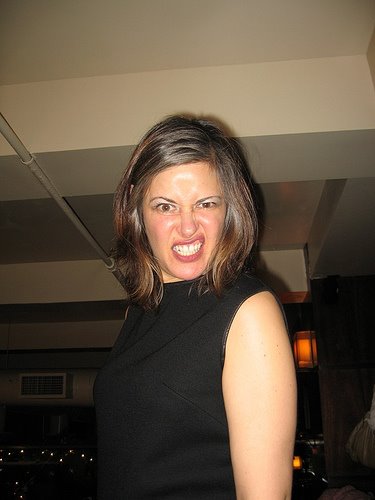

Snow is falling snow on snow here at Pratt Institute, where my classes have finished and I’m impatient to not be here but rather at home working on the plethora of projects that taunt me constantly with their charms. Will there ever be a life that consists solely of working on projects? I think of Peter-in-Mexico’s statement that he is not “a real writer.” What does it mean, indeed, to be “a real writer?” Shouldn’t it be that writing is pretty much all what one is obliged to do? It’s not that I mind my obligations… so much… but I can’t help but wonder what a life would be like devoted entirely to the realization of one’s poesis and techné. One manages to do an awful lot interstitially, but maybe not quite enough to completely form what one dreams of forming. “One.” Well, I mean me. It could be a kind of problem with my internal pacing. If I were only more deliberative and less generative, I could fully realize fewer visions better, but I suppose one can’t wish to be what one is just not. I mean me.
Even if I can’t be fulltime at the business of making stuff, I can still rejoice a little at the lovely pleasure of being surrounded by inventive and brilliant peers, whose very existence and productions serve to make being here on this planet and in this city exciting. There are so many good reasons to be a poet, but one of the best, for me, is the privilege of the company of other poets. How stimulating they are! How pensive! How intricate! And what is more fun than to attend a book party in the middle of the Fabric District, already a kind of heaven for me, celebrating three luminescent stars in the poetry firmament?
The party to which I’m referring was held last Monday upstairs from a Chinese restaurant called Chef Yu, and celebrated new books by Tan Lin, Kim Rosenfield, and Mónica de la Torre. I only had enough money to buy Kim’s and Monica’s books (although I later found out Gary already had the latter in his possession, so it turns out I could have bought at least one of the two Tan was selling, alas), so these are the two I will discuss on this snowy afternoon:
re: evolution Kim Rosenfield Les Figues
Public Domain Mónica de la Torre Roof Books
I should stress that I adore Tan’s writing, have read both Lotion Bullwhip Giraffe and Blipsoak engagedly (as to the latter, even though I personally have no desire to create poems that are remotely ambient, I think it’s an interesting notion), and FULLY INTEND to purchase his two new books in the near future.
Physically, Kim’s and Mónica’s books are quite different. Mónica’s has a big, light yellow sans-serif title, and also the signature size and glossiness of a Roof book, its cover showing “film strips” of a painting? a photo? moving from, to me, right to left, beginning with an image in color of a person walking down the street about to be engulfed in a cloud, and as the images move towards the left the more the color desaturates and the cloud engulfs. Kim’s book, from the front, anyway, has the Frenchified simplicity for which les figues design is known… it is narrow and rectangular, dark gray with delicate text in a bright turquoise double bordered by two frames, one thick, the other not. On the reverse side, no blurbs, thank goddesses, but a manipulated photo plus drawing of very disorienting and disordered architecture (just the way I like it).
The covers and design qualities of the books speak to their content. Mónica’s is in a way a friendlier book, a bit broader in its humor and perhaps more easily entered for the uninitiated. Kim’s is more blatantly intellectual, a little subtler and harder to characterize. Still, both books are notable for a kind of lightheartedness, especially in approach to materials. And this lightheartedness, interestingly, pervades despite the profundity of the themes each book addresses. In Kim’s case, those themes are evolution, gender, and science (particularly evolutionary science) as it interacts with art. In Mónica’s case, the overriding theme is identity, although there are several sub-themes such as linguistic identity, obsession, war, music, and names.
Kim’s book is bracketed by essays on the work: an introduction by Sianne Ngai, and (count ‘em) two afterwords, one an “analysis” and the other a “research paper,” all of which lend a fascinated validity to the slippery text. I have heard Kim read from this work a few times now, and I must say that I love what her performance brings to the work, as bits are sung (and the text is scored for that), and other bits are deliberately hesitated through, or read with great aplomb. Reading the book inside my head feels a little different, a little colder, but there is something I like about that coolness. It’s what Sianne refers to when she writes in the (gorgeous) introduction that, “nothing could be less like a Joseph Cornell box than a poem by Kim Rosenfield,” or when she describes this writing as (citing Laura Mulvery) being “anti-fetishistic.” (Again, this, like “ambient poetics,” is not necessarily a quality I strive for in my own work, but it interests me, particularly insofar as it refuses both preciousness and a too-heavy signifying.) I’m not sure I want to surround re:evolution with much more commentary, especially given that so much of it is so thoughtfully (much more so than I can accommodate in a blogspace, especially in a post composed on a snowy day after finals at work) part of the book’s actual “theoretical surround,” but I would like to quote a couple of my favorite passages, which are naturally some of the most hilarious. They are de (re) contextualized, but then so is everything else in this collaged book, so I hope that won’t matter too much. This one had me screaming “eww!” at her recent reading at the BPC:
I saw some spittle, the most disgusting that I had ever seen and I had to put my tongue and lips upon it. The act was so nauseating that I could not control myself and my heart beat so violently that I thought it would burst every vein in me and that I would vomit blood. I continued doing that as long as my heart revolted, and it was rather long.
I don’t mean to suggest that anything I quote from re:evolution typifies it in any way. I don’t actually think it’s typifiable, despite being concerned with science and taxonomies in its content. I mentioned as much to Kim after her BPC reading, that I was still trying to figure out what the limits of the text are, and she of course countered by asking whether it needed limits. Well, that’s a very good question, and one that I will leave rhetorical. Here’s another favorite passage, somewhat similar in mood to the one above but again not typical of the book per se:
The extraverts will dominate the sexual scene. The young extraverts will come running into the early dawn from their empty rooms out into the clean open, their naked bodies still sluggish and unkempt, unbeautiful in their bed-besprinkled sleepiness, all ready for a hectic plunge into the river of life, in their crude immersion revealing no special exquisiteness of body or grace of motion as swimmers in the river of life, a little polluting the fresh dawn of day by their noisy assassination of the day’s wonder and beauty. Strange fishes in the awkward contortions of the day’s wonder and beauty. Strange fishes in their glad way through the exhilarating waters of life.
[perfect place for a pee break here!]
Every page of re: evolution brings a surprise – nothing is predictable – and the same can be said for Public Domain. With both a variety of appropriated sources and a variety of formal approaches, these books keep changing the music the reader dances to, and I applaud both DJs for never boring me. Thank you for no homogeneity!
Mónica’s musical range runs the gamut from detournements to Zukofsyesque, often macaronic, sound-centered poems, vispos that are also performance texts, co-interviews on language acquisition ( a wonderful collaboration with Sujin Lee that incidentally speaks to my profession as an ESL teacher), a partially erased text culled from letters to the editor, a whole almost Arabically vowelless page of text that seems to address war, a wonderful carnival of emails (with photos!) regarding “other” Mónica de la Torres, oh and very very much more. You will love this book and you will love Kim’s book, too, please buy and enjoy them both.
I haven’t told you yet, though, what is perhaps my favorite piece in Mónica’s book, a section of poems & texts entitled The Crush. All the pieces in this section deal with an infatuation – real? imagined? : “I have a crush on a musician, or is it his music.” I do so want to ask Mónica if this “really happened,” but of course, that’s beside the point. “This piece is therapeutic,” she writes, and, “If this piece seems adolescent to you, there you go.” It doesn’t matter if it’s real, but it’s convincing, it’s pathos-funny, it mimics the forms of obsession, and emerges as almost Yoko Onoesque conceptual art:
Tell one of our mutual friends that an acquaintance of mine wants to do an interview with Blank for the publication that I work for, and needs to contact him. Once I have his contact info, write him a letter for every pice of music that he’s ever composed, performed, or produced, each one revolving around the idea of air. Write it on a surface on which it will disintegrate ¬ a block of ice, sand, on the sidewalk with a watering can – take a picture, and fax it to him.
[and note that this is only one of the brilliant schemes that emerges in this list of how to move through her obsession]
Just to give some sense, also, of the phonemic sensuality of this book as well, I quote from another poem in this section (beautifully footnoted, “Lists could turn into lisps”) entitled “Telephone Cryptomessage”:
oh yo be
in co.,
cougar sweet
they roof,
fir, oh moon
o’ mere wrong
coo, no, totter
I need to say it loud: I love both of these books, and their authors. I’m thrilled to have such entertaining, ingenious virtuoso sisters writing in the same city as me, no less. Run, don’t walk, to the websites of les figues and Roof Books, or SPD if these books are stocked there, and get these in your backpacks. You will surely be amused and enriched by the experience of reading them.
I’ve taken a cue from Ron and answered H.L. Hix’s 20 Questions questionnaire from the Best American Poetry blog.
1. What poet should be in Obama’s cabinet, and in what role?
Adeena Karasick as Secretary of Hermeneutics and Sensuality
2. If you could send Obama one poem or book of poems (not your own), what would it be and why?
Michael Brownstein’s World on Fire. It’s both alarmist and utopian.
3. What other poetry-related blog or website should I check out?
PennSound
4. Who is the most exciting young/new poet I’ve never heard of, but whose work I ought to find and read?
Margaret Christakos/ K. Lorraine Graham/ Lacey Hunter
5. What’s the funniest poem you’ve read lately? What was the last poem that made you cry?
The funniest poem I read lately was one of K. Silem Mohammad’s unpublished Sonnagrams: With lines like, “Wise fools who rub the curly heads of state” and “The UFOs in Limbo hover way low;/ In Purgatory, langue’s denied parole,” how can I but laugh?
Poems tend not to make me cry unless they are either by or for me. Sometimes I will cry (a little, or just “inside”) while writing them, but that’s just indulgent.
6. William or Dorothy? Robert or Elizabeth Barrett? Moore or Bishop? Dunbar or Cullen?
“Poetry must resist the intelligence almost successfully” or “No ideas but in things”? Autobiography of Alice B. Toklas or Tender Buttons?
Which Dorothy? Oz Dorothy? You don’t mean Dorothea? Anyway, Oz Dorothy.
O, Elizabeth Barrett, absolutely. Aurora Leigh is one of my favorite poems, not to mention the sonnets.
Moore, for sure.
Dunbar, because I like the mannerisms.
I’ll take both quotations, please; as a real poet, I am comfortable dwelling in ambiguity.
Tender Buttons, but that’s just predictable.
7. Robert Lowell wrote a poem called “Falling Asleep Over the Aeneid”; What supposedly immortal poem puts you to sleep?
Uh… lots of them. Maybe The Cantos?
8. Even for poetry books, the contract has a provision for movie rights. What poetry book should they make into a movie? Who should direct it, and why? Who should star in it?
I always thought Swoon should be a movie, but that doesn’t count, right?
How about Hannah Weiner’s Open House? Directed by Jack Smith? I can’t think about the stars.
9. What lines from a poem you first read years ago still haunt you now?
“Such hills as hive me waste away/ in the refulgent concatenations of failed display.” from Charles Bernstein’s “Foreign Body Sensation.”
10. What poem do you love, love, love, but don’t understand?
Stacy Doris’ Conference (a book, really, rather than a poem per se). I don’t care that I don’t understand it, because I love love love it.
11. If the official organ of the AWP were not the Chronicle but were the Enquirer, what would some of the headlines be?
Oh god, who cares.
12. If you were making a scandal rag for poetry in the grocery store checkout stands, what fictitious poetry love triangle would you make up to outsell that tired Hollywood story of Angelina and Brad and Jen?
Hmm. I like the idea of Mirabai involved with Larry Eigner and the Baron de Rothschild.
13. This is the Best American Poetry blog. What’s the best non-American poetry you’ve read lately?
The subtitles to the gender-bending Shaw Bros. Film, “The Three Smiles”
I made a poem out of them.
14. We read poems in journals and books, we hear them in readings and on audio files. Sometimes we get them in unusual ways: on buses or in subway cars. How would you like to encounter your next poem?
I’d like to see one appropriated on a t-shirt of strange English on a clothing rack in a discount store in a Tokyo suburb.
15. What poem would you like to hear the main character bust out singing in a Bollywood film? What would be the name of the movie? What would be the scene in which it was sung?
CHICKS DIG WAR
CHICKS DIG WAR
This would be Helen prancing around in a fluorescent green tiger outfit with Lata’s voice coming out of her. She would be twirling a variety of weapons as part of her cabaret act.
16. Do you have a (clean) joke involving poetry you’d like to share?
Q. How many flarf poets does it take to change a lightbulb?
A. Squid.
That’s not funny.
17. Tell the truth: is it a poetry book you keep in the john, or some other genre (john-re)?
Gary keeps his own book, How to Proceed in the Arts, in the john. We also have a lot of cinema magazines and old New Yorkers and Harpers, as well as one of those illustrated easy guides to Derrida. I maybe have a belly dance magazine in there, too.
18. Can you name every teacher you had in elementary school? Did any of them make you memorize a poem? What poem(s)?
I can name nearly every teacher. I don’t remember ever having been made to do anything. I did memorize some poems, though, voluntarily. “Jabberwocky” comes to mind.
19. If you got to choose the next U.S. Poet Laureate, who (excluding of course the obvious candidates, you and me) would it be? Of former U.S. Poet Laureates, who did such a great job that he/she should get a second term? Next election cycle, what poet should run for President? Why her or him?
I can think of many poets who I would be thrilled to see as Poet Laureates, but I really think it should be Clark Coolidge, partly because his name sounds so presidential. Also because we could then have a “spontaneous bop presidency.” I know that’s from Kerouac initially, but it gets transmuted ever so much more interestingly in Coolidge.
No second terms.
Hmm… presidential candidates… maybe Bill Bissett? Or Julie Patton?
20. Insert your own question here.
Why do we exist?
.flickr-photo { border: solid 2px #000000; }.flickr-yourcomment { }.flickr-frame { text-align: left; padding: 3px; }.flickr-caption { font-size: 0.8em; margin-top: 0px; }
What would be of most benefit to this sad girl with the scared eyes? Is she from a reform congregation? Is she one of those feminists? “The women do not need to dance because they are on a higher level than the men.” He squinted a little, trying to hit the right note with this hostile, melancholy American Jewess. He hoped to. “Do angels need to dance?”
I am tired of putting my head onto the bodies in masterpieces for now, so I am starting the Houri Series, which allows me to be exhibitionistic while “commenting on” orientalism, Levantine subjecthood, gender, dance kinetics, etc. The textual additions and Photoshop filters help to make this art, one hopes.
More at flickr, and more to come, unless the PC police get me first.
It occurs to me that if someone asked me that question, I would have to reply,
“No. I. Have. Never. Been. Mellow.”


 Otohime