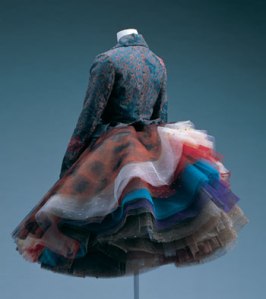
(a masterpiece in layered tulle by Vivienne Westwood)
Laura Moriarty has posted on A Tonalist Notes on fashion, and jeans in particular, in response to Brandon Brown having earlier brought up (and abandoned) the topic on HI!. A jolly comment stream ensued traversing the signifying powers of types of jeans, fashion puncta, the rule of “one thing out of whack,” fashion and money (especially as hip-hop appropriation of rich white old-money fashion code), and the superiority of skirts to jeans (my contribution).
Laura then asked me for some input on her “planned post on foof or hyper-girlie attire,” and also to address such matters as “costume” and “questions of overdressing — ultra femme or otherwise,” particularly in the context of the world of poets.
This is such a huge juicy lure for me that I hardly know where to begin, except by pointing out what we all already know (right?): that it’s all costume. It’s costume even when it’s conformity or camouflage, in the same way that any construction of language, because it is a construction that involves a conscious decision, is a kind of artifice.
In order to live in the world among other human beings, assuming that we are neither mute, nor illiterate, nor nudists, we need language, and we need clothing. These are two of the most basic social needs: the other arts, although they may feel necessary to us, do not qualify as social needs in quite the same way (although this is arguable… OK, maybe cooking could qualify, too, or architecture, or, OK, lovemaking, for that matter… looks like my thesis is breaking down here. Anyway.). (Anyway.) To me, this gives poetry and fashion a certain kinship: we have no choice but to get dressed and to communicate, but we can make astonishing choices about HOW to dress and HOW to communicate, and that, my friends, is what we call style.
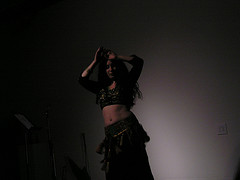
I perform “in costume” (overtly) not just because I love to but because by doing so I am signifying to the audience that I have considered the nuances of my art and its presentation… and also, of course, to be entertaining:
 photo by Stephanie Young


Other poets who do this might include Douglas Rothschild, Brendan Lorber, and to some extent Kim Rosenfield, although she may be more in the category of fashion flair, such as we see in Anne Waldman or Adeena Karasick, both of whom invariably look striking and glamorous but not so much “costumed.” I might say the same, Laura, of you, although your choices are more distinctly whimsical than theirs, I think.

Douglas Rothschild

Adeena Karasick, in a true costume for my 1995 Text/Styles event
I can’t think of any other woman poets besides myself who tend to make their readings into occasions for a masquerade. I’d love to know if you come up with any, or any men, too, for that matter. Gary, trying to help me brainstorm some, pointed to his own drab t-shirt and jeans and said, “I guess most of us are doing what we accuse mainstream poets of doing, with this deliberate ‘neutrality.'” “Exactly my point,” I said.
Chris Cheek, Julian Brolaski , C.A. Conrad, and Tim Peterson all make strong and beautiful assertions about gender in their sartorial choices, but that is not the same thing as being “in costume.”

Chris Cheek

Julian Brolaski

C.A. Conrad

Tim Peterson (Trace)
My own predilection for costume started about as early as I can remember, and was only ossified by growing up among hippies and Cockettes.Punk, of course, was costuming, too. My early teen years were spent in the thrift stores of Oakland and Marin, piling up stocks of jewel-toned mohair sweaters, novelty print skirts, cowboy boots, 40s dresses, and the like. The costume thing was further nourished in the Harajuku groove of Tokyo, I guess, until I almost didn’t notice all that beautiful outrageousness: the artificiality just seemed so natural. I remember one day, my friend Jimmy from SF was visiting me there, and a tall girl walked by in thigh-high white patent boots and an electric blue Louise-Brooks-style bobbed wig, and I just took it for granted until he said, “Did you see her?”
I guess it’s pretty clear that I’ll take overdressing (I’m MAD for PETTICOATS) over underdressing any day, although I’m not immune to the beauty of a minimalist outfit with ONE AMAZING ACCESSORY… I’m thinking a simple black tank top and a-line jersey skirt and arms LADEN WITH BANGLES, for example. I also adore combinations that very obviously oversignify contradictions, especially gender contradictions, such as (this is very San Francisco, I think, and very early 90s) Doc Martens with full or lacy skirts, or makeup and long hair on men, especially straight men.
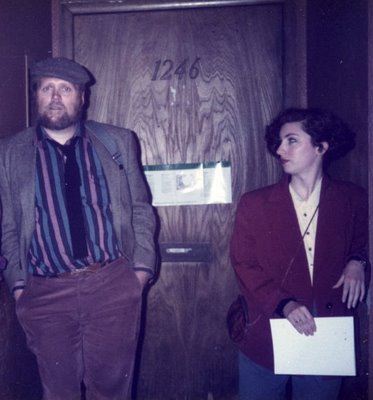
I’m not entirely sure how I survived the 80s language poet scene given that minimalism and neutrality were pretty much the order of the fashion day. There is a funny picture you took of me then, Laura, that shows me trying to sort of fit in, with that awful 80s bob, a (ugh) button-down white cotton shirt, and a 40s suit jacket about a thousand sizes too big. That was a very difficult fashion period for me and I’m grateful to have passed through it. (It occurs to me, though, that Ron looks very dapper here, indeed!)
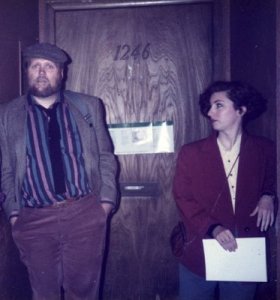 photo by Laura Moriarty
Laura, where was that talk you gave in NY published, the one where you mention the uncomfortable feeling of your lingerie? Wasn’t that in Jimmy and Lucy’s? And weren’t you kind of given a hard time for that? Am I misremembering? I do remember feeling incredibly grateful for that, and also for Harryette’s Trimmings, thinking, OK, someone has finally started to address dresses, and dressing, thank goddesses.
Here’s today’s outfit. I made the skirt, out of a heavy slub-weave traditional cotton print I bought last year in Tokyo, with a contrast hem in grayed-grape linen, set off by burgundy grosgrain ribbon. It’s an interesting pattern as it’s both gathered and pleasted, which gives it simultaneous fullness and control of volume. The challenge is how to do the same in poetry!

photo by Gary Sullivan


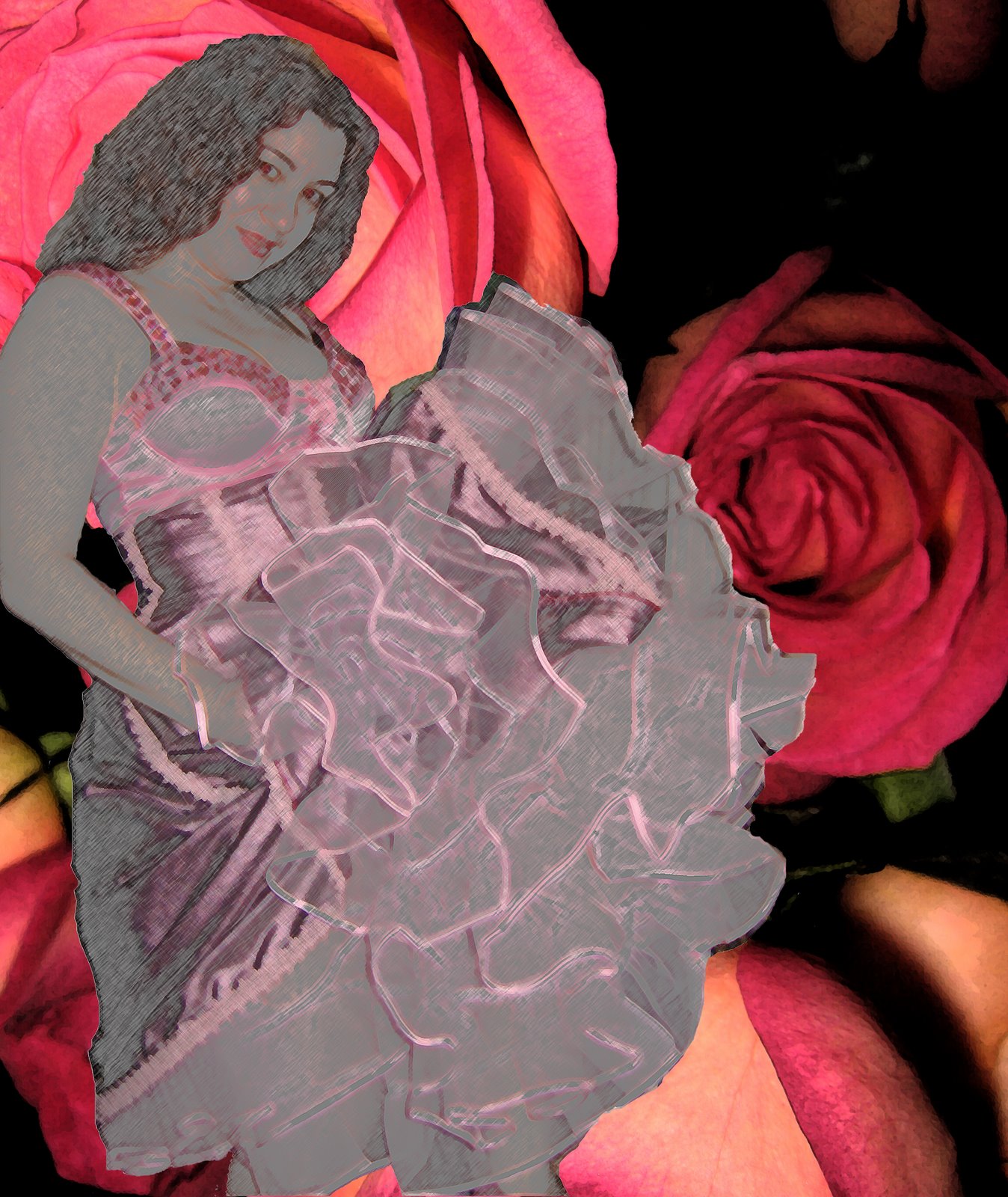

 Otohime