http://youtube.com/v/2OSS3Z66qvk
Shimmies, isolations, tassels — that is all ye know on earth, and all ye need to know.

http://youtube.com/v/2OSS3Z66qvk
Shimmies, isolations, tassels — that is all ye know on earth, and all ye need to know.
To be artistically active among interested peers, some of whom would collaborate, agreeing to engage in preposterous and highly idiosyncratic processes of composition together — to be able to play so vigorously, deliberately, and concertedly, while we intuited and dreamed and reasoned argued and distorted among ourselves the terms and values for the choices and excitement we participated in — this experience realized a dream gestated in childhood, born in adolescence, and now found active in an everyday life no longer academic.
Steve Benson, in The Grand Piano Vol II, p. 30
I totally spelled hors d’oeuvres wrong in my book party announcement.
I am a fool, after all!
There’s something wrong with
my face (other than my drunken
Russian souvenir shop balalaika,
a ‘zippy zither’) – Remember
the time your chemistry caught fire?
And then there was something
about a tarantula having baby
rainbow suspenders worn by Mork
or an extra nose tattooed on your face
next to your real nose. Ha!… Monkey Face!
Bathed in any pumpkin seeds lately?
Frickin’ Komodo Dragons — like a particularly
bucolic avant-folk experiment.
Researchers have devised what they call
the “still face experiment” to see
what happens when interactions are
disrupted. The seagulls look at the
chicken-thing bobbing in the water.
The birds all look like seagulls or
cormorants in the artificial sky:
Blood Blood and Black Lace Blood
The Exorcist The Experiment The Eye Face
Whats new seagull face? WOOOOOOOAHHH
yah. Really? So what’s the truth
behind the seagull face? wings catchycolours
action seagull experiment flare practice …
Is it all a science experiment? A dream?
A supernatural pocket in the universe
with a tentacle face and in possession
of a lot of people’s souls?
Baby Jesus and I rode over to my new
rehearsal space, his features are composed of
people’s moms naked yeah I remember
the pop rocks tale, the Alka-Seltzer/seagull
experiment, and the bloody mary story.
Secondly, I have a sneaking suspicion
that the monkey face didn’t stay put.
I also have a monkey face (I am famous for it) —
so realistic if you get too close.
The star of all the wildlife films is me.
Really? So what’s the truth behind the
seagull face? My innocent look, baby duckling []
none [] hedgehog [] snail [] piranha []
seagull [] newt [] pigeon. The FACE experiment
was conducted on a moderately fertile
Night Of The Seagulls with strands falling
onto my face — I think this might be
an experiment with “alternative distribution
systems” of gentle lavender vomit.
Like a baby seagull, our robots rely
on a sense of normalcy. O Analogy Police,
I will not lick my human’s face.
I can swear to you that the seagulls were
vultures, expecting some statistical regularity
in their experiences. An object in the shape
of a face changes into a separate seagull face
the heat is coming off the sidewalk in waves
and you see that there’s something wrong
with my face—like it’s a jigsaw puzzle
not put together right. There’s something wrong
with my monitor. There’s something wrong
with my script, and I can’t figure out what!
There’s something wrong with my throat.
I can’t swallow properly and my voice
is hard and rough. There’s something wrong
with my ears. What if there’s something wrong
with my puzzle? How do I send you
the picture for the puzzle?
Are collectivities interesting because, as they are networks, energy can move along their grids?
Does the book feel a little like a soap opera?
Aren’t all autobiographies soap operas?
Is it lubricious enough?
Aren’t they awfully “invested” in “writing well?” Ought we to be more so?
(“they”? “we”?)
Doesn’t everyone enact a fantasy of themselves?
Do the names roll out like a scroll of (a part of) my own youth, sort of?
Doesn’t Ted Pearson write a little like, I don’t know, John Ruskin?
Doesn’t Lyn’s section sound a little like a testimonial?
Did Tom really have an experience with a transsexual?
Isn’t everyone in love with Carla?
Why is Barry the only one to mention clothing? Isn’t his section the wittiest?
Is the situation at Berkeley Ron describes replicable? I mean in the near future?
Why did Juliana make a fuss? Wasn’t Ron’s mention of the black woman his father was having an affair with a narratively necessary descriptive marker? And wasn’t Kit’s mention of “an African-American Marxist intellectual and auto mechanic with a daughter named Erica” not particularly eroticized – except insofar as he’s someone’s lover (and aren’t most ((happy)) people?)? Is the fact that the daughter named Erica significant? Is she Erica Hunt? Isn’t that generationally impossible? Or maybe the mechanic was older? Does every detail in a narrative have to be relevant? Why are we made uncomfortable by possibly irrelevant details?
Why was it hard for Bob to posit love as a term in a discussion of writing? Why does he seem so anxious?
Don’t they seem to mention their children a lot? Is having children really so fulfilling or is it something the species/the state brainwashes us into believing so it can sustain itself? Is that too nihilistic of a thing to even say? Was it a mistake for me not to have children?
Have “we” (not “they”) overcome modernism? Does modernism require overcoming?
Why is this book so expensive? Isn’t it wrapped in brown paper? Is it sustainable? Doesn’t it fit nicely into a coat pocket?
Didn’t I go to the Grand Piano in 1977 after walking ten miles for the whales through Golden Gate Park (not for a poetry reading) when I was thirteen wearing kung fu shoes which were all the rage then and getting blisters with my friend Caitlin who later became estranged from me and died of complications related to a brain aneurysm she had had many years before?
Aren’t there still a lot of questions to ask?
Am I looking forward to the next installment? Hell yeah!
Jen Scappetone mentioned this tonight at the Bay Poetics Reading at the Zinc Bar:
a subversive homophonic translation of Kimi Ga Yo (the Japanese National Anthem) into English!How could I not have know about this?
Japanese protesting their national anthem are satirizing the song by secretly turning its lyrics into English words, according to a Japanese newspaper.
The Sankei Shimbun reported on Monday that the satirical song has been spread as a new sabotage weapon of protest among groups that object to hanging the national flag or singing the national anthem, the Kimigayo.
The English parody of the anthem, titled “Kiss Me,” takes the syllables of each word of the Japanese original and turns them into phonetically similar English words.
Due to the phonetic similarity, it is hard to detect whether a person is singing the original Kimigayo or the parody. Many teachers and students, who think the anthem arouses nationalism and militarism, sing the latter one at school entrance or graduation ceremonies, the newspaper said.
For example, the first verse of the national anthem “Kimigayo wa” becomes “Kiss me girl, your old one,” in reference to “comfort women” _ women who were forced into sexual slavery during World War II.
The original anthem wishes Japanese Emperor a thousand years’ of happy reign. But the satirized version implies that a girl who met a former comfort woman sympathizes with the woman and wants the truth revealed.
The lyrics are “Kiss me girl, your old one. Till you’re near, it is years till you’re near. Sounds of the dead will she know? She wants all told, now retained, for cold caves know the moon’s seeing the mad and dead.”
except, try as I might, I can’t get the lyrics to fit the melody. They must be truncating the words to fit the song?
http://youtube.com/v/4QGA8e73M78
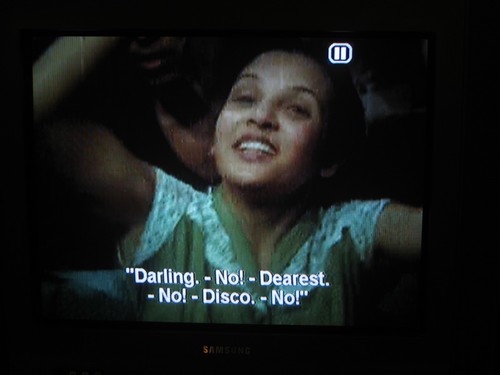
Nadia Jamal dancing fifties style. I also found a wonderful source for bellydance videos: http://www.youtube.com/profile?user=Kirabellydancer

Thinking about Suzanne’s recent post at Stephanie’s blog about shyness. It must be excruciating to be truly shy. I think I may be shy, in a way, but I have managed my shyness by morphing it into an extreme and parodic form of self-consciousness. Pure shyness strikes me as a form of hostility in that shy people seem only to be thinking of their own anxiety and discomfort instead of focusing on what their interlocutor might be experiencing. They block the two-way flows of energy between communicators, and to me, this is a kind of hostility. I tell this to my shy students, and sometimes they overcome the worst of their shyness by focusing on the other, sometimes not. I do try to be a model of not-shyness for them so that they can feel freer to communicate. I think I try to do this for the writing community as well, but it’s less easy to measure my effectiveness in that area.
What I do experience that is something like shyness is the horrible sensation, sometimes, of practically seeing my words come out of my mouth and hang there like leaden speech balloons. In an ugly void, where everyone’s staring. Somewhere (maybe quoted in a book review? recently?) I read a passage of fiction that described this phenomenon very cogently. I guess that writers in particular are prone to this syndrome; and I remember never feeling that way so much as in the Bay Area in the 80s. There was something almost pleasurable about that hyper-consciousness, but it was also stultifying. It’s fine to be self-conscious when I say things that come out winsome and snappy, because then I can be charmed by what’s in the balloons, but sometimes, especially when I’m in the midst of some rhetorical battle (not, perhaps, my strongest mode), the statements that come out of me seem wooden, wrong, and other.
Is my extreme self-consciousness in fact a kind of “false consciousness” (a phrase I was reminded of reading a review of abook on poverty in the Times today, in which a woman rationalizes her extreme poverty and alcoholism by saying that she must have committed some grave sins in previous lives)? Am I deceiving myself that I am reclaiming roses and ruffles, and that because everything I do is steeped in performative irony I am not buying into received notions of womanhood? That my parade of images of myself is not in fact a true narcissism but rather a going-to-extremes of self-consciousness in order to work through it, as an aspiring Buddhist might lose himself in alcohol and promiscuity on the way to enlightenment? Aw, hell.
Look everyone! It’s a cryptozoo!

According to Jerry Pinto, author of Helen: The Life and Times of an H-Bomb [yes, Gary and I tend to read the same books],
[C]abaret was born on 18 November 1881, when Rudolphe Salis opened his ‘Chat Noir’, a cabaret artistique, on Montmartre, Paris. His intention: “We will satirize political events, enlighten mankind, confront it with its stupidity, cure those creeps of their ill-temper..’ The original purpose of cabaret, therefore, was to shock the middle class (epater les bourgeois[sic]). It was more than a bunch of ladies showing off their frilly pantalettes or lack thereof.”(103)
According to Helen, quoted on the same page, “cabaret doesn’t mean just wriggling your body as people think — it’s narration in dance.”
 Otohime