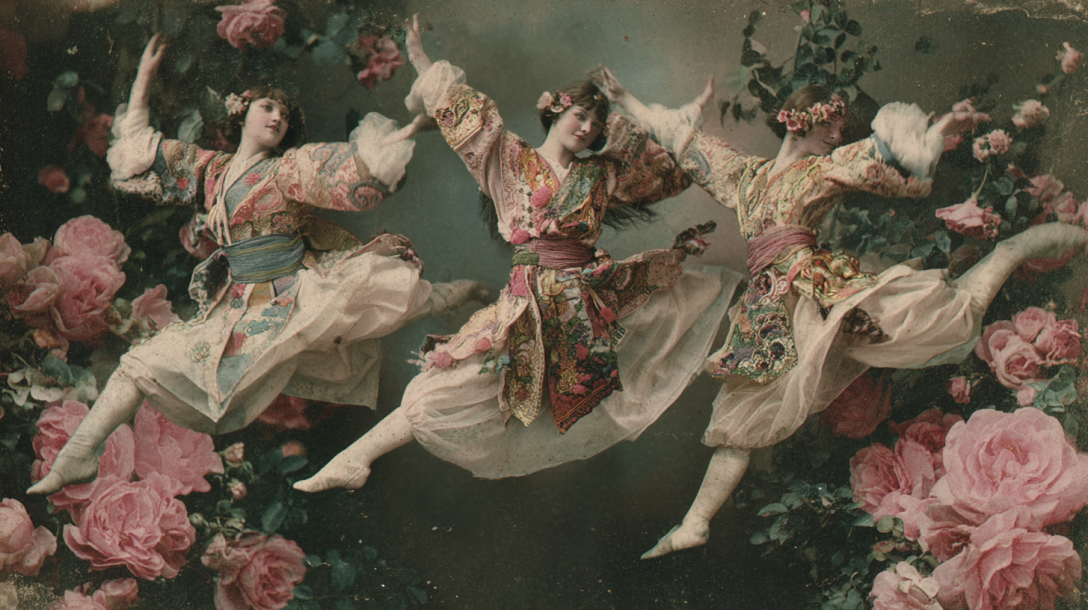
Segue Intro 4: Madeline Gins

Once upon a time, in the anime episode Gigi and the Fountain of Youth, also titled Magical Princess Minky Momo: La Ronde in my Dream, there was a king and a queen and they had a little girl named Princess Gigi. Gigi’s royal parents told her that in order to govern their world wisely she would have to learn as much as she could about people, and the best place to do that was on Earth. Once on Earth, Gigi discovers an island with a secret garden where everyone is a child. In the garden she meets Peter who controls the fountain of youth which keeps everyone young. Together Gigi and Peter learn the importance of following their dreams as they fight to keep the power of the fountain of youth from getting in the hands of an evil organization.

Real-life modern day Gigi is, of course, the uncategorizable luminous visionary poet architect physicist organism-that-persons Madeline Gins, the author of eleven books, many in collaboration with her partner Arakawa (analog to Peter in the anime story), and together they are looking for ways to, in Madeline’s words, “Save our Skins” by putting the power of the fountain of youth in our hands.

Titles include
Architectural Body
What the President Will Say and Do!!
The Mechanism of Meaning
For Example (A Critique of Never)
Word Rain
and most recently
Making Dying Illegal, Architecture Against Death

Madeline begins her bio: “B-b-b-b-b-orn and intends never to die.” Making Dying illegal – it sounds like an absurd proposition, doesn’t it? But then again, so did, at some point in human history, a non-flat earth, electricity, a personal computer, cloning. Gins and Arakawa are live serious about their project, and their built works include Bioscleave House–East Hampton; Site of Reversible Destiny–Yoro; Reversible Destiny Lofts–Mitaka, touted as dwellings that “boost immunity and increase longevity.”

Entering into their texts is in itself a revolutionary architectural experience. Reading them, one must make a pact with bioscleave. Bioscleave is Gins and Arakawa’s re-naming of the biosphere ‘to stress its dynamic nature.” “it is necessary,” they state,”to construct architectural works[poems] that reflect bioscleave’s intrinsic tentativeness.” Body, identity, mind respond elastically to the adventurousness of their works, which unabashedly do away with restrictive givens. Both writings and buildings are made to “invite optimistic and constructive action.” So, as to their Utopian projects, I say, suspend disbelief. Enter their “tactically posed surround.” We have nothing to lose but our mortality. To not to die? Why not? Why not indeed?

Segue Intro 3: K. Lorraine Graham

K. Lorraine Graham was conceived in Iran and has lived in countries as disparate and exotic as Papua New Guinea, Chile, China, and Singapore. She is the author of three chapbooks, Terminal Humming (Slack Buddha), See it Everywhere (Big Game Books), and Large Waves to Large Obstacles (forthcoming from Take Home Project), and the recently released chapdisk Moving Walkways (Narrowhouse Recordings). Lorraine has just completed the extended manuscript of Terminal Humming, whose title alone should win the award for Best Polysemy of 2007. In the first sense, it creates an exquisite logical impossibility: humming, which is by definition vibrant and continuous, cannot be in any way terminal. “Terminal” could also be thought of hyperbolically — as in “I love you to death” – as if humming were an extreme addiction-like-disease. It may not be so off the mark to characterize poetic activity as such. In this sense humming is an exaggerated statement of liveliness that is also privately incantatory and consoling to one’s intimates. One more sense: terminal might be a computer terminal that hums both literally and with the buzz of the poet’s mind. A mind could be a terminal – one node on a network of minds whose neural connections hum in all directions. But I meander, and so I should, for so does this text Lorraine has created, and so, in fact, does the activity of humming, n’est-ce pas? One thinks of the Situationist notion of the dèrive which Carla Harryman cites in the Grand Piano 4, and which the other writers of that volume take up. Debord defines the dèrive, which Carla translates as “drift”, as “a technique of transient passage through varied ambiances. The dèrive entails playful-constructive behavior and awareness of psychogeographical effects.” It’s a druggier, more active elaboration of Baudelaire’s flaneuring, and like the flaneur, the poet who falls into? employs? the derive becomes a kind of eavesdropper of both external and internal sonic presences, and a creator/explorer of an almost tactile maze. Reading Terminal Humming makes me feel free; it transmits a sense of Lorraine’s commitment to explorative wandering., and I think it is (thanks, Ted!) marvelous, feminine, and tough.

Now, a moment of revelation: Lorraine actually will not be reading from Terminal Humming today, but from two other works that I didn’t have a chance to look at until this morning. No matter – they also move along songlines of peripatetic delight. I’m very happy to welcome, all the way from Carlsbad, California….

Segue Intro 2: Barrett Watten

Have you ever had a Barrett Watten moment? The first one I remember, although I didn’t know to name it as such, was looking out the back window of a car at night on a northern California freeway when I was about nine years old. I saw a huge power station isolated among dry rolling hills, illuminated by hundreds of tiny orange lights, its form complex, interconnected, functional, necessary, deliberately constructed, and utterably, ineluctably modern. It was also dreadful, awesome, and beautiful.

Later, when I encountered Barry and his work – and, full disclosure – studied with him as an impressionable undergrad — I better understood my response to that power station. He helped me to see that a “form” is never merely a shape, but a set of both internal relations among its components and also a significant statement of external relations; that is, it exists – like the power station– meaningfully and historically in a field of forms.

Indeed, it’s impossible to imagine the contemporary literary field without the meaningful and historical influence of Barrett Watten. Editor of This magazine and This Press, and co-editor, with Lyn Hejinian, of Poetics Journal, he has worked continuously to raise the bar for standards of critical and poetic inquiry. His books include Progress, Bad History, Total Syntax, The Constructivist Moment: From Material Text to Cultural Poetics, and most recently, he has participated in the delightful, self-searching experiment in collective autobiography, The Grand Piano. In The Grand Piano, we see a side of Barry that is perhaps not so evident in his other works: we see Barry the seditionist, the revolutionary, if you will, punk whose hyperactive young brain was already perceiving the world in terms of its material relations, which he was –and, differently, still is — gung-ho to transform.

And truly, Barrett Watten’s brain is an extraordinary instrument – indefatigable, exact in focus and sweeping in scope, capable of switching in a moment between the views of The Large Binocular Telescope and a fractal microscope. Like a four-dimensional scanner in Sensurround it registers and engages with everything in its environment, processing and analyzing information in stunning outputs of fully formed units of thought in crystalline paragraphs and stanzas that accrete into monumental books. The sharp, cogent power of Barry’s brain shines like a stubborn beacon onto a landscape ever more apocalyptic, and no matter what the object of its attention – the Gulf Wars, Russian formalists, Ana Mendieta, Anthony Braxton, William Carlos Williams, the entire 20th Century, James Bond, or Barry’s own bildung, — the writing invigorates and astonishes.

Segue intro 1: Maggie O’Sullivan

Born in Linconshire, England of Irish parents, Maggie O’Sullivan is the author of over fifteen books of poetry, including red shifts, Palace of Reptiles, “all origins are lonely”, and newly out from Reality Street, Body of Work, which collects all of her early solo collections of poetry and visual texts. In 1993 she collaborated with Bruce Andrews on a work entitled eXcLa, and she is the editor of the 1996 Anthology, Out Of Everywhere: Linguisticallly Innnovative Poetry by Women in North America and the UK. Visual artist and interdisciplinarian as well as poet, Maggie O’Sullivan makes words matter, and the matter is radiantly dynamic. She dips and swerves them, cuts and grows them, pulls them, swoops them, divides and slathers them until they croon and careen like gulls or hang like lichen or pose and blend like living paint. She verbs the words, assembling and disassembling — structing, volving, viding, izing — gliding, building, curving, and eliding. She is an avant-primeval pioneer emanating interspecies empathy, a transformative troubador of unabashed corporeal melopoeia.

Valery on dance

“…this person who is dancing encloses herself as it were in a time that she engenders, a time consisting enteirely of immediate energy, of nothing that can last. She is the unstable element, she squanders instability, she goes beyond the impossible and overdoes the improbable; and by denying the ordinary state of things, she creates in men’s minds the idea of another, exceptional state…”

Paul Valery, “Philosophy of the Dance,” in What is Dance, p. 59