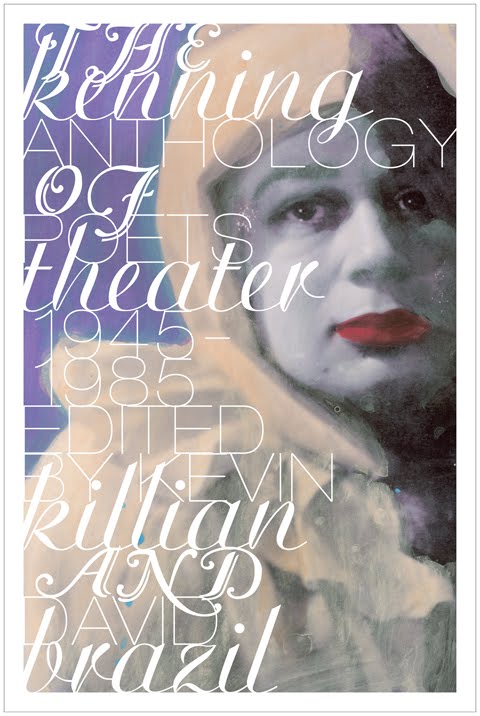
Eiríkur Örn Norðdahl, Icelandic Flarfist and innovator extraordinaire, interviewed here in English.
Place & Behrendt intros

Lynn Behrendt with Brenda Coultas
Gary’s intro for Lynn:
Lynn Behrendt is the author of 4 chapbooks: The Moon As Chance, Characters, Tinder, and Luminous Flux. A full-length collection, petals, emblems will be published this year by Lunar Chandelier. She edits the Annandale Dream Gazette, an online chronicle of poets’ dreams.
Of all of the value categories we speak of with respect to poetry—prosody, use-value, torque, relevance, “new”ness, etc.—the most difficult to pin down or describe, and thus perhaps among the least written and spoken of, must be “urgency.”
“It starts,” as Lynn writes, in an unsigned epigraph to her most recent book, Luminous Flux, “with this ache to tell you something.”
But can we assess urgency? Like pornography and art, will I know it when I see it?
Let’s put it this way: Most works of art, whatever fabulous things they may do for us, however relevant or exciting they may be, don’t necessarily feel as though the maker had no choice but to put this particular thing down, NOW, and in just this way. There’s a certain edge, for want of a better word, to a few things that maybe we can all agree on: Carolee Schneeman’s Interior Scroll, Ted Berrigan’s Sonnets, Charles Mingus’s Black Saint and the Sinner Lady, Kathy Acker’s Great Expectations, Chantal Akerman’s Letters from Home—work that is as emotionally charged as it is psychologically, philosophically, and formally so.
As Nada wrote on her blog when she first read Lynn’s Luminous Flux: “It pulsates.”
Published—self-published, I believe—in an edition of 20 copies, Luminous Flux is one of the rare books of poetry in recent memory that completely blew me away. Every line of this amazing poem simultaneously sings and sears:
I’ve got my scythe & I’m not afraid to use it
template of sound scraping
owl streaked sky
put this in her pipe & smoke it
choke weed persuasion
ranked quantitatively but not qualitatively
subordinate ratio of somber to pubic
implication hasty
I’ve said nothing, nothing at all
shift to tropical city
sound of hoofs […]
yellow silt starts to gather at the edge of every image
too old, I’m too old, too polished
I can’t stop & don’t really want to […]
I am just temporarily sheathed
Reading each line feels like I’m suddenly fully awake, until the next line, which makes me feel even more so. I’m fully conscious of the language and am totally there for it, imagining not Lynn’s influences or references or sources or methods but what it is that makes her alive.
I love this book. It is a real honor to have Lynn here to read for us today.
My intro for Vanessa:
Vanessa Place, co-director of Les Figues Press, author of Dies, a sentence, La Medusa, and (with Robert Fitterman, Notes on Conceptualisms, is also, in the words of sociology professor Barry Glassner, a “brilliant defense attorney.” Her newest book, “The Guilt Project: Rape, Morality and Law,” has been called essential reading for “anyone interested in criminology, specifically including legislators, judges, attorneys and prosecutors.” As a lawyer who specializes in defending sex offenders, she subjects language and representations of events in language to intense scrutiny, and cannot help but question the fabric of language that we call law and truth. Her vocation requires toughness and brilliance, qualities that Vanessa and her writing fairly exude.
I put out a call on facebook for contributions to this introduction, and here, barely edited, are friends’ contributions;
James Wagner
The rarest of writers–twinly gifted in lyricism and criticism.
Brian Ang
militantly essentialistically chilly
K. Silem Mohammad
Sexy like a hand grenade.
Gregory Betts
definitely the sharpest blade in the cookie jar.
Derek Beaulieu
Vanessa Place’s writing exposes the most wretched, most dangerous moments in language. In STATEMENT OF FACTS the quotidian is anything but — each moment of transcription, of testifying, of witnessing, dangerously re-inscribes and reveals the terrifying nature of language itself.
Kate Zambreno
her coining of the term “subjective correlative” in dies. the guyotat-like bulimia of her baroque, brilliant binges. the dizzyingness of la medusa and dies. how she theorizes glorious failures. one of the only american intellectuals who mirror the french feminists – theorist as well as stylist. sly and wicked.
Tony Dohr
When asked how she managed to write a ‘grammatically correct’ sentence 50,000 words long, Place replied, “Well i believe that the comma splice is not un-grammatical.” So i guess we can say, ‘Very Liberating.’ If we were an undergraduate who didn’t care about proof reading.
Tony Dohr
& ‘Why didn’t i think of that?’ If we were James Joyce or Marcel Proust
Kate Durbin
Radically evil.
(a very, very good thing)
Matias Viegener
Place is bulimic: bouts of excessive overindulgence are followed by depression and self-induced vomiting, purging, or fasting. She understands language as pus in which one might expectorate or rather suppurate words. Her writing alternately oozes primordial mud or turns into a stainless steel transcriptive implement.
Lemon Hound
embraces underbelly’s underbelly
Joshua Corey
Scary good scary.
So: darkness, sharpness, coldness, terror. Vertigo, severity, slyness, ooze, explosions. Vanessa is formidable. All she has to do is shine her dark light onto language, and we see it: naked, phosphorescent, shivering. baroque, abject, magnificent.
And here she is today to shine her dark light onto us.
pope
Abigail on Nada in Critiphoria
Heartfelt thanks to Abigail Child for writing about my writing in the new Critiphoria, and also for questioning my glib mutual collapse of form into content and content into form.
I’ve only barely started looking at the issue. Tons of great stuff here, folks: have fun exploring; this journal is aptly named.
signifier/signified
ON THE SQUIRRELESQUE
[I am incredibly sad that I didn’t write this. The authors have asked to be credited as “The Squirrelist International”]
ON THE SQUIRRELESQUE
We are developing an anapestic theory, which we are calling the Squirrelesque (we will not explain why a bit later), a theory which emerged from a steady steam of squirrels razed during the squirrelist movement of the Cambrian Era. We began to see a commonality among some of these squirrels, squirrels whose woods we think we know, and others who appear in manganese in which the squirrelery regularly incorporates and rejects acorns, lyricism, fragmentation, the word brane, butterlambs, and beauty: squirrels who act as the charm bracelet to bring all of these styles together. Like many other contemporary young squirrels, each of these squirrels employed a postmodern sense of butterlambs. This is not terribly unusual among young contemporary squirrels, but what struck us was “dolled up” in a specifically squirrely ditch in the escurel side of squirrelism. In the poem “Your One Good Nut” (the title itself conjures up squirrel angst), from her first collection of poems, Interior with Almond Joy, Brenda Squirrelnessy typifies this style with the stanza that reads:
Have some chicken,
maybe some sex…
Squirrel in the white
chicken pants, uh-huh.
You know, see what happens. (30)
This combination of the serious (“the chicken pants”) and the frilly (“uh-huh”) seemed to us a particular way of writing through and about nuts, and one that seemed to permeate work by squirrels with vastly different backgrounds. It also resonated with our own work, and we recognized its trimmings—Now we know what it’s like to be Joan of Arc.
We began to ask ourselves what happened to spur this squirrelry into chicken pants? What, if anything, is uh-huh about it?
A kind of corrosive, cute, or cloying awfulness.
At the poem talk yesterday, Al Filreis, Steve McLaughlin, Kenny Goldsmith and I were discussing a poem of Sharon Mesmer’s and at one point Al asked me whether I thought the poem was corrosive. I paused for a minute, because I realized that I didn’t, and I don’t think of flarf in general as being corrosive.
Of course, Gary’s now-famous (?) definition of the stuff is…
A kind of corrosive, cute, or cloying awfulness.
The fact is, though, to me anyway: Flarf is not corrosive.
Corrosion destroys, eats away at, disfigures. Flarf does quite the opposite.
It’s construction. Bricolage (using what’s around). Flarfists are magpies. It is a wholly creative and non-corrosive way of proceeding in poetry.
The famous flarf description above came from Gary. I talked with him about it this morning while we still in our robes, clutching our corrosive caffeinated morning beverages. He felt that flarf is certainly not corrosive now, but that it was at the beginning. I still disagreed. Flarf was/is about transforming poetry, not annihilating it.
I have noticed that Gary likes to use the word “corrosive,” and that he may have a somewhat idiosyncratic usage of it. For him, I think it might include some notion of criticality or obnoxiousness. Flarf is certainly, still now, liberally obnoxious, or at the very least rife with mischief… just not, I think, exactly corrosive. I also think that, while there is an element of invective (whose aim, surely, is somewhat corrosive) to flarf, the invective is always to some degree undercut by, or at least shot through with, the mischief.
Would you use the word “corrosive” to describe flarf? Why or why not?
Semiospectacle

Monday evening I had the very great joy of attending SEMIOSPECTACLE at PS 122, a literary cabaret/burlesque/extravaganza that I couldn’t help thinking was tailor-made for the likes of me. I mean, look, here’s the opening paragraph of the beautifully produced program/booklet (hurrah for Ugly Duckling!) that was handed out for FREE at this miraculously FREE show. I felt like I’d died and been born again in Utopia:
I invite you to compare this to the tag cloud at right.
The show was not perhaps absolutely flawless, but then, life’s not either. The moments of theatrical/poetic sublimity followed one upon the other:
Danny Snelson in a tiara and wristbands of pure crystal detourning the mormon gospel to a video collage of straitlaced religionists’ weird enthusiasms
The intertitular tapdancing Minsky sisters in their corsets and garters and eyelashes and plumes
Mashinka Firunt as stunningly attired MC and superfreak professorin
Jeremy JF Thompson fully capturing Chaplin pathos as Tourette’s-y zaum
Paolo Javier and his helpers on Bigfoot
Dr. Lucky, oh my goddess, preaching the gospel of glitter and Miss Piggy, stripping to her curly tail… this was just too too gorgeous
Lord Whimsy BRILLIANTLY arguing for self-construction, because life is drag…
Shonni Ennelow’s “My Dinner with Bernard Frechtmann” – a beautifully wrought and delivered tale of an obsession
Vaginal Davis’ narration to a slow motion (?) video of hippos underwater, then song-theory, lusty and throaty…
Divine. Really, Divine. Did I mention the orchestra, Grandpa Musselman and His Syncopators. Ohhh… may life be shot through with trombones…
This is not much of a description… I’m only kvelling. I have to run to get a train to Philly to do a poemtalk today. But thank you Semiospectacle…
Really the only thing I really disliked about the show was that I WASN’T IN IT.
cherrry bomb
proto-gurlesque