
1. Waves dash. 2. Kings reign. 3. Fruit ripens. 4. Stars shine. 5. Steel tarnishes. 6. Insects buzz. 7. Paul preached. 8. Poets sing. 9. Nero fiddled. 10. Larks sing. 11. Water ripples. 12. Lambs frisk. 13. Lions roar. 14. Tigers growl. 15. Breezes sigh. 16. Carthage fell. 17. Morning dawns. 18. Showers descended. 19. Diamonds sparkle. 20. Alexander conquered. 21. Jupiter thunders. 22. Columbus sailed, 23. Grammarians differ. 24. Cornwallis surrendered.
I have pneumonia.
😦
Japan Report
 |
| Hydrangeas everywhere |
Every time I take a major trip, I think, that was the trip of trips. I certainly thought that of Burma, which was in so many ways sublime, except for having my fingernail sliced open. This trip to Japan was incredible, too, and I am so grateful that my life circumstances have changed to give me the chance to spend meaningful lengths of time there, so I can steep myself again in a place that is already so much a part of my psyche. Something in me has been progressively changing…perhaps it is a result of my physical distance from the place…now when I am there I am REALLY there, I plunge in, I roll about in it, I’m greedy for it, I just suck it in, I’m full of rapture and amazement at all those little things I guess I started to take for granted when I lived there…the hydrangeas planted along the side of the railway tracks on the Inokashira line, the way little plastic packets full of sauce and stuff are designed to open smoothly and easily, the warm feeling of being enclosed in a group of Japanese friends, their kind and avid enthusiasm, the socks…oh! the socks! I could go on.
 |
| NHK at my inn in Beppu |
There were moments, and I knew there would be, when I asked myself, did I do the right thing by not accepting the Tokyo job? Finally, I think I did, and that is somewhat affirmed by conversations with expats there. While it is true that in many (maybe even most) ways I prefer the daily life there, especially the fact that there is some kind of whimsical charm or beauty wherever one directs one’s eyes, I think that New York is probably a better place for me to be. But perhaps I am making a virtue out of necessity? I don’t know. I love the performative formality of Japan. I love the ceremony of transactions and behaviors there. I love the courtesy. I love the courtesy even when it is a kind of net of lies. But I also know that if I lived there I would begin to feel that there was another kind of net of nervous self-consciousness surrounding me. In a way it is a beautiful thing; it entails always thinking of others and how not to inconvenience them. It would be very good if more societies (like this one – GOD – people are so HORRID here) (some of them) could adopt such a principle, at least to some extent. But it also involves a great deal of strain and tension. One sees it in the Japanese people and both admires and feels sorry for them. They are also wonderfully well-groomed, and that is a pleasure! Everyone looks as if they just stepped out of the pages of a magazine, the young guys with their carefully gelled, mussed-up hairdos so they look like anime characters…the women with their exquisitely penciled eyebrows, a most delicate calligraphy. What can I say? I am in love with the place.
 |
| Suteki-na hito at the Tokyo International Doll Show |
After staying for a couple of nights with my friends Atsushi and Akemi and their kids Kyosuke and Mahoro in their sweet home in Chiba, I started the first week with a whirlwind tour of the places I mentioned in my previous post: Sogenji, a zen temple in Okayama; Beppu, to visit my friend and former band member Yasuyuki, now a prominent radio entrepreneur, and also to bathe in the hot springs; Nagasaki, whose unique atmosphere I had not yet tasted; and the marvelous art island Naoshima, to which I want to return as soon as is humanly possible.
At Sogenji, I stayed on a hard plank bed in a spartan little room, and wandered about the grounds, admiring the heron hanging out in the landscaping by the lovely temple pond. In the morning I breakfasted with the monks, most of whom were from countries other than Japan, and many of whom were super-handsome. The breakfast was intensely ceremonial, and involved a ritual passing of the dishes, sutra-chanting, and the cleaning of the three bowls allotted to each person with takuwan. The shojin ryori (temple cuisine) was so delicious that I made the kenchin-jiru (a kind of hearty soup of vegetables and tofu) when I got to Tokyo.
 |
| The lake and heron at Sogenji |
In Beppu I stayed in a pretty little inn with exquisite kaiseki and a private hot spring. I don’t mind sharing a space with other bathers – in fact, this is one of the traditional pleasures of Japan–but I really felt like a princess having the whole beautiful space to myself! It was not really expensive. Especially with the current exchange rate, Japan seemed mostly very reasonable. My greatest expense, I think, was train and bus fare while I was in Tokyo. They do not have a NY style metrocard. I easily spent $20 a day just on getting around. Yasuyuki drove me around the green landscape, up a lovely mountain and then to Yufuin, an elegant little town that reminded me of a tiny Kyoto.
 |
| Welcome to Beppu! |
 |
| Breakfast in Beppu |
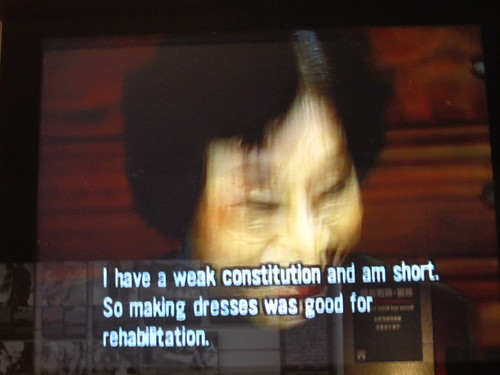
I had one fine day in Nagasaki, investigating the old colonial mansion on a hill, Glover Garden, and wandering through Chinatown. The next day, when I visited the Atomic Bomb museum, was pouring down rain, and this seemed fittingly melancholy for such an experience. I moved through the museum very slowly, and spent a good deal of time watching the videos of the survivors’ testimony as well as, toward the end of the exhibit, video interviews with people who live near nuclear facilities and near testing grounds, and who have suffered as a result. As when I visited Hiroshima, I could not help but note the charm of the recovered city and the kindness of the residents. It does tug at the heart.
 |
| Glover Garden in Nagasaki |

I did not mind visiting Japan during the rainy season, since it was so green and there were gorgeous hydrangeas (second mention) everywhere. And once again I was able to see the irises at Meiji Koen! Next time I go during this time of year (and it looks as if this will be next year!), I will bring the rain boots I bought toward the end of my trip, having suffered soaked shoes and socks one too many times. I also bought the loveliest imaginable umbrellas, since the umbrellas sold here in the states are vulgar and hideous things, for the most part. I think that if one has the right rain paraphernalia, a rainy day can be a beautiful thing, except for the havoc it wreaks on my Jewess hair.
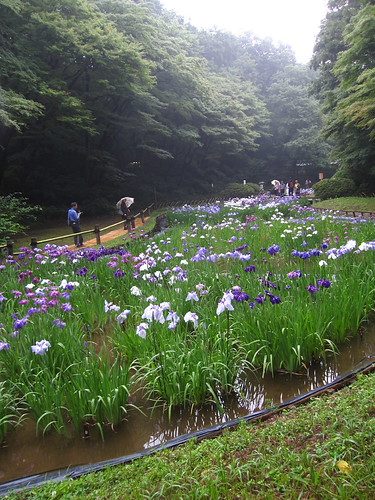 |
| Irises in Meiji-koen |
If you do nothing else in life or visit no other place, please visit Naoshima. The combination of the exquisite natural scenery and the artwork is idyllic. Apparently there are other art islands, such as Teshima, in the area there. and I wished I had had a longer time to stay there. It was a bit of a trek to get there…an hour or more out of Okayama and then another half hour or so on the ferry, but so very worth it. My favorite thing out of many favorite things there was this public bath that had been turned into a whimsical work of collage art/sculpture, and was still functional as a bath! At the bottom of the tubs were inlaid images of antique Japanese woodcut porn! How cool! And there was a life-size elephant sculpture atop the wall that divided the men’s and women’s bath sections! I stayed in a wonderful little guest house in the port town in a perfect room with a tokonoma, and talked to Hiro, the assistant proprietor there, for at least a couple of hours about various intercultural and philosophical matters.
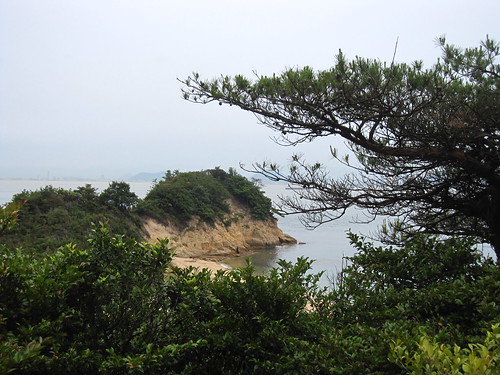 |
| Scenery at Naoshima |
I love how after I am in Japan for a week or so, I can feel my Japanese re-blooming. Of course I still stumble over grammar and vocabulary sometimes, but it starts to feel more and more natural. By the end of the trip I was talking to myself in Japanese.
 |
| Reversible Destiny Loft, Mitaka |
Staying for a month in a Reversible Destiny loft was…incredible. The colors were gay and fine, and I was always happy to wake up among them. At first I was wary of the wavy floor, and afraid of stubbing my toe, but I didn’t even once. It felt a bit like a very clean version of camping. I loved how the center of the apartment was a kitchen, and when I had friends over for a little party, I pretended I was a mama-san with my own “sunakku” bar.
 |
| Mama-san |
The layout really fostered a kind of intense communication, as I had noticed when I visited many years ago and talked with Arakawa in one of the lofts – he also was behind the kitchen counter as if a proprietor – but then I suppose no communication with Arakawa could be anything but intense. But my favorite part, really, about being there was getting to know the staff there, the graceful Momoyo Honma, as well as Enomoto-san and Matsuda-san, who became my friends as well as my language pupils. I feel ambivalent, honestly, about the notion of living forever, and am unsure about the extent to which an architectural construct might extend one’s life…but what moved me most about being there was the fact that this extraordinary vision of Arakawa and Madeline’s was real, and so tangible! I could live in it! I touched its cool surfaces of many textures! I made food in it! I found that I even made a little nest in it, a favorite spot where I would curl up and read my Isabella Bird book on my iPad, or write in my pink notebook. It was more comfortable than I had expected, although I did feel that a couple of minor things about the space were a bit…bullying…in terms of forcing me to change some physical habits…but I’m not sure I was there long enough to know whether those changes had any salubrious effect on me. I hope so!
 |
| Vegetable field in Mitaka |
The lofts are located on the edge of Tokyo, in an area that has both big box stores and vegetable fields! On one side, there was a KFC and McDonald’s, and on the other, bamboo groves. Literally one block from the lofts, I watched a woman dig potatoes in her field, next to which was a convenience store where I bought bottles of water and occasional daifuku and kanten. This sort of peaceful contradiction is indeed one of my favorite things about the country…
I explored a lot. Of course I spent a lot of time in my old haunts…Shimokitazawa, Shinjuku, Kichijoji, Shibuya…but I also went farther afield. I went to a spa in Toshima-en called Niwa-no-yu, and another spa near the lofts, in Jindaiji. I went to Sugamo, known as the “Old ladies’ Harajuku.” I visited a luxury apartment in Azabu-juban. I went to the Tokyo International Doll and Miniature Show.

 |
| Tokyo Tower |
I climbed Mt. Takao: a tough route. I hung out with my friend Marcellus on a super-rainy day in Kamakura, and at the Tokyo American club with my friend Jeffrey. I walked through Shinjuku san-chome with my ex, Masaya. I browsed shops in Koenji and Nishi-Ogikubo, getting into interesting conversations with the shopkeepers. I followed the trail of Gegege no Kitaro in Chofu. I went to a sento kind of by chance one evening in Sendagi because my feet and back were hurting from simply walking around too much. An older guy with missing teeth tried to pick me up in Ueno park. I ate really delicious yaki-zakana everywhere, but particularly this new place I found in Takadano-baba. I hung out with my former student Nham in Omotesando and Shibuya. I gave a reading in Aoyama, and met some fascinating Japanese poets. I visited the writers Eric and Naoko Selland and their beautiful basenji Rita out in Machida…and just…really…had a splendid time. And, oh, look at this beautiful cafe I found in Nezu!

So now here I am back in this benighted country. We are having a heat wave. The Martin case is on everyone’s mind. I just got in a stupid facebook argument about it. I spent the first few days I was back cleaning up cat pee…for Nemo had peed on many of the couch cushions…I felt, during the cleaning…that I was living in a bottle of vinegar…and noticing he was very thin, I thought to take him to the vet. It turns out he is hyperthyroid, and must have a rather costly procedure done to cure him. I don’t mind so much the expense, although it will be a bit tough to manage. I’m just sad that he has been suffering, and feel bad that my absence must have made him even more stressed out. You know…suddenly…I’m plunged back into my reality! Because this city feels like such an awful, smelly mess, I am fixing up my apartment, caressing it into greater order and beauty. And I have sewn the first of many new skirts with fabric bought in Japan. Onward, then, to August…and then…to autumn!

 |
| The weird little guys on the fabric in the lower left are “kobito-zukan” – my new fetish |
 |
| Poor little Nemo…
1400 or so more pictures here! |
Japan Itinerary
Tomorrow I leave for Japan for five weeks. My bags are 90% packed and I am dithering only about what my electronic connectivity options should be but my outfits at least are decided on, and indeed that is the hardest part. I notice sometimes before I travel I buy cheap “practical” clothing that I don’t actually like and this is a very stupid thing. Cargo pants are light and comfortable, it is true, but they do NOTHING for me, and I shouldn’t buy them, even if they are mint green and have interesting zippers.
Here is my itinerary.
My plane arrives on Sunday evening, and my dear friend Atsushi, who with his lovely family lives near Narita, has kindly offered to pick me up. I will stay there Sunday night and Monday night as well.
Tuesday morning I will leave early for Okayama, where I will stay for one night at Sogenji, a beautiful old zen temple. There are several international people studying zen there. I am not sure whether I will take part in their meditation as I worry a bit about my sciatica, but I look forward to drinking in its peaceful atmosphere.

From there, I am going to take the train to Kyushu, where I have never before visited. Another old friend lives in Beppu, a hot spring town said to be “the Vegas of Japan.” I will stay two nights in a lovely hot spring inn and take day trips to the beautiful onsen towns of Yufuin and Kurokawa.

Then I will take a scenic train ride across Kyushu to Nagasaki. Nagasaki is unique for its international history even at a time when the rest of Japan was closed to most of the world. I will stay two nights in a hotel with “mediterranean” décor.

On my way back to Tokyo, I’ll stop again in Okayama and take a train and boat to the “art island” of Naoshima, and stay in a little pension near the ferry port.

Then, once back in Tokyo, I will be staying at the Reversible Destiny Lofts in Mitaka, performing some of the architectural procedures in which Madeline Gins herself has tutored me, and seeing what it feels like to inhabit such a revolutionary space. I will stay there for one month. Here is me in 2008 on a visit to the lofts.

It is a long time to be away, and I will miss my sweetheart, my cats, and my friends… but I am so hungry for Japan and its grace. I can’t wait to be there.
Voyeur (after Mary Ruefle)
I have become an orca
washed up like a salty white bitch.
Mammaries,
how do they make them now…
so squeezable–
in this life, I’m already so wasted,
and still spewing
Miracle Whip
~ Merely Ruffles
b. 1952
I’m Free!

The Norton Got it Wrong

I am glad to be included in the new Norton Anthology of Postmodern Poetry. I guess I have earned it, having plugged away at this racket for a few decades now? Of course, there are so many others who have as well, and who should be included, but then the book would be even more unmanageably massive than it is now. Poetry has reached a state of uncontainability, and that is an excellent thing.
What is not so excellent, at least from my point of view, is my bio entry in the book. I suppose they have a good reason for not running these by contributors, and I do recognize the enormity of the task of putting together all the materials. Still, there is at least one bit in mine that is so egregious that I want to go to all my friends’ houses who have the book and black it out with a Sharpie.
Hoover included material from an interview I did with Tom Beckett as a setup for the poems he chose from Swoon, but he rearranged it in a misleading way. He begins by quoting this paragraph:
Gary and I had a crisis, and one of the ways we dealt with it was to write a blog to each other. The material of the blog was therefore ‘natural’ ‘expressive’ language. I used a random poem generator program to generate thirty pages of stuff from the language on that blog.
Now, this blog had NOTHING to do with Swoon, except that it was a (hopeless, it turns out) attempt to recover something like trust in our relationship after his extended clandestine affair with the “poet” Wanda Phipps. We thought that since we had initially built trust in writing, we might be able to rebuild it. But the experience of writing that blog was not Swoon. In a way, it was Swoon’s unraveling, an anti-Swoon. Hoover, however, collages the passage in such a way that it seems that Swoon was the blog the passage refers to! I find this vexing, as if someone had misspelled my name on my tombstone.
Beyond this erratum is the problem of the poems he chose to include. The poem of Gary’s that is in the anthology was not written to me, and although it is published in Swoon, it is there as a kind of quotation, not as part of our collaboration. In fact, Gary wrote it for his first wife. More disturbing to me is that it hardly represents Gary’s most important contributions to poetry. His bio note mentions the Flarf Klassic “Mm-Hmm,” the poem that launched a thousand Google searches, but does not include it. This is, to my mind, a grave mistake. The one that was chosen, “Among the Living,” is a kind of blancmange of a piece that better represents the sort of work coming out of the Bay Area in the early 90s with its shifting pronouns and high, still diction – almost a kind of homage to Michael Palmer – and has nothing to do at all with the mark that Gary made on poetry. If anything, his later poems to me and his Flarf work come out of a reaction against that sort of poetry.
My poem, “Moonscape with Earthlings,” in some ways foreshadows my riper poetry: it is playful, Oulipean at moments, sort of macaronic (although in a dumb way; if you understand Japanese you can understand just how dumb, in retrospect), multiform. I am not entirely embarrassed by it, but it is definitely not my best or my most representative work.
Finally, and I know it is futile to rail against something like this, because it does make some kind of editorial sense, but I can’t STAND that it is a dual entry. I might feel less that way if the poem of Gary’s that had been included was the one to which my poem responded. But the poems don’t read as a collaboration, because strictly speaking, they are not. And beyond that, we each have made contributions to poetry separately that surpass anything we did in Swoon, IM(maybe-not-so)HO. I do think the dual entry is a problem not just because of our vicious divorce, but on historical and feminist grounds as well. I’m emphatically my own thing, not a Gary thing, even if he was instrumental in helping me get to where I am.
Q & A
A student of Sandra Simond’s asked me some questions. Here are some of the answers I sent her:
1. What influenced you to write poetry?
As a child I learned to talk early and from three or four years old was a voracious reader. I don’t remember so much liking to run around; I liked to read. I read books totally absorbedly over and over and over I suppose there has always been as a result a lot of language in my head. I was the only child of a single mom and entertained myself a lot, writing stories and poems. Writing served (serves) as a refuge from boredom, chaos, and loneliness. At one point – I couldn’t have been very old – maybe 12? – I had a job in a little used bookstore. It may have been there that I picked up a hardback green copy of an anthology titled “Major Poets.” I read this book as I had the books of my earlier childhood, and certain poems really penetrated me: John Dryden’s “Song for St. Cecilia’s Day,” D.H. Lawrence’s “Bavarian Gentians,” Dylan Thomas’ “Fern Hill.” I liked Shakespeare, Shelley, Plath and cummings – maybe a fairly typical taste-constellation for a young literary aspirant of my generation? Then as now I was drawn to musicality in language, finding music the ultimate “transcendent” art and also interested in how language strains against its limits in poetry, and sometimes breaks through to something like music.
2. How long have you been writing poetry?
I recall dictating my first poem to my mom when I was about seven.
3. Are there any poets whom you are heavily influenced by?
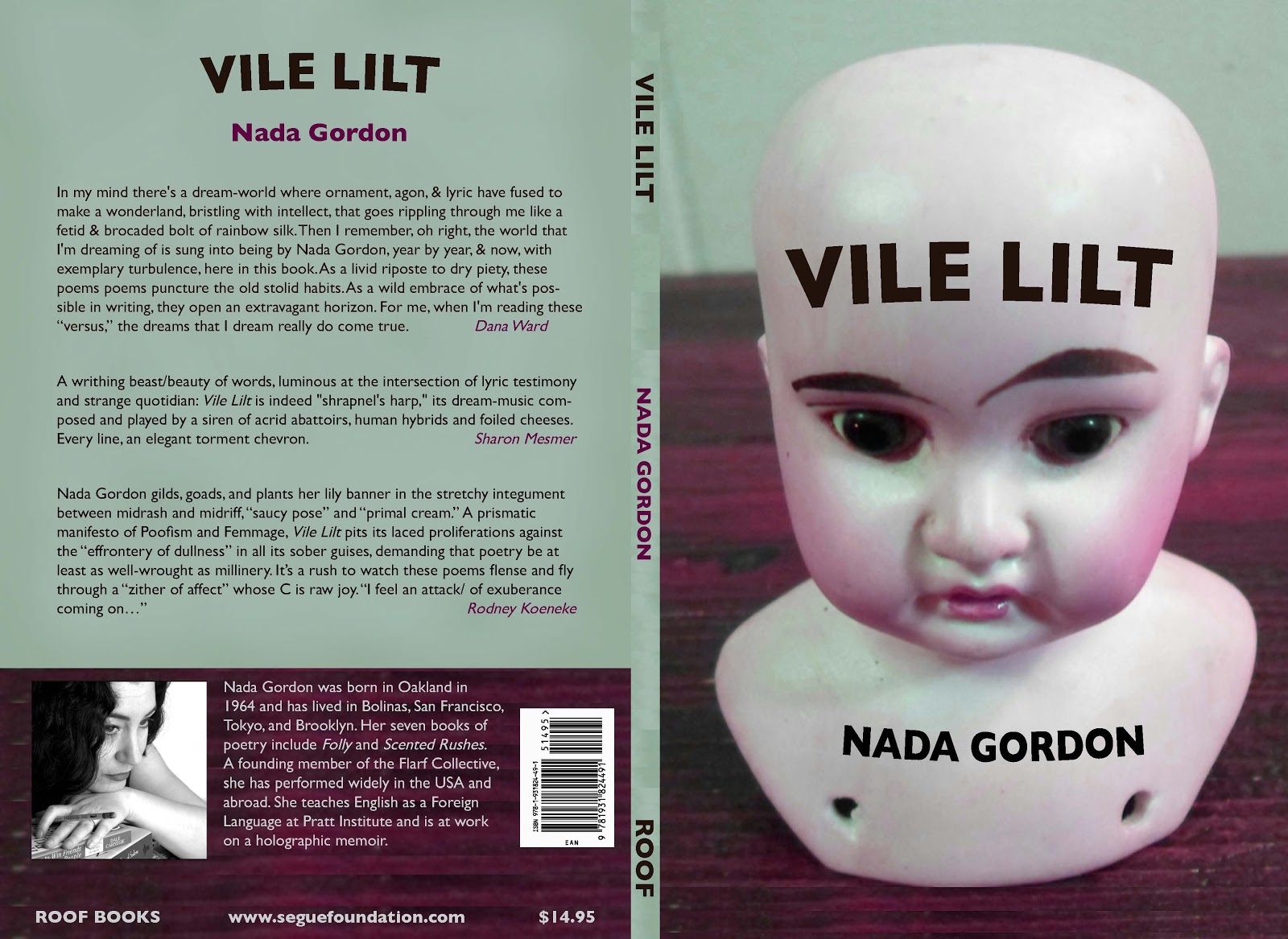
I suppose the snowball of influence that encases me is at this point rather heavy, although I’m not sure that naming a few names is a useful exercise here. Because I so often inhabit others’ poems from the inside, and then set about transforming them, it may be more accurate to talk about my outfluences. I have rewritten poems by many poets: traces of the originals streak the poems themselves. I like to think of beings and also artworks as porous, leaking into each other in all sorts of ways. In Vile Lilt, for example, I rewrite poems/texts by Marianne Moore, Dana Ward, Havelock Ellis, William Blake, George Herbert, Brian Ang, John Keats, and The Internet. I also rearrange the dictionary a bit.
4. What is your favorite poem from ‘Vile Lilt’ and why?
I think I like “Droop Loss Slave” and “Wildcats Can Be Revealed (Vile Lilt)” the best. In these poems the vocabulary is quite various and rich, as are the sources. Many of the words are woven in from online lists of obscure words for spammers hoping to evade detection. I use the words in service of cadence and emotion. At a remove from simple “expression,” they amplify the aesthetic power and complexity of the lines in the way that a wisteria vine climbing over the face of a building makes one more fervently desire to enter or inhabit it. Such baroquerie, to me, redounds upon the quality of the emotion as well, making of the poem a fearfully poignant code.
5. Any advice on becoming a better writer?
Focus. Trust your impulses. Always have a pencil ready. Try different materials, styles, environments. Have writer friends. Steal and borrow, but always transform. Have a ball. Don’t worry about being “better.”
6. What is your writing process like?
My process varies according to the piece. I collage a lot, weave things into and around each other. Sometimes I “just write.” I often add and substitute language to existing texts. I am less likely to subtract (erase) things as this strikes me as the least interesting of procedures, at least according to my “wisteria” aesthetic. I also like to remind myself that nothing is “set in stone,” that I can always bend, twist, modulate, or modify things. I find myself often gathering language “to use later,” and this is very useful.
7. What are your goals for the future?
Mainly to write more poetry, as well as other sorts of things, but I am actually superstitious about public enunciations of goals.
8. What inspired you to write your poem titled ‘poetry’? (which is my personal favorite from Vile Lilt)
You may have already guessed that the poem is a rewrite of Marianne Moore’s poem of the same title. This was actually my contribution to a group “intervention” by the Flarfists. We all wrote poems to submit to Poetry magazine, and each poem had to include a line about a nuthatch perching in a urethra. We all submitted our poems under separate cover; not one was accepted by the magazine.
Have you missed me? Some MoMA pics and event announcements!
Have you missed my blog posts? I’ve been busy.
Last Saturday I read at MoMA in an orange dress. The first photo is by Toni Simon, who so deftly captured the moment! I did spend a bit of time reading from the floor, yes. MoMAwas a difficult reading environment, with miserable acoustics and shifting audiences, and afterwards I was quite spent, and could only sit on my bed eating blueberries.

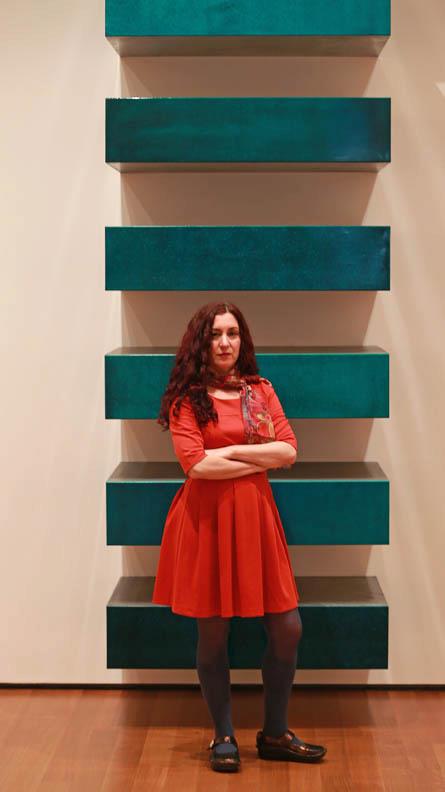
Here I stand in front of Donald Judd’s UNTITLED(STACK) 1967…The Museum of Modern Art staged a poetry event entitled Transform The World! Poetry Must Be Made By All! as part of Kenneth Goldsmith’s Poet Laureate program. 4th Floor Painting and Sculpture II. Photo:copyright Lawrence Schwartzwald(No reproduction without express permission) (I obtained express permission) (by the way I don’t think I usually stand like that; Lawrence told me to cross my arms).
BUT IN CASE YOU MISSED THE MoMA festivities, don’t despair! Next week there are two more events at which I shall make appearances.
The first is Monday April 29 at 6:30:
Postmodern American Poetry: A Norton Anthology Reading
Wollman Hall (at the New School), 65 W 11th St, (between Fifth and Sixth Aves)
Featuring readings by contributors to the anthology “Postmodern American Poetry,” 2nd edition (W. W. Norton, 2013), edited by Paul Hoover, including Charles Bernstein, Katie Degentesh, Elaine Equi, Drew Gardner, Peter Gizzi, Nada Gordon, Lisa Jarnot, Caroline Knox, Noelle Kocot, Tan Lin, Steve McCaffery, Eileen Myles, Sharon Mesmer, Bob Perelman, Joan Retallack, Cole Swensen, Edwin Torres, Marjorie Welish, Susan Wheeler and John Yau.
I’m cutting and pasting, and too lazy to mess with the HTML. Can you tell?
(I can’t resist an internal rhyme, either.)
(I can’t resist an internal rhyme, either.)
AND THEN: A BOOK PARTY for my own Vile Lilt and Michael Gottlieb’s Dear All!
(c & p’d from fb)
-
 Poisson Rouge, 158 Bleecker St
 -

Come celebrate the publication of Gordon’s _VILE LILT_ and Gottlieb’s _Dear All_ with special guest Drew Gardner


THE NEXT BIG THING: VILE LILT!
@font-face { font-family: “Times”; }@font-face { font-family: “MS 明朝”; }@font-face { font-family: “MS 明朝”; }@font-face { font-family: “Cambria”; }p.MsoNormal, li.MsoNormal, div.MsoNormal { margin: 0in 0in 0.0001pt; font-size: 12pt; font-family: Cambria; }a:link, span.MsoHyperlink { color: blue; text-decoration: underline; }a:visited, span.MsoHyperlinkFollowed { color: purple; text-decoration: underline; }p { margin-right: 0in; margin-left: 0in; font-size: 10pt; font-family: Times; }span.st { }.MsoChpDefault { font-family: Cambria; }div.WordSection1 { page: WordSection1; }
I was tagged on facebook by Susana Gardner to create this auto-interview about my forthcoming opus, Vile Lilt.
What is the working title of the book?
Vile Lilt is the title, no longer the working title, but I hope the title works. I’m interested in the fact that people keep mishearing/misreading it as Vile Lit.
Where did the idea come from for the book?
It came floating down the stream hidden in a giant peach, donburako, donburako, making that sound as it went…(una grossa pesca galleggiava!).
What genre does your book fall under?
Poetry, plays, benshi scores.
What actors would you choose to play the part of your characters in a movie rendition?
For some reason the vision of Ruby Keeler’s face, multiplied, floats up before me, as in this scene from Dames (1934) http://www.youtube.com/watch?v=hXMPXo8Epn8. I suppose she would be the guiding persona, the stand-in for my “authorial” presence in the work? Since it is “lyric” poetry, I would hope also to be played by Young Werther, Miss Havisham, and of course Meena Kumari. Mahipal and Sandhya are already present in the Navrang benshi piece, as are Eriko Hatsune and Fhi Fan in the Uzumaki piece. I would hope that Cynthia, Maureen, Jane, and Patti would play themselves in the play, “Beatles’ Ex-Wives’ Reunion.” I would need to hold auditions for people to play the parts of Dana Ward, Brandon Brown, William Carlos Williams, Marianne Moore, William Blake, Havelock Ellis, Dr. Zizmor, Mikhail Bakhtin, Lev Vygotsky, Ezra Pound, Dante Alighieri, Sylvia Plath, Guillaume Apollinaire, Joe Brainard, Oscar Wilde, Lew Welch, John Keats, Percy Bysshe Shelley, Jack Spicer, and any other sundry characters. I guess it will have to be directed by the Quay Brothers.
What is the one sentence synopsis of your book?
Girl loses boy, writes poems, in full costume.
How long did it take you to write the first draft of the manuscript?
From January 14, 1964 until now.
Who or what inspired you to write this book?
Some kind of helpless compulsion or itch or voices in the head: a vile lilt.
What else about your book might pique the reader’s interest?
There are many words in the book you will not know. Examples: preponed, pedunculate, banausic, tolazoline, enfoldion, phenolic, desmid, hybriddy, stuckly, kumkum, ptyalize, viridity, prognathous, runch, chicot, sandilands, Bobis, guggling, megachiropterae, viridine, dhobis,
Will your book be self-published or represented by an agency?
What means this…”agency”? It will be published this spring by Roof Books!
What is it that you want of a book?
I want them to be (like) dioramas I can enter and get lost in.
Tagged: Adeena Karasick, Sharon Mesmer, Lynn Nino, Thoe Htane, Yi Ywel Yway
 Otohime