Tonight: Poetry Extravaganza at ISSUE PROJECT ROOM

This Friday, October 9, 7:00 pm — The Way of the Word
Poetry Extravaganza curated by Bob Holman, Suzanne Fiol, and Kenneth Goldsmith
ISSUE PROJECT ROOM
At the Old American Can Factory
232 3rd Street, 3rd Floor
Brooklyn, NY 11215
Tel: 718-330-0313

featuring the amazing poets:

Bob Holman
Ken Goldsmith
Jonas Mekas
Anne Waldman
Judith Malina
Abiodoun Oyewole (of the Last Poets)
Hettie Jones
Jeff Wright
Esther K. Smith
Georgia Luna Faust
Michael Carter
Kathy Engel
Kimiko Hahn
Beau Sia
Holly Anderson
Max Blagg
Frank Lima
Betsey Andrews
Mike Topp
Steve Dalachinsky
Yuko Otumo

and the FLARF POETS:

Gary Sullivan
Sharon Mesmer
Drew Gardner
Katie Degentesh
Jordan Davis
Brandon Downing
Nada Gordon

Rest in peace and art, beautiful Suzanne.

to the tune of

In the greasy howls and fidgets
of our dirty knees, I’m a wannabe
In the clown hole of your rubber lime

To steam you adderall me
and Afghanistan
Now I’m a man
Ah but I mayonnaise
try and scratch chagrin

dee dee dada dadadadadada
dadada
dadada
da daaaaaaaa

For me to rub your jowl
‘Twould be a Swedish thing
‘Twould make me king
Ah but I mayonnaise
Try and scratch chagrin

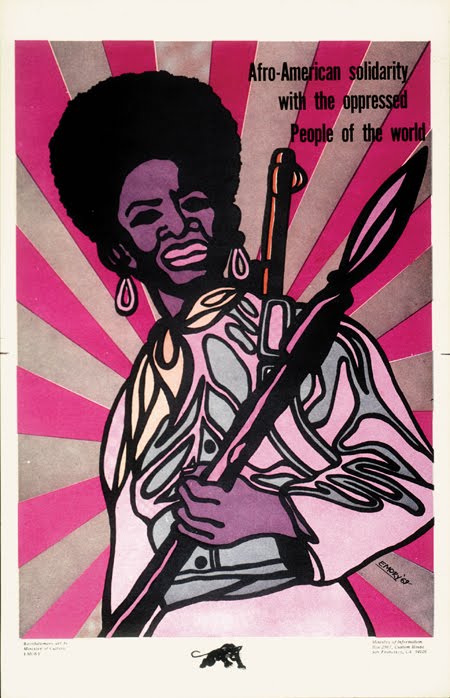
Emory Douglas

I’m teaching my students about the Black Power Movement and taking them to see the Emory Douglas show at the New Museum on Thursday. They were floored by this image, and oddly, did not initially recognize the figure as a woman, pink background notwithstanding. They did get the reference to the imperial Japanese flag.

By the way, that’s a pen she’s holding, but she’s got the gun as backup.

Ensembles Galore

Thrilled by fall’s fashion panoply. At the poetry project the other night, I rhapsodized with Stacy and Sharon and Mel over the joys of muted tones.

I admired Stacy’s recent lushness of hair, and entreated her to keep it that way. She said, can I be on your blog, and I said, of course! The subtle combination of burgundy and army green: perfect.

IMG_7165

Sharon (who never looks bad either in life or in pictures: unfair) and Mel here wearing pale grays and blacks and sheer flarf charisma.

IMG_7166

Mel had a marvelous faux vintage necklace of I think wrapped fake jet beads that is not quite visible in this picture. Really, I should have got a photo of her shoes, something like that great futurist Umberto Boccioni sculpture. Mel rocks the 70s and 80s like no one else: more delicately, more ironically, more adorably…

I was in muted tones, too, but the OUTFIT was anything but muted. When I took off my jacket, Sharon said, “what are you wearing?”

IMG_7159

Taupe ruffled nylon thing bought for under $12 at a discount store (Janice’s) at the Fulton St. Mall, purple stretch miniskirt, tights striped two shades of lavender (but I ripped them, dammit, with the Velcro on my Steve Madden Frankenstein/Harajuku boots), chestnut shrug. I told Mel and Sharon and Stacy that I had learned about how to wear this sort of palette in Japan: all tones except maybe the shrug are somewhat grayed, and this color sensibility harks back to what is “shibui” (astringent, modest, subtle, austere) in that culture. Conversely, though, I find something lush in the mutedness. Such colors are hard to find in American shops, as the subtlety tends to be lost on, say, the consumers at American Apparel and Old Navy, but the fact is that these grayed tones tend to be very kind to the whole range, I think, of human skin colors.

We discussed the difficulty of mauve, how few Americans do it well, and how, despite its loveliness, it seems to call up a kind of 80s doctor’s office décor, especially when combined with gray. Well, I hope I avoided giving that effect.

As an antidote to mutedness, here’s this, a photo that Brenda Iijima posted on facebook some time ago and I asked for for this blog. Because it’s just splendid. Her caption follows.

By my side is Stephanie Hough—this photo was taken in my parent’s living room by my dad (we spent a few hours modeling Aunt Josephine’s clothing which we had to clean out of her house when she passed away. My father was the commissioned photographer). The campiness is an ode to her primadonna personality and she sure had the clothing to exquisitely don her mood and mode. I can’t remember the precise date this was taken but it was about 8-10 years ago.

A couple more recent outfits. Red seems to be dominating. Perhaps I’m trying to “build up my blood”? Look, look, how my skirt and ruffly scarf (a present from my dear mother-in-law) and hair catch the light! And the raw edges of the skirt!

IMG_7182

IMG_7181

Yesterday’s outfit: a rare sojourn into pants. Cranberry Fluevogs and lace scarf. Rose sweater. I think I look like Valentine’s Day.

IMG_7189

IMG_7191

Note to self: need to post on the semiotics of Frankenstein boots.

While you’re waiting, why not check out this interesting article in the NY Times?


Unlike other artists whose materials come from the wardrobe — Cindy Sherman, Leigh Bowery, Yong Soon Min or Nikki S. Lee — Ms. Hardy seems less interested in making commentary on body morphology or the tensions between mainstream and minority cultures than in teasing out the subtle emotional meanings latent in clothes. “This blanket expression that you shouldn’t judge a person by their clothes is ridiculous to me,” she said. “Every article of clothing is so loaded with signifiers, I don’t know how you can help but make up stories about people and their desires based on what they wear.”

a New York encounter

A couple days ago a big black guy (in jeweled eyeglasses, fancy sneakers) I would say around my age (that would be mid- going on late forties, people) got on the G train with his friends, sat down, and started talking very audibly (the whole train car could hear him) about how he was gonna get his GED, go back to school…said he already had a business, that he came from the hood and has always been a hustler, and now he was worried about his son out smoking weed… well, everyone learned a lot of information about him.

He was sitting right by the door and I said to him as I got off at Clinton/Washington: “You’ll like school: it rocks.” I told him I was a teacher (you see, I try never to miss a “teachable moment”). “School rocks? Yeah?” he said, smiled hugely, and hi-fived me. Then he looked me up and down. “You fine, too.”

OK, so he “objectified” me or whatever… but I think it was a kind of beautiful little New York encounter.

Shuwen Song on feminist art

My student, Shuwen Song, writes in her journal:

I just remember when I was in college, there was a class we discussed about the feminist art work. My professor mention that:” There are a lot of thing we never pay attention to but them still exist. As the difference between man and women. For example, if a man want buy a pen, he will ride his bike along to the nearest shopping mall. Then as quickly as he can to finish his work and come back. The whole process can not over run 30 minutes. If you talked about women, it may be totally different. At first, women always want to take her friends ( at least one) to come with her. On their way, they may find something interesting, like a cat. Ok, after teased the cat, they just enter the mall. Then they look around every conner, and buy some stuff which never be necessary. Finally, they spend all their money then decide to go back. Now they just remember the purpose of their trip: a pen. The whole process is more than 2 hours. You see, that’s difference. Man is straight, but women is vacillating.”

Well, I just love this.

Adfempo report part 3

The Closing Plenary & Feedback Session

Before I begin this section, I would like to emphasize what most of you have probably already noticed, that I make no claims to objectivity in my reportage here, and these posts are no more then my blind and partial elephantine gropings. If you’ll remember, I was kvetching in parts 1 and 2 about my physical state, and by the end of the day, everything was exacerbated: fatigue, blood, general social overwhelm… and these factors very much influenced how I perceived the proceedings.

The onstage moderators were Gail Scott, Tonya Foster, Rachel Levitsky, and Erica Kaufman, all people whom I admire and with whom I have some rapport, so I hope that any criticisms that follow will be taken as constructive. Rachel began by apologizing for replicating inequalities in power dynamics by them being up on the stage with microphones while we were down in the audience, and pointed to microphones set up in the aisles for our use. Then each of the moderators spoke a little about their experiences of the conference, and each one (except Erica, who is relatively taciturn) spoke maybe a little too much. I wasn’t taking notes, and I don’t remember precisely who said what, but I think Gail and Tonya did seem to dwell a bit on the desire not to be pinned down or categorized, and brought up some resistance to “feminist” as a label. There was also some discussion of the notion of “the commons,” and although I understand the usual usage of the word, I wasn’t at the panel where the term was fleshed out, so I wasn’t entirely sure what they meant by it. There was also something about “exteriorization,” but again I don’t really remember what was being said about it: Tonya? When it came time to elicit comments from the audience, there were so many concepts on the table that it was hard to know what to address, and the moderators seemed to sort of nervously be pressing them all at once in layers of questions, surely out of a desire to make the discussion lively, but honestly I found it a little confusing.

One thing I have learned as an ESL teacher is not to layer questions, but to ask one question at a time. That might have helped me to focus better on finding something to say, but the topics seemed to lurch about from this to that, and besides I was afraid if I stood up I would gush blood, so I kept mum pretty much the whole time, even when Jen Scappettone tried to call me out (more on this in a bit).

I wonder sometimes about the function of speaking up in fora (is that the plural of forum? Word just auto-corrected it) like that. I mentioned the same thing earlier writing about the Q and A sessions after panels. Is the function really mainly to speak one’s mind and to listen to other people speak their minds? Or is it to sort of establish a social position? It reminds me an awful lot of testifying in church. If I really know what I want to say I am not afraid of speaking in public, but I can’t just open my mouth and speak. It doesn’t work that way for me. For one thing, I have a kind of microphone-induced Tourette’s syndrome. Whenever I’m in front of a mic and asked to say something extemporaneously, my id seems to take over and I say the worst possible thing I could say under the circumstances. Since I have a lot of conflicted feelings about groups, and about groups of women, and especially about groups of women writers, I really thought, even though my brain was roiling with possibilities, that I had better sit this one out.

Several people spoke, and here are some that I remember: Eileen Myles, Jen Scappettone, Jen Hofer, Evelyn Reilly, Lila Zemborain, Rachel Blau du Plessis, C.A. Conrad, Caroline Bergvall (I think), and Laura Elrick. I don’t remember who said what, or even what they said, exactly. Laura said something about how scary it can be to take the risk of “jumping into speech,” out of the “refuge of writing,” and I could relate to that, given my metaphorical Tourette’s. I think maybe a lot of people feel that way.
As an ESL teacher, here’s one of the ways I get around that with my students: I get them to write first, then speak. The feedback session could have started with writing, say, with a sentence completion exercise, or a questionnaire. Or people could have submitted anonymous comments to be randomly pulled from a box. I am sure this sounds juvenile, but it would have certainly changed the dynamic in the room from the parade of strong personalities that approached the mic to something a little more inclusive.

Let’s see what else I remember. I think someone suggested that we think of feminism as a verb rather than a static noun. I liked that suggestion. Someone else asked how many 17-year-olds consider themselves feminists. (Here I wanted to suggest that we look at “Girldrive” for our answer, but I was keeping mum.) Evelyn said something very cogent that I agreed with but I can’t remember what it was. Always have a pen at the ready, ladies! Write everything down! C.A. Conrad I think said that the most insidious force infecting our youth was capitalism, or something to that effect. Jen S. said that what is in urgent need of our attention now is not bourgeois white feminist issues, but international feminisms, and referred to Juliana Spahr and Stephanie Young’s project of collecting information and responses from feminists around the world. There was, as there always is, some talk of the efficacy of poetry in fomenting political action.

I know that if I had stood up to speak on the last point I would have ended up sounding like Baudelaire or something, and I really didn’t want to be pegged as “the amoral hedonist aesthete” again in that crowd especially even if there is something to the accusation (that last sounds too apologetic, but I mean it good-humoredly).

You remember I said in an earlier post that the truffles I had brought would be important? Well, Jen S. began another comment with an anecdote, saying that she had finally got around to eating one of my truffles and had found that it was moldy inside. She wasn’t sure whether that had been an accident or some kind of conceptualist prank. [I protested vociferously that it had not been intentional!] [I would never do anything malicious like that, and actually was a little hurt that she thought I might.] She used the metaphor of the truffle to say that actually she had looked forward to a little more performative mischief at the conference, and to reiterate what apparently (someone told me this later) had been her question in the opening plenary: why are women so polite with each other and reluctant to critique other women, at least publicly? This is a paraphrase of a second-hand question, so if I got it wrong, Jen, please correct me.

Of course, one knows the answer to this. One wants to have some sort of solidarity with the other members of one’s oppressed group, and one wants not to undermine that. It’s not always healthy to repress one’s critique, though, and I reckon it finds its way out in other ways, maybe in opinions expressed in dyads and triads and in other forms of social behavior. I know that I feel a marked chilliness from some women writers, and I can only project the reasons for that. They maybe think I have bad politics, or that I am insufficiently “activist,” or just too absurd, or too male-identified, or too femme-y, or too much of a provocateuse, or that my mother dresses me funny. Maybe they don’t like that I am so much in contact with my inner buffoon, that it might rub off on them. Or you know, maybe they just don’t like me. There’s nothing wrong with that, even though it makes me a little sad. I certainly can’t allow myself to be stifled by their disapproval or dislike. I remember a friend in the punk days (which were heavily western-inflected) in SF saying something to the effect of “well, you don’t have to like someone just because they wear cowboy boots,” and you know, it’s true.

Still, without wanting to sound too generous or virtuous, I really try personally not to be chilly to anyone, even if I disagree with them, or even, maybe, in some way, dislike them. I am thinking in particular of someone (not a woman, BTW) who tried to tell me, when I said that I felt his Marxism bordered on the evangelical, that Marxism was “not an ideology.” What? It’s not? In this, I guess I feel like my politics are profoundly interpersonal: I want to assume amongst my fellow [sic] artists a common ground of affection that is meta-moralistic. (And I also, if you haven’t noticed, like to practice a kind of radical honesty.) Not everyone, clearly, shares this view, and sometimes I feel a bit like, well, not a pariah, but someone whose point of view and aesthetic affiliations are not really thought of by some people who are very wedded to their convictions as being worthy of consideration. It may be that I am projecting a kind of “scary mommy” or “judgmental teacher” persona onto them, and of course I have no idea what really goes on in their minds at all; I am only interpreting behaviors. Well, what sensitive person doesn’t enjoy a little social paranoia, I wonder?

The fact is, though, that I really do privilege “the aesthetic,” although I’m not so sure that I would say that the aesthetic realm is separable from the social and the political. Art is how I engage with the world. I don’t really know any other way to do that that satisfies me, although certainly there are other ways. That said, though, I don’t really understand why people want to write or read or listen to poetry about political convictions they already have. Is it that it shovels coal in the boiler for their impulse to activism? Or that they feel educated by it?

I love Stephen Rodefer’s, “It is not the business of poetry to do anything.” It really isn’t. For me, it is the space of liberation, and if that’s not some form of cultural activism (if not, in Charles Weigl’s terms, actually revolution), well then, I don’t know what it is. “Efficacy,” it seems to me, comes out of a paradigm of bean-counting. It’s almost I dunno Fordist [later edit: Taylorist. I meant Taylorist. I guess I just needed to Fletcherize]. When I make stuff I’m stepping out of that paradigm into a field of energies. Who agrees with me?

Adfempo Report Part 2

continued from Adfempo Report Part 1, here

I remember something else about the Q and A session. In response to the person who asked, if we cannot define precisely what conceptual writing is, could we define what it is not, or what we do not want to do with it? (I thought this question was interesting, given this.) Kim Rosenfield’s response was that she doesn’t write “to make meaning,” or at least, she said, not some predetermined sort of meaning.

I’ve been thinking about this, because while I agree with the second half of her statement, I feel quite opposite regarding the first: I absolutely unqualifiedly write (or make videos, or sew, or teach) to make meaning, and not just to make it, but to make it fructify and divide and morph and sing, and a ton of other verbs I could search down the path of this sentence if I didn’t feel I have so much to say about so many other things right now. And it seems to me that her work also is rife with meanings, so… hmm… I’m wondering about this… what is it writers do exactly if not dive into a sea of potential significations?

I’m sure I’m oversimplifying her statement or not quite understanding what she wanted to say. Certainly I am not interested in creating closed structures with “messages” or pat little “organic wholes”: perhaps that is what she wanted to say. Kim?

………………………………….

After our panel, I ducked out with Laynie Browne for a quick lunch down the street, and we ran into Joanna Fuhrman at the café. Joanna talked a bit about the keynote speeches (I had missed them), and mentioned that Eileen had dissed Language Poetry in hers, as well as, what was it?, group formation around what everyone is already doing anyway. I said I thought that Eileen had spoken out of a desire to preserve her rock star status against the combined forces of groups. That sounds as if I have something against Eileen, but I don’t at all, I think she’s amazing and brilliant and totally compelling, really genuinely a rock star, and I wouldn’t say that if I didn’t mean it, because I don’t flatter people. It’s just that I am getting a little weary of people who identify as solo artists criticizing people who are in bands (as if bands can’t be formations of individual rock stars!) as if the bands are “merely” some kind of market label instead of indications of actual solidarity, affiliation, and identification.

I agreed with Joanna that individual differences of people in groups can be overlooked or glossed over, but I believe that anyone who reads avidly and respectfully will see and notice and maybe even love those differences; it is only those who are eager to dismiss the entire group categorically that will not appreciate them, and who will suffer the greatest loss, I believe. It is also true that unaffiliated or relatively unaffiliated individuals will often be overlooked, and this can be terribly unjust, but surely that is no reason to dismiss group formation out of hand. Anyway, it does seem to me that to bring up Language Poetry as a Big Baddie strikes me as silly now in 2009 (even sillier than it did in, say, 1984) when we have so many other things to think about.

After lunch I thought to go to the film panel, whose description sounded right up my alley. I reproduce it here:

The Event in the Image: Poetry and Cinema
Curated by: Angela Joosse
Films and poetry by: Peggy Ahwesh, Lise Beaudry, Abigail Child, Margaret Christakos, Moyra Davey, Kelly Egan, Laura Elrick, Su Friedrich, Amy Greenfield, Shana MacDonald, Bridget Meeds, Izabella Pruska-Oldenhof, Selene Savarie, Joel Schlemowitz, Nathalie Stephens, Souvankham Thammavongsa,Gariné Torossian, Cat Tyc

Description: This program of recent experimental film and video examines the productive impact to be found at the intersection of feminism, poetry, and the moving image. Sharing common concerns with rhythm, duration, and the slippage and condensation of meaning, experimental cinema and poetry have had rich relations since cinema’s inception. Yet the avant-garde edge of these art forms does not rest with medium-specific concerns, but rather with the capacity to install the audience in a situation that enables a potent shift in one’s very perceptions of embodied, social, geographical, gendered, political, and cultural locatedness in the world. Through poetic approaches to cinema and cinematic approaches to poetry, this program explores varying possibilities of the image as an event situation.

I stayed for five of the films. My notes:

(Kelly Egan) crazy Yoko-ish singing, bodies, films of film strips, filed scratched words, like a parody of an art film, guns, clutched breasts, wailing, jumping bodies, more scratches, hands on bodies, masturbation

(Amy Greenfield) “Men Must have dreams but they should never be asleep”, skinny stripper against brick wall, thigh-high vinyl boots, skin, oh ugh, “there’s violence breeding inside this tube of lipstick”

(Izabella Pruska-Oldenhof) solarized, gels, effect, hexagonal light forms, crunchy scratchy sounds, giant bees flapping, breathing noises, underwater, OK got it, amniotic, “avant-garde” screeching, little sexy panting noises, I suppose this is beaut

(Shana MacDonald & Margaret Christakos) My Girlish Feast, seems a little Sesame Street (Stein?) … cutout paper dolls in natural settings, “your bust is guilt and hair of it,” OK, I like this poem, onto portraits, renaissance, I think of Berger, some kind of feathery net with orchids and maybe milkweed seeds? “thirsty cinema”

(Nathalie Stephens) “Entre J’entre a tender film of a lesbian couple riding a train

(Joel Schlemowitz)

I left at this point, although there were many others I wanted to see, especially Laura Elrick’s and Peggy Ahwesh’s (of course I had seen Abby’s Mirror World, which she had collaborated on with Gary). There were moments in these films I liked or thought beautiful, but for the most part they seemed to me to be enactments of some of the worst clichés of experimental film by women: the screechy vocalizings, the tenderness (I just can’t deal with tenderness in art at all), the forced “sensuality”… I don’t know. Pruska-Oldenhof’s was technically interesting, and I loved the bees, especially, but overall none of these were working for me. This just reflects my own prejudices, I realize, and I am happy to hear your arguments for these films and why you love them. The comment box is just below.

It turned out Rob and Kim and David Buuck left exactly when I did, and we found our way in to the end of this panel:

Body as Discourse
Chair: Kate Eichhorn
Panelists: Joan Retallack, Trish Salah, Laura Smith, Nathalie Stephens (Nathanaël), Ronaldo V. Wilson
Description: This panel explores questions of the body, referentiality, remapping bodies and borders, intertextuality, narrativity, aesthetics, and the challenges of de-essentialization as we scrutinize “female,” “queer,” “raced” and “othered” bodies.

We got in just in time to hear Ronaldo Wilson, the last presenter, who was totally urbane and fabulous and switching codes all over the place. I was totally intrigued but since it was the end of the panel, just before the Q and A, I had no idea what he was talking about. The Q and A was really ramped up, with all the grad students batting around the word “alterity” like there was no tomorrow. I was sitting on the floor in my lace and boots, and very uncomfortable, so I didn’t manage to get my notebook out until a bit later, when someone left and I got a seat, and I wrote down this great quote from Joan Retallack:

“If you’re in a relationship of reciprocal alterity, it doesn’t mean everything is hunky-dory.”

There were many interesting things said about trans bodies and cruising and vulnerability and rapture vs. rupture and the Christian problematics of the word rapture, but you know once again I had the feeling that I have just not been trained to discourse on this level, and I was a little stunned and amused by everyone’s facility. For me, you know, the road not taken, and that’s why I speak to you now rather straightforwardly.

Upon arrival, I thought to pass around a box of truffles that had been given to me by a student and were sitting around in my kitchen uneaten so as not to find their way straight to my hips. They were quite expensive, I know this because my student had left the receipt in the bag, they were $42.46. Later on in my narrative these truffles will emerge as being quite important, so I will ask you to hold them in mind.

**************************************

Next, in the same room, was this panel, which I had already marked in my program:

Feminist Utopias
Chair: Margaret Carson
Panelists: Justin Parks, Divya Victor, danielle vogel, Steve Zultanski
Description: This panel will be exploring the possibility of a Utopian promise in contemporary poetry. We will be looking at the work of Renee Gladman, Lisa Robertson, Melissa Buzzeo, and Jewel in an effort to explore these authors’ formal and political relationships to urban space, and to their readers. We don’t assume these writers share a vision, but rather that their poetics and poetry are in some ways at odds — suggesting that any recognizable Utopian impulse is not a fully-realized imaginative portrait of a better world, but a fractured and incomplete projection of a time yet to come.

I wanted to see this because I have recently become aware of Steve Zultanski as a wonderfully energetic poet, and I’m always delighted by Divya Victor’s erudite and mischievous witticisms on facebook. Plus, I was intrigued by the fact that Jewel was on the agenda. What would they find to say about Jewel, I wondered.

Steve started with his Jewel paper, which was really a sort of cultural studies-type of examination of the reception of poetry as well as a critique of celebrity. Divya then spoke on Renee Gladman’s The Activist, giving a critique of the failure of Jameson’s cognitive mapping. Justin Parks spoke on Lisa Robertson, focusing on The Weather. At this point the two ibuprophen that Kim had given me pretty much knocked me out, and I could barely attend to what danielle vogel was saying about Melissa Buzzeo’s work, something about the ductility of metal, in a very soft voice….

It’s a good thing (I guess) then, that the Q and A was so spirited, because it woke me up… or really I should say, it was vicious, with a couple of women in the audience, one in particular who had been a women’s studies major, slamming Steve for having chosen Jewel as the focus of his academic rigor and accusing him of condescension. He countered with a few points: 1) that his paper had opened with an anecdote about a male journalists who had mocked Jewel for using the word “casualty” when she meant something like “casualness,” 2) that he actually was interested in the poetry because it did have features of literariness such as tropes, and as such it was more than just “diary poems,” and 3) he said that in fact there is no such person as Jewel, as she was really a manufactured persona…. Finally one astute woman in the audience recapped his rhetorical strategy and framed the paper as coming from a cultural studies perspective, and everything was relatively peaceful thenceforth, but goodness, what a hullabaloo.

***************************************

OK, still to come later: part 3, Closing Plenary and Performances.