
Author: Nada Gordon
skirt artist
entertainer
ESL teacher
poet
Violet Snails

Photo: Bill Rudman
Order: Sorbeoconcha (Neotaenioglossa)
Superfamily: Janthinoidea
Family: JanthinidaeThe Violet Snail, Janthina, with its float of mucus bubbles floating alongside the siphonophore Physalia on which it feeds.
Often washed up on beaches as empty shells, Violet Snails spend their lives floating at the surface of the open ocean, feeding on the Bluebottle Physalia, and related cnidarians. It floats by producing a mass of mucous bubbles which harden into a bubbleplastic-like float.
I suppose there are far worse ways to spend one’s days.
the hidden, yet fascinating object Alcibiades believed to be enclosed in the depths of Socrates’ hideous body
pathetic fallacy vs. anthropomorphism
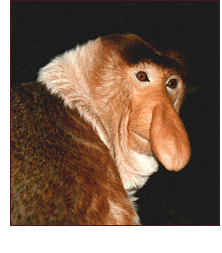
Somewhere back in 2003, in my mutual interview with Marianne Shaneen, I addressed my predilection for the generally-taboo-in-modernism pathetic fallacy. I wrote:
I go on to list a number of examples compiled from science textbooks by an anti-pathetic fallacy science teacher, and characterize the list as a kind of insta-“sought poem.”
Pathetic fallacies are taboo in modernism because they hearken back to primitive mind. If you identify too much with the world and with nature you cannot face it empirically. Pathetic fallacies are a kind of magical thinking (which I tend to oppose in principle, except that I like pathetic fallacies as literary devices, largely because they are taboo). The intellectual problem, I guess, is the way in which pathetic fallacies overlap with anthropomorphism, when animals and objects, instead of just being conceived of as, or fantasized as, emotive or thinking subjects, are attributed specifically with HUMAN emotions, thoughts, values.
I bring this up because last night Gary and I were watching a DVD of an episode of nature focusing on “ugly” animals, including starnose moles, naked mole rats (which, we were interested to learn, are neither moles nor rats), warthogs, monkeys and male sea lions with huge probosces, etc. I had rented it in a search for sensational imagery to use in collage movies.
I found the video disturbing: not for its images, which I really liked, but for the language that infected it. I guess that the audience for such shows is largely children, right? Well, nowhere in the video did the narrator bring up the notion that beauty and ugliness are not universal principles, and especially may not travel across species lines. Instead, the whole thing was rife with a shallow judgmentalism regarding the appearance to (some) humans of these various creatures, and was an exercise in using (inexact) synonyms for ugly: abhorrent, off-putting, disgusting, hideous, etc. Now, I don’t expect a nature show to present all the nuances of a philosophy of aesthetics, but all the same it’s hard for me to believe that the writers couldn’t at least give a NOD to acknowledging the ridiculous and biased anthropomorphism they were perpetuating. This was an opportunity to teach that instead was a shallow kind of anthro-supremacist inculcation: lousy pedagogy.
I’m still steamed up about that, but do intend to use some of the images in my next movie. The adjutant storks! The vultures! And those gorgeous proboscis monkeys! (OK, that’s a value judgment, too, but at least it’s a positive one.)
dry
Sometimes I like to eat things that are really dry.
ornament is neither functionless nor superfluous
Ross Brighton writes:
Thoughts on this:
Poetry is not functionless. It has many functions, as address, as connector, as trace, as “energy construct.” (I always liked that collocation.)
It is exactly as superfluous as everything else in the universe and perhaps as superfluous as the universe itself. That would make, conversely, everything equally essential.
Poetry is ornamental, but ornament is neither functionless nor superfluous. This is a very common misconception.
I also am biased against what is sparse and laconic, for the most part, (because it’s not my thing) as well as against the boring (although this, too, has a place in art). My point is that the type of poems that Ross is describing do not actually mirror “real speech..” Or real colloquial writing. Everyday language, colloquial language, is rich, varied, and crazy interesting, crazy poetic.
The problem with the sort of poems Ross is describing is their failure to enact that, as well as their slavish conformism to the most bland notion of what poetry can or “should” be. There is little or no invention in such poems.
Poets, be receptive.
Poets, be inventive.
Thank you.
Žižek on pleasure in pain
[writing on castrati singers being made to “cry to heaven after suffering a horrible mutilation] This is (the singing) voice at its most elementary: the embodiment of ‘surplus-enjoyment’ in the precise sense of the paradoxical ‘pleasure in pain.’ …Pain generates surplus enjoyment via the magic reversal-into-itself by means of which the very material texture of our expression of pain (the crying voice) gives rise to enjoyment….the same go[es] for love poetry and its ultimate topic: the lamentation of the poet who has lost his beloved….Poetry, the specific poetic jouissance, emerges when the very symbolic articulation of this Loss gives rise to a pleasure of its own.
Slavoj Žižek in The Plague of Fantasies, p. 58
Kevin Killian on benshi, etc.
Eartha Kitt – I Love Men – video
http://youtube.com/v/hbg5i6TI5xg
I had no idea that Eartha preceded me in using this title. OK, how much do I love this? Is it even measurable? Dig the disco groove!
Conceptualisms: theoretical puzzlement
[I’ve been asked to write a statement on the relation of my work to “conceptual writing”… and would appreciate any feedback on these thoughts…]
Even after reading the little blue book, Notes on Conceptualisms, I admit that I am not entirely sure what conceptual writing is not. I am pretty sure I know what it is, but I don’t know where exactly to draw the line that distinguishes it from what it is not.
I get that it is allegorical, but it is not allegorical in the standard way that A Pilgrim’s Progress or Paradise Lost are allegorical: these are teaching texts that ask us to become better people by reading them and comprehending their correspondences and how those correspondences relate to our lives. The new conceptual writing is allegorical in that it points outside itself to other structures it aims to critique, as opposed to structures we should obey and follow and be improved by. That critique may serve to make us more “conscious,” but that consciousness doesn’t necessarily improve us or make us virtuous. The old allegory tries to make us obedient; the new allegory is subversive, and asks us to be disobedient. Maybe, given the contemporary social frame, disobedience is the new virtue?
There are also so many practices listed in the little blue book (hence, plural conceptualisms) – “appropriation, piracy, flarf, identity theft, sampling, constraint” – all of which I gleefully subscribe to – that the term could almost spread out to cover just about all the writing I do and that I pay attention to. Considered VERY broadly, all writing, even historically, is all of the things in the list above, with the exception of flarf (a narrower and more culturally specific term): we simply cannot use language without appropriating, pirating, stealing identity, sampling, or constraining. Can we?
Thus, in my state of theoretical puzzlement, I can only say: When I write conceptual poetry I don’t set out to write “conceptual poetry.” When I “appropriate,” I can compare it to wandering in a field and seeing, oh, lupine, and Queen Anne’s lace, and mariposa lilies, and wild irises, and because they are beautiful (and grotesque, like all flowers) they compel me and I take them and arrange them, even though it may not be legal to do so. Flowers are nature’s readymades. Or maybe “appropriation” is like wandering in my neighborhood in Brooklyn (admittedly looking for poetry) and seeing a giant sign over a Russian nightclub that reads “EUPHORIA.” The “conceptual” mindset, then, is about looking and noticing: as Place points out (writing of the image as reference), “like any good art, it teaches you to linger.” Not just, I think, to linger: to somehow penetrate what is noticed until it penetrates you. There’s a kind of interinanimating ecstasy (Donne) in this.
I do not privilege obviously appropriated writing over a more Romantic interiorly generated writing (although the latter, as I mention earlier, is in a sense also appropriated): in fact, the sort of writing that most intrigues me most is that which (I have written elsewhere) performs a kind of pavan between these two modes, because that is how I experience the world, as input and output gracefully and/or shockingly affecting each other. I want to lay bare this affect to myself and to anyone who takes the time to read what I write. I’m very much with Place when she writes, “If there is superior art, it lies in the ability of any image – real or abstract, written or pictorial – to dropkick, lick, tickle and torture, to render its reader absolutely sensate.” [italics mine] Thus, the “purely” appropriated writing I do is absolutely subject to my authorial manipulation and editing in the service of that sensation.
…………………………..
Coda: Wondering… given the definition (or lack of definition) above… is the following poem (which I wrote when I was eleven or twelve) “conceptual”?
3.95
a number
a poem in itself
a mathematical complicational digital3 figure.or
Love – Beauty – Virtue – And other corny junk
or
Chinese Noodles and fried asparagus noses
or
BLEEP
but all it really is
is
3.95
 Otohime