that the New York Times this morning, instead of having “New York TImes” at the top of the front page, had “THROWS WHITE SPACE AWAY”
(take it, Lynn)

that the New York Times this morning, instead of having “New York TImes” at the top of the front page, had “THROWS WHITE SPACE AWAY”
(take it, Lynn)
I went to the MoMA today to look at pictures by James Ensor. I had always loved his paintings of masks I’d seen in art history books, but I had no idea just how revolutionary an artist he was. The real revelation to me was his drawings: layered, intricate things that combine various styles of drawing (along a continuum from real to surreal) and disparate subjects on one plane, like exquisitely hand-rendered collages. One of my favorite drawings was this one:
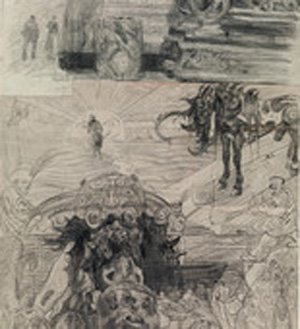
I realize it’s almost impossible to get a sense from this poor-quality image of what the drawing is like, but you can see how the dark fabulous monsters contrast with the more peaceful everyday images done in fainter lines. The drawing is quite small, maybe, I don’t know, 5″ by 3″, so I had to get up very close to see it, and I almost fell in.
The mask paintings were more luscious, weird, and compelling even than I had imagined, very large and brilliantly colored and confrontational. I loved how in some of them the entire space of the canvas was crowded with images of false faces, interspersed with some ‘real’ ones.
Ensor loved crowds, and this strikes me as wonderfully Baudelairean. He had amazing patience in drawing them, and extraordinary imagination as well in making each figure in the crowd stranger than the next.
Plus, oh, did you know? He often depicted himself as a crossdresser! One self-portrait shows him in a perfectly feminine & ridiculous flowered hat.
Satire! Carnival! Ensor! Rescued by these images today from oh the bitterest and broodiest mood…
Lynn Behrendt appreciates Flarf the way it SHOULD be appreciated:

in vain for an image of Madhubala sweating… and instead found this:
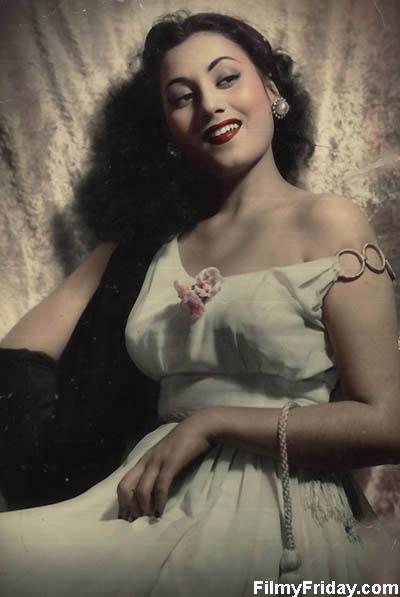
utter, complete beauty!
the punctum, by the way, of the image I now have in the header box above, is the chinese takeout menu that has been slipped under the door
http://youtube.com/v/LRm3B4T5SkU
and of course that makes me think of this

a cross-section of the closet
.flickr-photo { border: solid 2px #000000; }.flickr-yourcomment { }.flickr-frame { text-align: left; padding: 3px; }.flickr-caption { font-size: 0.8em; margin-top: 0px; }
Or it could be 1978. I think I was fifteen. I had spraypainted my boots and jacket silver, and I’m not sure, but I think I used some horrible-smelling silver hairspray meant for old ladies as well. It was all very toxic. The boots have kitten heels, but you can’t see them here. Please note the cowboy hat, sling stud belt, check taffeta vintage skirt, cigarette.
Photo taken outside of 330 Grove St., an old S.F. punk venue. The Dils played, but I don’t remember who else: maybe DOA? I also don’t remember the kind photographer.

Gary and I have a big TV, but it gets no reception, and is basically just a 42″ screen for watching groovy DVDs from around the world. Pretty much the only time, then, that I ever watch anything like a TV show (aside from the Project Runway seasons G. and I both watch religiously on DVD or YouTube) is when I am in a hotel or when I fly Jet Blue. Jet Blue seems always to have a channel that plays continuous episodes of What Not to Wear, and when I am not flipping back to check out Animal Planet this is what I watch on board the flight.
It’s always a very emotional process for their victims to be stripped of their wardrobes and made to refashion themselves according to Stacy and Clinton’s rules. Exposed in front of everyone, they are shown confronting their deepest complexes and body issues (or “figure faults,” in 50s parlance) and told how to “conquer” or “hide” them.
By the end, each victim testifies to having undergone a kind of religious conversion or personal rebirth. They often do look genuinely better, happier, even healthier, when Stacy and Clinton get done with them. But still, there is something about the show that I find really profoundly disturbing: its primary aim seems not to help people become more like themselves, but to normalize them into a kind of shiny corporate appropriateness.
Stacy and Clinton hate anything “quirky” or “bohemian.” If they had it their way, every woman would be clad in form-neutralizing black pants and a cute-but-dignified empire-waisted blouse, and maybe a “fabulous” pair of kitten heels that look as blandly designer-y as they must be excruciating. Everyone at the end of the show ends up looking sort of like a mannequin from Express. The hosts might make the victims look more “attractive,” but invariably at the expense of their uniqueness. It isn’t just that they lose their pathos, because in a way that is just transformed. What they really seem to lose, if I can get away with saying this, is their essence.
I looked around on YouTube for the opening sequence of What Not to Wear, but couldn’t find it. Maybe you know it? The two hosts, Stacy and Clinton, are shown walking around New York City instantly changing people’s outfits from donts to dos like a couple of interventionist fairy godmothers.
One of the transformations I find personally offensive: a beautiful woman with long frizzy hair wearing a Palestinian or Bedouin dress is transformed into an “office lady” with a cute little 40’s blouse and frizz straightened into middle-class acceptability. Isn’t this indicative of a kind of ethnic self-loathing? At least on the part of Stacy, who, come on, has got to be a Jewish girl from Long Island, right? Or on the part of the executive producers, five of whom have fairly obviously Jewish names? Or if not self-loathing, doesn’t it show a more general bias against “ethnicity”? As I mentioned, I couldn’t find the sequence, but here’s me doing the “before” persona (pictures of me with my hair straightened, yes, I do have some, are so odiously bourgeois-looking that I will indulge in some rare self-censorship for once):

I mean, OK, I probably couldn’t walk into an office dressed like this, especially with the fake Bedouin facial tattoos, but so? Stacy & Clinton, wanna make something of it? Go ahead, STRAIGHTEN MY HAIR, I dare you.
p.s. ok SHRIEK, fuck the self-censorship, here’s, EEK, a straightened hair picture, with Brenda Iijima on our mutual birthday party I don’t know maybe four years ago? Five? Horrible! (Brenda looks fine.)

.flickr-photo { border: solid 2px #000000; }.flickr-yourcomment { }.flickr-frame { text-align: left; padding: 3px; }.flickr-caption { font-size: 0.8em; margin-top: 0px; }
OK people, you have got to check out David Highsmith’s nostalgia photos on flickr.


 Otohime