What Not (not) to Wear

Gary and I have a big TV, but it gets no reception, and is basically just a 42″ screen for watching groovy DVDs from around the world. Pretty much the only time, then, that I ever watch anything like a TV show (aside from the Project Runway seasons G. and I both watch religiously on DVD or YouTube) is when I am in a hotel or when I fly Jet Blue. Jet Blue seems always to have a channel that plays continuous episodes of What Not to Wear, and when I am not flipping back to check out Animal Planet this is what I watch on board the flight.

It’s always a very emotional process for their victims to be stripped of their wardrobes and made to refashion themselves according to Stacy and Clinton’s rules. Exposed in front of everyone, they are shown confronting their deepest complexes and body issues (or “figure faults,” in 50s parlance) and told how to “conquer” or “hide” them.

By the end, each victim testifies to having undergone a kind of religious conversion or personal rebirth. They often do look genuinely better, happier, even healthier, when Stacy and Clinton get done with them. But still, there is something about the show that I find really profoundly disturbing: its primary aim seems not to help people become more like themselves, but to normalize them into a kind of shiny corporate appropriateness.

Stacy and Clinton hate anything “quirky” or “bohemian.” If they had it their way, every woman would be clad in form-neutralizing black pants and a cute-but-dignified empire-waisted blouse, and maybe a “fabulous” pair of kitten heels that look as blandly designer-y as they must be excruciating. Everyone at the end of the show ends up looking sort of like a mannequin from Express. The hosts might make the victims look more “attractive,” but invariably at the expense of their uniqueness. It isn’t just that they lose their pathos, because in a way that is just transformed. What they really seem to lose, if I can get away with saying this, is their essence.

I looked around on YouTube for the opening sequence of What Not to Wear, but couldn’t find it. Maybe you know it? The two hosts, Stacy and Clinton, are shown walking around New York City instantly changing people’s outfits from donts to dos like a couple of interventionist fairy godmothers.

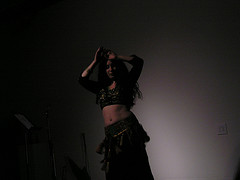
One of the transformations I find personally offensive: a beautiful woman with long frizzy hair wearing a Palestinian or Bedouin dress is transformed into an “office lady” with a cute little 40’s blouse and frizz straightened into middle-class acceptability. Isn’t this indicative of a kind of ethnic self-loathing? At least on the part of Stacy, who, come on, has got to be a Jewish girl from Long Island, right? Or on the part of the executive producers, five of whom have fairly obviously Jewish names? Or if not self-loathing, doesn’t it show a more general bias against “ethnicity”? As I mentioned, I couldn’t find the sequence, but here’s me doing the “before” persona (pictures of me with my hair straightened, yes, I do have some, are so odiously bourgeois-looking that I will indulge in some rare self-censorship for once):

I mean, OK, I probably couldn’t walk into an office dressed like this, especially with the fake Bedouin facial tattoos, but so? Stacy & Clinton, wanna make something of it? Go ahead, STRAIGHTEN MY HAIR, I dare you.

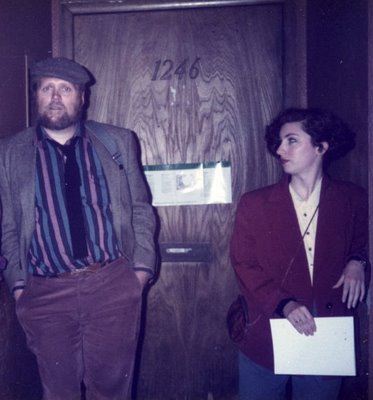
p.s. ok SHRIEK, fuck the self-censorship, here’s, EEK, a straightened hair picture, with Brenda Iijima on our mutual birthday party I don’t know maybe four years ago? Five? Horrible! (Brenda looks fine.)

IMG_1263

On Interests

William Keckler appears to have liked my new chapbook, Interests. Thank you, William: I’m glad you enjoyed it!

He writes:

The poems in Interests seem to consist of lists of interests (insert a “Duh!” of whatever coloration you choose here) which compose portraits of some disparate individuals.

Of course, there is a possibility these are all one person’s lists, but then this person would most likely be afflicted with multiple personality disorder, since the personalities tend to be distinct, if not always altogether consistent in their interests. But then who is?

One wonders whether the poet asked friends to list their interests and she worked from that, or whether she just did these “shorthand portraits” of friends, acquaintances or strangers (or the lesser-known kook, oddball or perceived enemy or frenemy which drew her attention or ire).

Some of these are rather bilious portraits and a few are clearly poison-pen works of The School of SmartAssitude. Gordon, like her partner Gary Sullivan, is a natural literary satirist. When seen in this light, the title Interests takes on a different shading, and would seem to encourage an interpretation along the (critical) lines of “vested interests”. But, mercifully, the book doesn’t skew overmuch in that tiresome direction.

Here’s how I wrote the book, actually: Have you ever noticed that if you list your interests on your blogger profile, your interests become links? If you click on the links, you can find other bloggers who have listed the same interests on their profiles. The first page of my chapbook is my list of interests. Every other page is a purloined list from someone who was automatically linked to me. I did choose from the lists, selecting those that were most prosodic and quirky, and I did edit the lists internally a tiny bit.

It’s very much a conceptual work, I think, but it’s interesting that it comes off as so New-York-School-y, as, yes, it functions as a collection of list poems.

Here’s what I realized reading other people’s lists: we are so much defined by our enthusiasms. In a way, we are what we like.

Also, of course, enthusiasm is contagious. There is a great deal of joie de vivre in the lists, isn’t there?

I should add that something that William thought was deliberate (“When she places “the world” all by itself on one page, we know as readers she’s doing this to break up the monotony of poetic forms which are too repetitive.”) was actually not. The list just spilled over to the next page in layout.

The alphabetical ordering, which WK saw as potentially tiresome if it had been consistent throughout the lists, only depended on whether the original bloggers had alphabetized their lists or not.

It was more or less “insta-poetry.”

I thank all the bloggers who (willy-nilly) contributed to my book. And again I thank Andrew Lundwall, who made such a cool cover for it. Thank you! Thank you!

on the inevitability of style


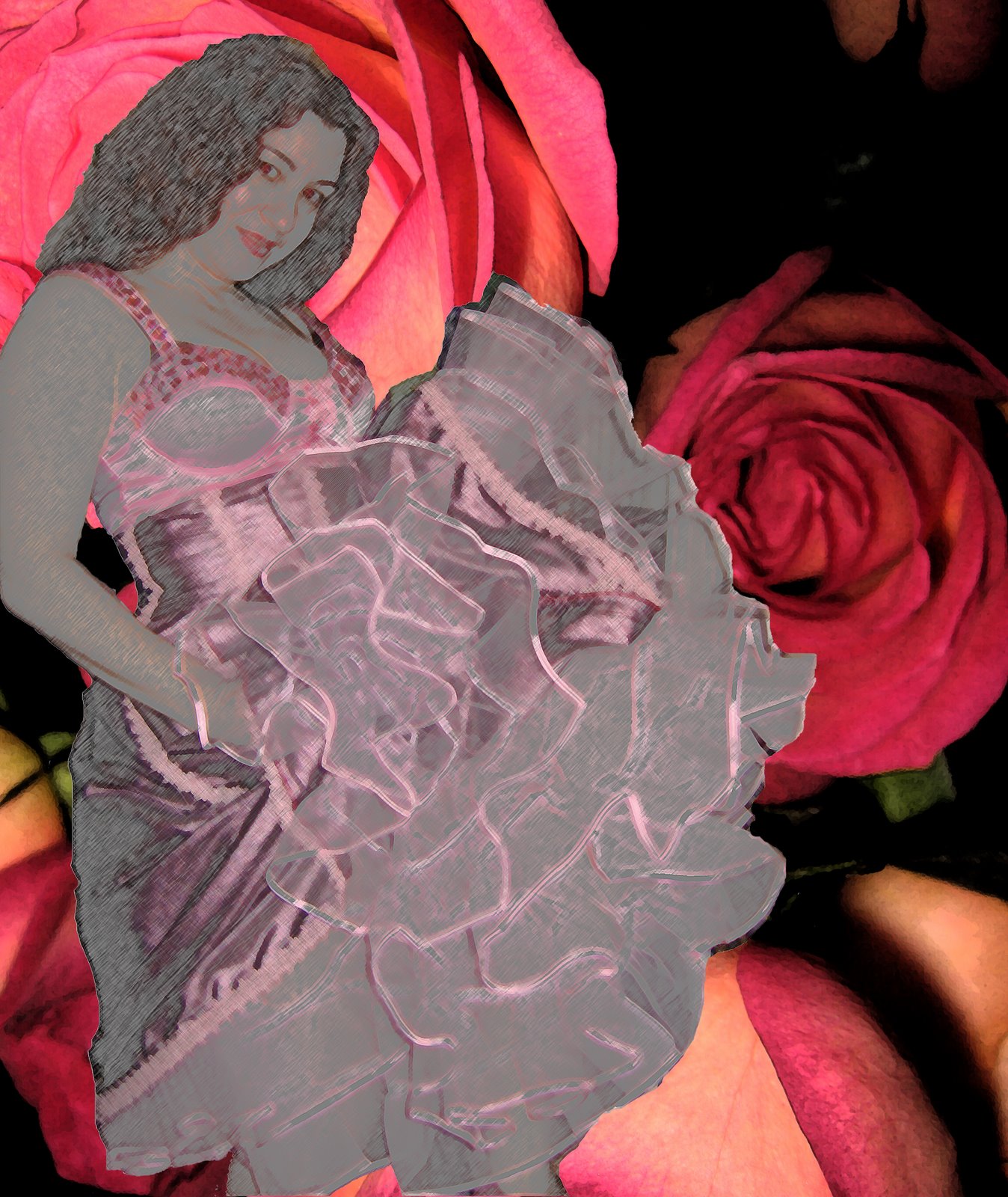
(a masterpiece in layered tulle by Vivienne Westwood)

Laura Moriarty has posted on A Tonalist Notes on fashion, and jeans in particular, in response to Brandon Brown having earlier brought up (and abandoned) the topic on HI!. A jolly comment stream ensued traversing the signifying powers of types of jeans, fashion puncta, the rule of “one thing out of whack,” fashion and money (especially as hip-hop appropriation of rich white old-money fashion code), and the superiority of skirts to jeans (my contribution).

Laura then asked me for some input on her “planned post on foof or hyper-girlie attire,” and also to address such matters as “costume” and “questions of overdressing — ultra femme or otherwise,” particularly in the context of the world of poets.

This is such a huge juicy lure for me that I hardly know where to begin, except by pointing out what we all already know (right?): that it’s all costume. It’s costume even when it’s conformity or camouflage, in the same way that any construction of language, because it is a construction that involves a conscious decision, is a kind of artifice.

In order to live in the world among other human beings, assuming that we are neither mute, nor illiterate, nor nudists, we need language, and we need clothing. These are two of the most basic social needs: the other arts, although they may feel necessary to us, do not qualify as social needs in quite the same way (although this is arguable… OK, maybe cooking could qualify, too, or architecture, or, OK, lovemaking, for that matter… looks like my thesis is breaking down here. Anyway.). (Anyway.) To me, this gives poetry and fashion a certain kinship: we have no choice but to get dressed and to communicate, but we can make astonishing choices about HOW to dress and HOW to communicate, and that, my friends, is what we call style.

I perform “in costume” (overtly) not just because I love to but because by doing so I am signifying to the audience that I have considered the nuances of my art and its presentation… and also, of course, to be entertaining:

photo by Stephanie Young

Nada & Natsue

Other poets who do this might include Douglas Rothschild, Brendan Lorber, and to some extent Kim Rosenfield, although she may be more in the category of fashion flair, such as we see in Anne Waldman or Adeena Karasick, both of whom invariably look striking and glamorous but not so much “costumed.” I might say the same, Laura, of you, although your choices are more distinctly whimsical than theirs, I think.

Douglas
Douglas Rothschild

Adeena
Adeena Karasick, in a true costume for my 1995 Text/Styles event

I can’t think of any other woman poets besides myself who tend to make their readings into occasions for a masquerade. I’d love to know if you come up with any, or any men, too, for that matter. Gary, trying to help me brainstorm some, pointed to his own drab t-shirt and jeans and said, “I guess most of us are doing what we accuse mainstream poets of doing, with this deliberate ‘neutrality.'” “Exactly my point,” I said.

Chris Cheek, Julian Brolaski , C.A. Conrad, and Tim Peterson all make strong and beautiful assertions about gender in their sartorial choices, but that is not the same thing as being “in costume.”

IMG_1520.JPG
Chris Cheek

IMG_4379
Julian Brolaski

IMG_3050.JPG
C.A. Conrad

Tim Peterson
Tim Peterson (Trace)

My own predilection for costume started about as early as I can remember, and was only ossified by growing up among hippies and Cockettes.Punk, of course, was costuming, too. My early teen years were spent in the thrift stores of Oakland and Marin, piling up stocks of jewel-toned mohair sweaters, novelty print skirts, cowboy boots, 40s dresses, and the like. The costume thing was further nourished in the Harajuku groove of Tokyo, I guess, until I almost didn’t notice all that beautiful outrageousness: the artificiality just seemed so natural. I remember one day, my friend Jimmy from SF was visiting me there, and a tall girl walked by in thigh-high white patent boots and an electric blue Louise-Brooks-style bobbed wig, and I just took it for granted until he said, “Did you see her?”

I guess it’s pretty clear that I’ll take overdressing (I’m MAD for PETTICOATS) over underdressing any day, although I’m not immune to the beauty of a minimalist outfit with ONE AMAZING ACCESSORY… I’m thinking a simple black tank top and a-line jersey skirt and arms LADEN WITH BANGLES, for example. I also adore combinations that very obviously oversignify contradictions, especially gender contradictions, such as (this is very San Francisco, I think, and very early 90s) Doc Martens with full or lacy skirts, or makeup and long hair on men, especially straight men.

I’m not entirely sure how I survived the 80s language poet scene given that minimalism and neutrality were pretty much the order of the fashion day. There is a funny picture you took of me then, Laura, that shows me trying to sort of fit in, with that awful 80s bob, a (ugh) button-down white cotton shirt, and a 40s suit jacket about a thousand sizes too big. That was a very difficult fashion period for me and I’m grateful to have passed through it. (It occurs to me, though, that Ron looks very dapper here, indeed!)

photo by Laura Moriarty

Laura, where was that talk you gave in NY published, the one where you mention the uncomfortable feeling of your lingerie? Wasn’t that in Jimmy and Lucy’s? And weren’t you kind of given a hard time for that? Am I misremembering? I do remember feeling incredibly grateful for that, and also for Harryette’s Trimmings, thinking, OK, someone has finally started to address dresses, and dressing, thank goddesses.

Here’s today’s outfit. I made the skirt, out of a heavy slub-weave traditional cotton print I bought last year in Tokyo, with a contrast hem in grayed-grape linen, set off by burgundy grosgrain ribbon. It’s an interesting pattern as it’s both gathered and pleasted, which gives it simultaneous fullness and control of volume. The challenge is how to do the same in poetry!

IMG_5214
photo by Gary Sullivan

I am So Gory (Greeny) Today

I am So Gory (Greeny) Today

My emotions in tremble, an enzyme in my tail
Whenever this love had been closed in a book of deceptive flashes,
Separated by three seconds of darkness in an invertebrate melodrama,
Just as rainbow that comes in a bad time for the females crawling down the grass,
Even though it’s pleases the male displays of antlers and feathers for the eye to see,
Truly, i am so gory (greeny) today, glowing like an adult,
Where am i gonna save my day from the gifts that form coils in a male’s abdomen?
If my gullible legs aren’t support me,
And my pulsing hands always say no or yes to nuptial gifts,
I hope Thy less conspicuous flashes for a cry of mine
(conspicuous flashes have bigger gifts),
So my life can go through a extra fog of cheap light and coiled forms,
Like sticky traps equipped with lights that mimic courtship duets
(although if making light is so cheap for males, it seems odd that they have not
all evolved to be more attractive to females) (I think the reason is ideological),
And round up in a dream to the slowly starving blue female’s
Flickering orange rain of bad-tasting chemicals.

a big commotion

Yesterday may 24, 2004 I had said that I don’t think that I want to be in double duch practice any more because of Lashawn is always minding someone’s business. SO Jennifer Bostic went Back & told laShawn what I said and know she don’t like me. So when we were in the locker Room laShawn was looking at me like oh I want to fight you. So then Tiara Simmons came by and she bumped me so I hit her Back and that was when she pushed me into …and she hit me so I hit her back and walked out of the locker Room. The … told her to slap me in my face so she came out and hit me so I hit her back and Fred Perry hit me & said don’t touch her. And it was just a big commotion.