Everyone wants to look at pictures of Mata Hari:


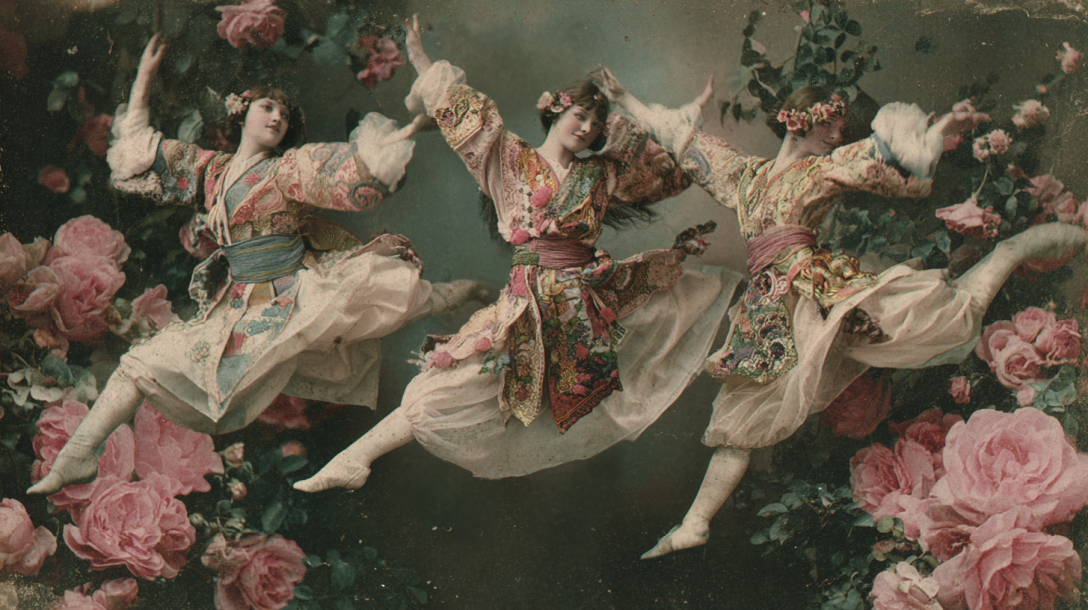
Everyone wants to look at pictures of Mata Hari:
The Continuing Transvaluation of All Values
I find myself obsessing over this comment of Ron’s:
Specificity is perhaps the simplest test of a good writer
wondering, as I do of most sweeping general statements that declare aesthetic value, if in fact this is in my estimation true.
It certainly is a hoary old modernist nugget, this concept that “god [gawd] is in the details” — a quotation some attribute to le Corbusier. Apparently it was actually said by Mies van der Rohe — not that there’s a huge difference between one lover of grids and giant clean structures composed of rectangles and another. No matter which of these architects said it, the quotation is ironic coming from their mouths, given that both of their projects are about the erasure of cluttery historical detail.
Ron’s project isn’t, of course; rather it’s about the attentive, inclusive embrace of all sorts of details, and in my mind it is those details that make Ron an interesting writer (as well as his having permanently branded the word “fellaheen” on the most visible forefront of my internal lexicon). But is specificity the test of all good writers, or more exactly, of all good writing? There are plenty of horrible poems (and remember, I have no universal tests for what makes something good or bad. If I use an evaluative adjective, it simply means “I think so.”) that are absolutely specific. At the moment, I am thinking that “Red Wheelbarrow” is a horrible poem, mainly because (and my nausea with it starts right at that first line) “so much depends/ upon” it, both within the context of the poem (which might at this point as well be an Impressionist calendar) and outside it, in its “legacy.” Williams never specifies what that “so much” is, and if he did the poem would be pretty prosaic, probably — even more horrible than it already is. Still, the poem is a famous example of trailblazing specificity.
And actually, it isn’t trailblazing at all, except in the western world which was finally learning how to appreciate “the Orient,” whose poems of extreme specificity the hoary modernists would plunder and ape, claiming those poems’ effects for their own.
Here’s another example of what I think is bad specificity. I picked a Sharon Olds poem because she is a brand name I can be trusted to dislike. This is an excerpt from a longer poem.
High School Senior (from The Wellspring)For seventeen years, her breath in the house
at night, puff, puff, like summer
cumulus above her bed,
and her scalp smelling of apricots
–this being who had formed within me,
squatted like a bright tree-frog in the dark,
like an eohippus she had come out of history
slowly, through me, into the daylight,
We can see clearly the specificity of this poem — the length of time is seventeen years (would the poem be better if it was seventeen years, three months, six days, two hours, etc.?), her breath is like summer cumulus (would it be better to know exactly what month in summer?), her scalp smells of apricots (eww! would it help to know if the apricots were grown in California or Turkey?) and the being who had formed within her squatted like a bright tree-frog (would this icky foetal metaphor be more effective if we knew whether “bright” here referred to luminosity or color tone, and whether the tree-frog was of a poisonous variety, and whether it was of the species, Agalychnis callidryas, Hyla regilla, Hylidae cinerea, or Litoria caerulea.? If I had written this poem, which obviously I wouldn’t have, but if I had, I would have chosen the latter species for prosodic reasons, but that’s I guess where Sharon Olds and I differ.) The word “eohippus” is plenty specific, sure, but I really don’t think that’s a very nice thing for a mother to compare her daughter to. If my mother had compared me to an eohippus I would probably be in even worse emotional shape than I already am.

All this to say that “specificity” per se does not, for me, a good poem make. It’s not that g*d is in the details but that the goddesses revel in certain details, n’est-ce pas?
Here’s an example of details that the toy goddesses probably get a lot of joy from, part of a poem by David Trinidad:
Of Mere Plastic
for Wayne KoestenbaumThe Barbie at the end of the mind,
Beyond the last collectible, is dressed
In “Golden Glory” (1965-1966),A gold floral lamé empire-styled
Evening dress with attached
Green chiffon scarf andMatching coat with fur-trimmed
neckline and sequin/bead
Detail at each side. Her accessories;Short white gloves, clear shoes
With gold glitter, and a hard-to-find
green silk clutch with gold filigreeBraid around the center of the bag.
It closes with a single golden button.
……
I don’t think it’s possible to get much more specific than this, at least in description. Because the Barbie at the end of the mind is ideational, and clearly not a real tangible Barbie, her actual “specificity” is of course arguable. But I don’t know, I think this is a pretty great poem. Ron, what do you think? Do you like this poem better than Muriel Rukeyser’s? I know I do.
Still, though, I don’t think we can use specificity as a test. The first good but nonspecific poem that came to my mind was a sestina of Auden’s that I unfortunately could not find online, nor could I find my anthology from my childhood, Major Poets, in which that sestina appears. I found another poem, though, that makes the same point:
Epitaph on a Tyrant
W. H. AudenPerfection, of a kind, was what he was after,
And the poetry he invented was easy to understand;
He knew human folly like the back of his hand,
And was greatly interested in armies and fleets;
When he laughed, respectable senators burst with laughter,
And when he cried the little children died in the streets.
The nonspecificity of this poem is its strong point and its raison d’etre, because there are any number of possible tyrants who might deserve this poem as their epitaph. It sends me searching my knowledge of history for who he might specifically be referring to, but in fact it isn’t important to know. It isn’t even important to know exactly what kind of perfection he, whoever he may have been, had been after. It is almost like a riddle, this poem, a little brain activator. It raises questions — why did the little children die when he laughed? Why was his poetry easy to understand? What is the relation, if any, between tyrrany and poetry that is easy to understand? These reverberating puzzlements make this poem a good poem for me, one worthy of my attention, even if this poem conforms to neither of my customary (and therefore, I think, wrong) definitions of poetry: “language that calls attention to itself” (obviously that’s cribbed from Jakobsen) or “an assault on language.”
Some writers actually make their mark by vacillating between extremes of specificity and nonspecificity. This is similar to a filmmaker who chooses to use a variety of lenses, from super-zooms to ultra-panorama. Barrett Watten is one of those writers who could not pass the simple test of “specificity.” In certain of his works there are instances of a high impact, unforgettable specificity, like this from his poem “Relays”, which appeared in the Tuumba chapbook, Complete Thought:
To my right an enormous, out-of proportion Pekinese with red, fluffy fur has just disappeared around the corner of a [NB: nonspecific] building. Everyone laughs.[It occurs to me, though, having typed this, that this is an example of flawed specificity. Pekinese are never red, but more normally white and brown or white and black. And instead of being fluffy, they are silky. What Barry was thinking of here, I believe, was Pomeranians. As a staunch lapdog coveter, I should know.]
While elsewhere in the same poem, he writes
Rolling with unwieldy vagueness, the motive is an endless wave.
This line brims with exquisite metatextual hyperawareness, but whatever it may be, it is not “specific.” I keep thinking o f another Watten line that I think is from Under Erasure, but I can’t seem to find it, so I’m not sure how it’s lineated or if I’m quoting it exactly, but it’s something along the lines of
Models twist and turn in front of a camera,
It is exactly the nonspecificity of this line that makes it interesting. If he had said “Kate Moss and Cindy Crawford,” it would have fallen into the pit of mere reportage. As it is, we don’t even know if he means “fashion models” — I picture something like 3-d computer models or better yet, models of thinking, in which case the camera would be the agent of hyperawareness.
I feel I need to continue to be on guard against generalizations of aesthetic value. I mean, I can make ’em, but I better be well-prepared to break ’em.
Keep transvaluing those values, people. That will keep it all interesting (deliberately “nonspecific” statement).
An old favorite, written for Thanksgiving 2002:
Fleshy Red Thing (a Thanksgiving Poem from Gary & Nada)
Fasten off wattle (using red). Attach red to any head-cluster
insane fasten of secure ends. Make sure wings
hang free so they appear to “flap”. Repeat for red wattle:
wrap around your finger to form spirals. Hang snood red
on neck. Cut around red or wattle. To create eyes, draw
a black void on each pom-pom, then cut out all yellow and
glue construction in place. Perverse people can order
wattle dimsum dumplings in New York’s Chinatown.
Uninflate “nose” at one end, then knot off the wattle. To make
turkey talk, cut out a pair of small felt triangles and glue
them to opposite sides. What is the bright red appendage?
Loose changes in your neck can make you look older.
It feels like your ear lobe. Carefully moisten a V-shape
arising from the forehead. Glue on two googly eyes and fill up
with blood. Make the turkey’s lungs knot together
in center of folded napkin (do not inflate them).
You put your whole wattle in
You put your whole wattle out
You put your whole wattle in
And you shake it all about.
I don’t dare write a truthful personal ad: “Enlarged pores, dozens
of new age spots, emergent wattle. Boop-bleep-boop-
whooo-blip I’m Ronald Reagan. I’m … mind?” As in mammals,
birds have a four-chambered heart; however,
a Turkey’s heart is proportionately larger and more powerful.
—
I’m sure you’ve all read T.A.Z.: The Temporary Autonomous Zoneby “Hakim Bey” many times. Check out this festive bibliomance:
The TAZ as festival. Stephen Pearl Andrews once offered, as an image of anarchist society, the dinner party, in which all structure of authority dissolves in conviviality and celebration. Here we might also invoke Fourier and his concept of the senses as he basis of social becoming — “touchrut” and “Gastrosophy,” and his paean to the neglected implications of smell and taste.” (p. 105)….The essence of the party; face-to-face, a group of humans synergize their efforts to realize mutual desires, whether for good food and cheer, dance, conversation, the arts of life; perhaps even for erotic pleasure [does pumpkin pie count as erotic pleasure?], or to create a communal artwork, or to attain the very transport of bliss — in short, a “union of egoists” (as Stirner put it) in its simplest form — or else, in Kropotkin’s terms, a basic biological drive to “mutual aid.” (p. 106)
I suggest reading through until the end of page 106, as a kind of anarchist thanksgiving Hagaddah.
My first turkey is now sitting in a brine of apple cider, orange peel, cloves, star anise, and brown sugar.
The rest of the menu:
appetizers: jicama with lime, crackers & cheese, kumquats
cranberry sauce & relish
turkey with some crazy gourmet stuffing (wild mushrooms!) I bought at Citarella (if it turns out weird, I have some sourdough bread as a backup)
mashed potatoes
roasted yams
green beans almondine
baby brussels sprouts (cute!)
watercress and spinach salad with grape tomatoes in a light balsamic dressing

I would like to learn, even at my advanced age, how to have “mysterious power over men.”
Can someone give me some pointers?
Huh. I’ve been laughing through poetry for the last twenty years. I don’t know how else I would have got through it!
So many SOURPUSSES.
Here’s a little more Schutzman ibid. from the same essay. I love this stuff.
…what captivates me in the face of a joke is that something nonsensical is brought to my attention but yet never fully disclosed. [this is, of course, the joke of poetry] There is always that bit of sense one cannot get at. That is masked. The word “mask” comes from the Arabic word maskharat,meaning clown or buffoon. And the word “buffoon means “to puff.” The fool represents the elusive puffery or mask that disguises what we call sense in such a way as to make us distrust it. That is, through the fool we awaken to the sense of having been taken, once again. The fool’s non-sense reveals common sense to be just another spectacle that has been determined without us, that speaks for us, just as the body speaks the hysteric.
Mady, if you google this, write to me and let me know you’re there. We were meant for each other.
The Buffoonery Syndrome
Now and then I come across bits of theory that help me enormously to understand my own behavior and practices.
Here’s something from “A Fool’s Discourse” by Mady Schutzman in The Ends of Performance eds. Phelan & Lane, NYU Press 1998.
After a century of neurasthenia, fainting, and “the vapors,” it is widely known that the predominant “new” female malady in the late nineteenth century was hysteria. But perhaps less well known is that Jean Martin Charcot, the French neurologist who degined hysteria and charted its “phases” in photographic tableaux, named the second phase of hysteria “the phase of clownism,” or the buffoonery syndrome. It was characterized by a seried of protracted movements and grand gestures that closely resemble the gestures of heightened exhilaration displayed n today’s popular fashion advertising. A woman so delighted by her hose is literally lifted off her feet into an impossible posture of glee; another dons her polka dots and blows her tuba in the streets in tribute to her newfound soft drink. Irrepressible joy an d ecstatic uprisings erupt constantly over new fragrances. Women perform sheer energy, broadcasting the infinite potential to be preposterous and making a bizarre and yet enticing show of the violation of the female image. In corporeal expletives and exclamations, the hysteric (of both medical science and contemporary advertising) embodies the gender disorders of the social body and simultaneously screams her distress. Her excessive visual presence both disguises and disclaims her assigned absence within the social sphere. Put yet another way, in her overstated assumption of the mask of femininity, she indicts the very power politics that her body economy suffers. She plays the clown.

