Today’s ensemble: the problem of language, locust trees, curl twists, regression

It would be better if there were other ways to have conversations besides language. Language becomes a site of confusion and aggression because we hardly know what other people are talking about. If in a blog post I say language is material, another person will understand “language” differently, and yet another will differently understand “material.” One can hardly write a love letter even without having to tiresomely unpack the numerous meanings of love. Even a grocery list given to a well-meaning friend will yield different results than one might have expected (how could I have wanted anything but PURPLE cabbage, really?). Philosophers keep examining the problem of language but always problematically, because they do it in language, so they really don’t get very far. They spend most of their arguments defining their terms, which is crucial, but unfortunately they can only define their terms in other words, so the whole project ultimately becomes absurd. In that crevice of absurdity, poetry steps in, not to save the day, but to detourne it. I wedge myself into that crevice with a kind of cheerful resignation.

Today’s outfit took off from yesterday’s: the bracelets. pigtails again. Some coral & magenta plastic bling around the neck. The top, amazingly, is by Vivienne Westwood, bought for no more than $15 at a secret place in my neighborhood that sells cut-rate designer goods. If I look a little puffy it’s from allergies. The locust trees spread pollen all over the NYC sidewalks; my throat is scratchy and eyes running. Horrible!

IMG_6350

My hairdo morphed as the day got hotter (in the 90s today). Curly-haired friends, did you know that your hair will hold a twist? This is a hairdo idea from my Black sisters. Two rubber bands and about four minutes, and presto:

IMG_6364

Gary is not fond of the pigtails, but that doesn’t bother me. They help me into a state of playful regression. How else am I going to get through my adulthood (not to mention the New York summer)? Really!

language note:

ponytail vs. pigtails

today’s ensemble: antidote

As an antidote to the brocade and kitsch formality of yesterday, today I wore purple & black gingham jeans and ponytails (what is it with the ponytails lately?). The puncta of today’s look are the candy-colored chunky bracelets on my right arm. I’m not at all sure of the meaning of the strange hand gesture I’m making here.

today's ensemble

The shoes are my second pair of FitFlops, the ones I think look “Italian.” Their comfort is almost beyond description. They make them for men, too. If you want happy feet, just buy these shoes, although they are admittedly not at the very height of fashion. No, no one paid me to mention them here.

I had to do a lot of walking today, because, like a good kid, I went to meet my mom who was transiting through JFK on her way back home from a hypnotherapists’ conference in Boston. We posed together:

IMG_6318

My mother likes to talk to people, and we got to know rather well the bartender at the airport bar we sat at: he was Chilean, with a Jewish mother, and he had recovered from colon cancer, although he now has Crohn’s Disease. He said he no longer has a large intestine, and that he’s had to wear a bag for the past eleven years. He was in his early thirties, and looked absolutely glowing with health. I congratulate him on his pluck in the face of adversity.

Then I took the J train to the city to meet up with Gary and Stan and Tova and Leo. For some stupid reason I forgot to take a picture of them, but here are two interesting street fashion sightings for your entertainment:

(I like how her freckles coordinate with her dress:)
IMG_6344

And this one needs no comment:
IMG_6345

Today’s (actually, yesterday’s) ensembles: to the nines

A dress-up occasion yesterday: a reception to celebrate the marriage of longtime sweethearts Rick Snyder and Eleana Kim. They gave a beautiful and intimate party in the Flatiron district, so G. and I decided to put on the ritz.

IMG_6277

The theme of Gary’s tie is “heraldic lions,” and I love this because it reminds me of my late grandfather Harold’s favorite restaurant (Lyon’s, somewhere on the Bay Area penninsula), which used a similar motif, I believe. They had a smorgasbord very conducive to overeating; I remember my boyfriend-at-the-time, Anthony, ate so much there he had to step out back and throw up. Anyway, the tie was one from a lot I bought on eBay several years ago when I first took it into my brain to sew things. I wanted to make a necktie skirt. I didn’t realize a couple of things: that necktie skirts are actually hopelessly déclassé and amateurish-looking, even when they are made well, and also that they are in fact kind of difficult to make correctly. If you just sew them together at the sides with out unstuffing them they form a big unwieldy swirl. That project was a “fail” (a word Safire remarked on yesterday), but Gary got the pick of the litter in terms of the best ties from the eBay lots. The gold of the tie is of course picked to match my brocade party dress, which I am pleased to say I bought a couple of weeks ago at the Housing Works thrift store for TWENTY DOLLARS, and I just sort of happened across it, saw it in the window and drifted in. The best things come to you when you are not looking for them, clearly. The same is true of the shoes, although they were not so cheap, and they are not particularly comfortable (I have very fussy feet), but MY GOD, aren’t they gorgeous? They were half price: JUNO is the brand, and I do feel like Juno in them, really.

IMG_6307

Rick and Eleana looked ever so elegant in their reception outfits: Eleana ethereal in a simple off-white loose shift with asymmetrical side drapes, and Rick in a Mad Men suit that fit him like a dream.

IMG_6281

I asked Gary to photograph my ponytail, because I never know what I look like from the back, and then also against some graffiti because it was there.

IMG_6287

IMG_6298
Black beaded clutch purse and necklace inherited from my glamorous grandmother, Geri Goldberg. I really felt I was channeling her yesterday. She actually had a gold lamé BIB that she would wear to restaurants.

Here’s Gary in the cab home checking his iPhone and looking fluffy.

IMG_6311

p.s. here’s what I wore during the day. I thought I looked “Italian”:

Today’s ensembles: masks & kameezes

Gary wears a UniQlo t-shirt with a motif of traditional Japanese masks. A birthday present from yrs truly, along with the black 501s. Footwear by Keens: serviceable and crunchy. Foyer also painted by me, can’t you tell? Feng-shui koi poster embellished with sequins ALSO by me. Postcard with the gypsy oud player from the Paris flea market. Mini silver service a wedding gift from Laura and Rodrigo. Glass jar a wedding gift from Murat filled with roses from our wedding party (from whence the peacock feather also hails). They still smell hypnotically sweet.

IMG_6246

I wasn’t sure whether I wanted to continue the Outfit Project, honestly, but readers have spoken, and I thought my ensemble today was rather original. Lavender kameez with white embroidery and opalescent bugle beading, bought on Coney Island Avenue at one of the Pakistani shops, worn over a short full skirt of African or faux-African cotton print fabric in shades from deep grape to vivid violet. I like how the cultures are combining here for a fresh and novel effect. I would have held out for a better photo, but Gary is less patient than my tripod. I thank him anyway for his assistance on this beautiful September-like August morning. Shoes and bracelets (not visible) in gold to complement the purple.

IMG_6257

Tomorrow evening I will be attending a wedding, and if it’s not too hot, I have an AMAZING dress to wear there. Stay tuned!

Disjunction is not dead.

Disjunction is not dead. I disagree with Kenny and Anne on that point. “Things” have not suddenly cohered; language has not suddenly become a vast unitary sensical blob. It’s still all editing: of fragments. There is no whole: only continuity.

Regarding syntax, if I were to level a critique on my fellow flarfists, including, occasionally, myself, it would be that, syntactically, the poems are often made to flow rather too smoothly. I need bumps along the way to remind me that I’m interacting with stuff, material; I need to feel that tangible textuality. That is what makes the poems sublime, even when they are flarf poems, which are not supposed to be sublime although sometimes they are. Disjunction is somehow fluorescent: it represents for me, when I stumble on it in a poem, a little flashing message that things are in question, and that excites me. Too much disjunction is blinding, alienating, but without it there’s a kind of plodding from sense unit to sense unit. At the level of units though, rather than from word to word, many of the poems we write are still disjunct, in source, in gesture, and otherwise. Could that be what Anne means when she writes, “JUNCTION IS ALIVE.” Is junction just SEAMING? Is disjunction technically impossible? Isn’t collage always junctive, no matter how diverse its materials? Well, now I’m getting confused on terminology, as I always do, because even prose, this prose, insofar as it can be said to be prose, is textual, and the matter of language is puzzling me again.

To pronounce anything abstract dead, it strikes me, is to risk dogmatism. I don’t mean to be dogmatic about what I have always called disjunction, or torque, before (do I need a new term?); it could be that my affection for it is generational. I came of age as a poet at disjunction’s apex; it could be a kind of attachment like that one has for the fashions of one’s youth. But no, I think there’s something more. Judiciously employed, it releases unpredictabilities; it’s a powerful tool in our alchemical lab. I am not inclined to abandon it, and I don’t agree with these pronouncements of its demise.

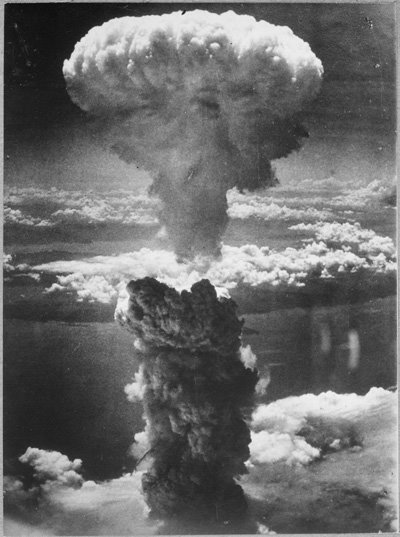
Interesting to be thinking on these things on Hiroshima Day.

Can we talk about something important for a moment?

I am a little over 45.5 years old and my eyes aren’t working properly. I need progressives. I hate wearing glasses because I am vain, but now it is time, I’m afraid, to bite the bullet. I spent at least an hour trying on every frame at my optometrist’s office, after having had a very interesting conversation with him about early punk rock. I narrowed my choices down to these three, and I would really appreciate your input. Which should I get?

This pair resembles a pair of reading glasses I bought for 99 cents and on which I have received compliments. I think that with my hair side-parted and held with a barette and these frames I would look like someone about to be put on a train to Dachau. I mean that in the best possible way; they have that 30s in Berlin kind of vibe.

Choice A:
30s

This is the pair I’m afraid I like the best, but are they just too outrageously dorky? Devo glasses. The woman who worked the front desk at the eye doctor’s said, “They’re too big for your face, but you might be able to get away with them.” To me, they say “well below 14th St.”

Choice B:
50s

And then there’s these, which seem to me like a kind of compromise between the two:

Choice C:
compromise

What do you think? A, B, or C? Or none of the above? I would really appreciate your comments.
—————-

Addendum

OK, wait, there are two other possibilities: glasses I already own.

I think these are cool: REAL vintage. But Gary says I look like an old lady in them (isn’t that sort of the point?):

Choice D:
IMG_6240

and then these, which I like, but I’m not sure they are big enough for progressive lenses:

Choice E:
IMG_6242

I know I’m awfully flushed and sweaty here, but it’s like 90 degrees in my room at the moment

Flarf: Memorable? Novel?

IMG_6229
left to right: David Wolach’s brother, Julian Brolaski’s back, David Wolach, Brenda Iijima, friend of Tracy & Julian, Erica Kaufman, E. Tracy Grinnell

Last Sunday, I gave a reading out in Bushwick with Julian Brolaski, Adam Fieled, Scott Hightower, Chris Stackhouse, and David Wolach. Adam and I had a brief, and somewhat heated conversation about Flarf and its import or lack thereof. Adam blogged today that at the reading he had his “first chance to talk in depth to a member of the Flarf Collective”; well, first of all, that was ME, Adam, you can say my name!, and secondly, I mean, depth is relative, I suppose, but it didn’t seem to me that our conversation went beyond a skimming of the topic. He says that the conversation (which lasted at most, I would say, seven to ten minutes) didn’t change his mind, but honestly, that wasn’t my intent. I don’t fancy getting rhetorical about things that people have already made up their minds about without a prolonged investigation. It’s not really worth my energy, and besides, it isn’t up to me to make people try to like things that they are not inclined to like.

As he mentions in his post, his position on Flarf is that he doesn’t see how it can possibly be of lasting value. I told him that was not my concern at all, and that I wasn’t in poetry to get a toehold on eternity: “I do it for kicks,” I said. I also told him that I thought the term “post-avant” is ridiculous by definition; he countered by making the cogent point that “flarf “ is a ridiculous term, too, and I came back with this even more cogent point: “yes, but it’s supposed to be.” I remember saying that what gets passed on through the ages doesn’t necessarily do so because of any innate superior quality, but because of the machines or systems that move it along; otherwise, William Snodgrass wouldn’t be a name we recognize. Adam thinks that poetry is “left to later generations to determine what’s what and who matters,” but this strikes me as awfully naïve. It isn’t entire generations that do that, but a struggle between the forces of canonization (and these are complex, with factors like mentors and peer groups and lowest-common-denominators to consider) and individuals who continuously ferret out what has been wrongfully ignored. It pains me, really pains me, to think that I was able to go through college studying poetry without ever learning who MINA LOY was, or BARONESS ELSA. I had to write my thesis on Bernadette Mayer because no one seemed to really be talking about her.

Adam’s primary point of objection to Flarf is that, in his view, he does “not think [it] makes for the creation of very memorable poems.” To that I can only wonder, firstly, well, which of the high modernist poems are terribly memorable, beyond the first line or so? We can all call up a wheelbarrow, some sawhorses, some tender buttons, but beyond that, is memorability really a criterion for the continued influence of modernist poetry? Isn’t it more the GESTURE of the texts that we remember? I certainly remember many key texts of the language poets, but that could be more because I read them over and over again (“fellaheen” “Tashkent” “Relax/ Stand at Attention” “people are walrus, fuck ‘em”) than because of any inherent “memorability” of the texts themselves.

Even so, and even as an insider, my sense is that Flarf poems actually are memorable, although more perhaps because they are “bad” (In the sense of Eartha Kitt’s “I Want to be Evil”) or obnoxious or funny than because they are “good”: once you have heard titles like “Annoying Diabetic Bitch,” “Chicks Dig War,” or “Mm-Hmm” you will have a difficult time forgetting them even if you want to. They are mindworms.

Adam also made the point that he doesn’t have the sense that Flarf is doing anything new, and that he “fail[s] to see how it adds to the Duchamp paradigm (of the “ready-made”) that was put into place one-hundred years ago.” I couldn’t agree with him more. I don’t think any of us is claiming to be doing anything new, at least not with form or with conceptual gesture. We aren’t motivated by the desire to be at the cutting edge, even though we may be there by default, because everyone else is repeating the same art moves, too; we just have more fun doing it. We write this stuff because it entertains us to write it and to read it, and because it channels, releases, and reshapes energies – notably those of despair and of hilarity.

Adam writes that, “nothing is going to turn me into a novelty freak, because this kind of trend-hopping is anathema to the very slow development of real poetry history.” It strikes me that actually, despite all the media hoopla we Flarfists are enjoying recently, it is not in fact a “trend.” It’s been going on healthily for eight years now. Nor can we even speak, I think, anymore, of “real history” without betraying a very deep conservatism (to which Adam owns up in his post) and willful blindness to the necessity of allowing multiple perspectives and contexts. Maybe Adam is nostalgic for some organized world of poetry he learned about in his Norton Anthology, but it just isn’t like that anymore. In fact, it was never like that. It was all an illusion.

Strange desperate feeling today, and overworked (reading student papers). I don’t feel like taking my goddamn picture. Does that compromise the project? And if it does, so what?