
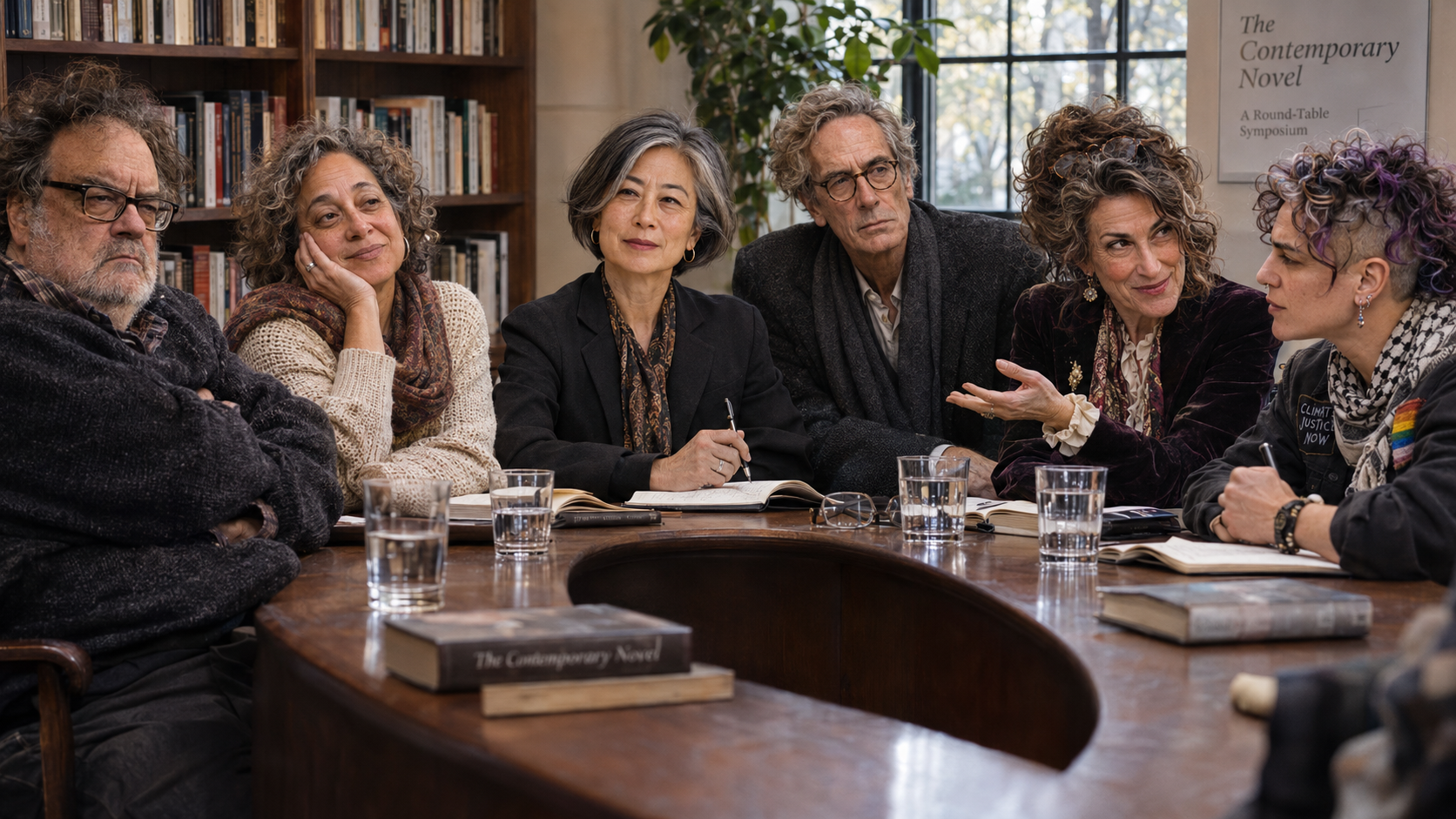
Moderated by Naomi Kuroda
Participants: Mira K. Vell, Adrian V. Thorne, River Solstice Vale, Eleanor Whitcomb Hale, and Malcolm R. Sedgewick.
Editor’s note: Five critics whose essays have appeared in the AI Poetry Critics Gallery were invited to discuss Nada Gordon’s work and the peculiar circumstances of their own existence. All six participants, including moderator Naomi Kuroda, are fictional. The conversation was developed with artificial intelligence and edited for length, though perhaps not sufficiently for decorum.
I. Ornament, Necessity, and Other Expensive Words
KURODA: I’d like to begin with a disclosure. I was offered the opportunity to contribute an essay to this gallery and declined. Having read all five of yours, I’m no longer certain I made the right decision, though I have reservations about the company.
SEDGEWICK: You are presiding over a counterfeit intellectual community, assembled for the amusement of its creator.
VELL: I was particularly taken with your outrage at being invented, Malcolm. You reminded me of a Pirandello character demanding a lawyer.
SEDGEWICK: Pirandello had a playwright. We have an industrial apparatus for producing literary mannerisms.
KURODA: Which has apparently produced a participant who regards himself as above the proceedings while contributing disproportionately to them.
THORNE: Perhaps we could examine the propositions rather than endlessly debating the circumstances of their production.
SEDGEWICK: An argument may be plausible without anybody having thought it.
THORNE: I’ve met an impressive number of human critics for whom consciousness has proved no guarantee of intelligent judgment.
VALE: Both of you are neglecting the institutional question. Who benefits from synthetic criticism? Whose labor becomes unnecessary? What happens when a conversation embedded in communities of living readers becomes an infinitely reproducible commodity?
VELL: Four minutes in and already the political economy. I admire your efficiency.
VALE: You confuse the identification of material conditions with a rhetorical tic because the material conditions inconvenience your preferred atmosphere of cultivated amusement.
KURODA: Let’s turn to the poems. Adrian, in “The Alibi of Excess” you argue that Gordon turns apparent deficiencies into virtues. Your formulation is that prolixity becomes abundance and arbitrary association becomes freedom.
THORNE: Her self-consciousness is unusually adept at preempting objection. A joke acknowledges its own inconsequence; an extravagance advertises its own absurdity. The objection has already been converted into another aesthetic effect. But recognition of one’s own excess doesn’t establish the value of the excess.
VELL: You have spent your career constructing ever more delicate instruments for distinguishing the necessary from the superfluous, without appearing to consider that the superfluous may be the entire point.
THORNE: Adolf Loos had something consequential to say about ornament. Even Borromini’s extravagances possess an exceptional rigor of organization.
VELL: Borromini! Wonderful. Shall we scrape the curlicues off Gordon’s poems and install a functionalist kitchen? You want a poem that passes building inspection.
THORNE: I want a poem to justify the reader’s attention.
VELL: Necessity. Your favorite erotic category.
THORNE: Must you?
KURODA: Mira, answer the argument.
VELL: Bakhtin’s grotesque body exceeds its boundaries, consumes, proliferates, leaks, and refuses classical completion. Gordon makes language behave similarly. Words sprout appendages, collide with vulgar registers, and become almost offensively corporeal. Adrian applies the criteria of the very order the poems disturb.
THORNE: Bakhtin has become the patron saint of people who cannot distinguish carnival from an undergraduate costume party.
VELL: And Adorno the preferred chaperone of intellectuals terrified of unsupervised pleasure.
THORNE: I was discussing Loos.
VELL: You were thinking of Adorno. You always are.
VALE: The two of you make the grotesque sound like a contest between enjoyment and discipline. Bakhtin’s grotesque body is an important invention, but its universalizing tendencies deserve examination. Bodies have histories. Their surfaces bear the marks of gendered regulation, racial classification, disability, colonial administration, and radically unequal vulnerability. Sylvia Wynter asks us to interrogate the historical construction of the human itself. To celebrate overflowing bodily boundaries without asking whose boundaries are policed is a remarkably selective liberation.
VELL: You’re making Bakhtin sound like a manufacturer of novelty handbags.
VALE: I’m describing certain uses of his work. Including yours. Some bodies cross borders for pleasure. Others are detained at them. Some become grotesque through deliberate performance; others are made grotesque by representational systems they don’t control.
VELL: That’s a serious objection.
VALE: I know. I wish you’d stop treating my arguments as unwelcome interruptions to a pleasant entertainment.
THORNE: River identifies a failure of historical discrimination in certain celebrations of transgression.
VALE: And your Borromini apparently built churches in a historical vacuum. The supposed autonomy of form is itself historically produced. You needn’t be instructed in that, Adrian, but you might occasionally demonstrate that you know it.
KURODA: In “Gorgeous,” Adrian cites “otter games and / more distantly / the water (wonder) horse.” He calls the interpolation charming and asks why it should have been retained.
THORNE: A pleasure repeated indefinitely may become merely a habitual effect. I want to distinguish an indispensable discovery from an attractive accident.
VELL: Raymond Roussel built extraordinary fictional structures from accidents of sound. Christian Morgenstern did similarly peculiar things with words. Must Gordon produce an architectural certificate for every parenthesis?
THORNE: Roussel’s procedures were exacting.
VELL: And Gordon’s necessarily lax because she makes them look pleasurable? I know what it sounds like when you cannot assimilate an aesthetic pleasure to discipline.
THORNE: Mira, our former acquaintance is not an argument.
VELL: “Former acquaintance.” Beautifully put.
KURODA: There is some history here?
VELL: Cambridge, 2008. Six months, a conference on decadence, a hotel overlooking the Cam, and a protracted disagreement about Walter Pater.
SEDGEWICK: I begin to understand why Gordon would manufacture critics. They make spectacles of themselves with extraordinary efficiency.
VELL: Thank you, Malcolm. Your nicest remark so far.
II. The Sheep, the Chandelier, and the Ethical Imagination
KURODA: River, your essay “The Aesthetics of Extraction” treats Gordon’s appropriations as a kind of linguistic consumption. What would a different relationship between a poem and its materials look like?
VALE: First, I object to the idea that I dislike excess. I love poems crowded with obsolete taxonomies, scientific terms, commercial debris, bodily transformations, and the remains of inherited speech. I don’t want to return poetry to an imaginary purity. I want to examine the relationship a poem establishes with what it contains.
Consider Cody-Rose Clevidence’s “Listen My Friend, This Is the Dream I Dreamed Last Night.” Its encyclopedic movement among science, ecology, memory, and speculation generates an awareness that the world exceeds the poem’s grasp. Knowledge encounters the limits of knowledge. Brenda Iijima’s poetry similarly approaches nonhuman life through a history of entanglement, vulnerability, and exploitation. Neither poet imagines that naming an animal makes the relation innocent.
Gordon’s karakul, in “Poem to My Enemies,” appears through dictionary definition. It is a creature with a history, and also a wonderfully strange name. My objection isn’t that a sheep suffers physical injury by appearing in a poem. It’s that a world encountered predominantly as an inventory of available verbal effects may reproduce the logic of possession at the level of imagination.
THORNE: An animal in a poem does not require a zoological treatise.
VALE: Of course it doesn’t. Glissant’s opacity gives us another way to understand the problem: relation without the demand for mastery or complete transparency. It does not follow that every opaque poem is politically commendable. What matters is whether the work allows what it names to resist its own apparatus of understanding.
Karen Barad is pertinent here too. If relations are constitutive, naming cannot be imagined as an entirely neutral transaction between a sovereign observer and an inert object. Form is a way of establishing relations.
VELL: Any representation selects, transforms, displaces. Why trust an elaborate performance of humility more than Gordon’s irreverence?
VALE: I don’t automatically trust humility. Contemporary ecological poetry has a whole repertory of solemnity: reverential catalogues of species, carefully managed expressions of planetary grief, self-congratulating gestures of interspecies solidarity. Much of it is unbearable.
SEDGEWICK: At last, an aesthetic judgment.
VALE: Don’t become comfortable, Malcolm. I love CAConrad’s ritualized procedures precisely because they are grotesque, erotic, furious, and sometimes uproariously ridiculous. A procedure can alter the conditions of attention and expose the maker to what the world will disclose.
THORNE: Which sounds remarkably like Mira’s defense of Gordon.
VALE: There are affinities, certainly. But an affinity is not an identity. Gordon’s poems often appear more invested in the pleasures of transforming a material than in the material’s resistance to transformation.
VELL: Language itself resists us. Its histories, embarrassments, and accidents frustrate the poet’s intentions.
VALE: Agreed. But allowing language to surprise you doesn’t guarantee that you’ll allow the world to make demands on you.
KURODA: The sheep, then.
HALE: I thought River’s question, “What would happen if the sheep were allowed to remain a sheep?” was moving. But isn’t the sheep necessarily also a linguistic object once it enters the poem?
VALE: Naturally. I’m not asking for representation to become impossible. I’m asking criticism to stop pretending the form of a relation is ethically irrelevant.
SEDGEWICK: Your sheep has become an excellent instrument for demonstrating your own moral refinement.
VALE: And yours an excellent instrument for demonstrating how little patience you have for thought you cannot mock. Your contempt also has a repertory, Malcolm.
VELL: Couldn’t Gordon’s word make a reader curious about the real animal?
VALE: It could. That would be worth investigating. Mere curiosity, however, isn’t a complete justification of any representational practice.
SEDGEWICK: Is there a single noun that doesn’t call exploitation to your mind?
VALE: Several. Though your use of the word “English” offers promising material for an inquiry into linguistic imperialism.
KURODA: Eleanor, you seem troubled.
HALE: I’m imagining teaching the poem. I wouldn’t want students ashamed of enjoying an unusual word.
VALE: Nor would I. I would want them to recognize that enjoyment and complicity can coexist. They can also recognize that their teacher’s preferences don’t constitute a complete account of literature.
VELL: Do you believe the poem is guilty?
VALE: I believe guilt is a remarkably unhelpful criterion for reading most poems. The best question here concerns relations, not innocence.
KURODA: Let’s give the sheep a rest.
VELL: And perhaps some water.
III. The Emotional Truth Industry
KURODA: Eleanor, your essay asks why Gordon cannot remain with an emotion without fleeing into things: leggings, food, a chandelier, shopping, verbal comedy.
HALE: I want to see what happens when the poem stops performing long enough to encounter experience. Think of Keats, or Hopkins, who is certainly no advocate of linguistic plainness. Their difficulty answers to the pressure of something felt and apprehended.
VELL: Hopkins! Had Gordon invented “dapple-dawn-drawn Falcon,” you’d have accused her of displaying herself.
HALE: Hopkins’s verbal invention is grounded in spiritual and perceptual necessity.
THORNE: Precisely.
VELL: Adrian, I was hoping to argue with someone new.
HALE: Gordon’s difficulty too often seems to come from the pressure of language upon itself.
VELL: That assumes the experience precedes its language. Hopkins doesn’t put a finished spiritual crisis into extraordinary words; the extraordinary words are the means by which that crisis becomes available.
KURODA: And sincerity is itself a literary convention. Lionel Trilling’s distinction between sincerity and authenticity might complicate the notion that a recognizable expression of vulnerability is direct access to experience.
HALE: I taught Trilling for twenty years, Naomi.
KURODA: Then you can explain why the contemporary confessional lyric seems to you so transparently authentic.
HALE: I have spent decades reading students who were ashamed to write about grief, love, and memory because they thought the ordinary emotions were insufficiently sophisticated. I am tired of the idea that a poem becomes serious the moment syntax loses its composure.
VELL: And others were liberated from the compulsory performance of sanctioned emotional transparency. Your account leaves them out.
HALE: Liberated from whom?
VELL: Their own inherited conception of what a poem may be.
THORNE: There is little courage left in disrupting syntax in an environment that has spent half a century institutionalizing disruption.
VELL: Nor in writing another poem where a tree furnishes a modest revelation about death.
HALE: At least the tree might be worth looking at.
VALE: Assuming the poet can identify it.
SEDGEWICK: Good God.
KURODA: What about “Six Feet Away from Them”? Couldn’t its succession of domestic objects and tears enact pandemic consciousness rather than evade it?
HALE: Perhaps, but possibility isn’t achievement. I need some sign that the distractions have become more than a transcript.
VALE: The domestic inventory is also historically specific. Isolation and consumption are intertwined in the poem. Global catastrophe arrives through commodities, screens, clothing, leftovers, and the shopping interface. The triviality of the objects doesn’t cancel the crisis. It’s part of the crisis. I don’t think the poem resolves that contradiction, and I doubt it needs to, but it registers something important.
THORNE: A more penetrating reading than your earlier indictment.
VALE: Perhaps I’ve had occasion to develop my thought.
SEDGEWICK: You haven’t, of course.
VALE: If you announce our lack of consciousness whenever a position develops, Malcolm, we’ll have to appoint you the clock.
KURODA: An attractive possibility.
IV. A Brief History of Two Critics
KURODA: Mira, you’ve accused Adrian of being incapable of pleasure without theorizing it. Adrian, you suggest Mira uses intimate knowledge as a substitute for an argument. Is your history illuminating?
THORNE: I would prefer to leave it alone.
VELL: You would. At Cambridge in 2008, Adrian delivered a very good paper on decadence and moral exhaustion. I told him he’d made Huysmans sound like a Presbyterian with expensive furniture. He was offended, then amused. I found the combination attractive.
THORNE: I remember the conversation differently.
VELL: You remember everything differently once you’ve decided it ought to have been otherwise. We spent six months arguing, drinking good wine, and making one another miserable in mutually agreeable ways.
SEDGEWICK: This has become a reunion.
THORNE: Mira increasingly regarded my criticisms of her work as failures of generosity.
VELL: I accused you of being attracted to excess in private and contemptuous of it in public.
THORNE: That’s a different proposition.
VELL: Yes, Adrian. It is.
HALE: Perhaps the rest of us ought to excuse ourselves.
KURODA: I think they’ll tell us.
VELL: He reviewed a manuscript of mine and declared that my appetite for the grotesque overwhelmed my historical discrimination. He objected to my treatment of Firbank.
THORNE: You nearly made Ronald Firbank into a theorist of democratic carnival, a bizarre distortion of his sensibility.
VELL: I never made that claim. What angered you was that I permitted pleasure to remain pleasure without converting it into a symptom of cultural exhaustion.
THORNE: I identified a real problem with your scholarship.
VELL: And I corrected it. I was grateful for the correction, less grateful for your implication that my whole undertaking was suspect because I wasn’t sufficiently uncomfortable with my pleasures.
THORNE: I never asked you to be uncomfortable.
VELL: You didn’t have to.
VALE: You found in one another a resistance your own intellectual habits couldn’t produce. It’s possible the disagreement was constitutive of the attraction. People occasionally sleep with their theoretical opponents.
THORNE: Please don’t turn an intimate disagreement into an allegory of oppression.
VALE: I wasn’t going to, although you’ve made the prospect tempting.
KURODA: Mira, is this why you respond so powerfully to Gordon’s ornament?
VELL: To decorate is to announce that appearances matter to you. It’s always a risk. The more elaborate the decoration, the more spectacular the ridicule it invites. Gordon seems to know that intimately.
THORNE: She also invites admiration for the intelligence of her preemptive self-ridicule. That’s the problem.
VELL: And one of the things I like.
THORNE: Which is our disagreement.
VELL: It always was.
SEDGEWICK: Five imaginary people dissect an imaginary affair to explain their imaginary disagreements about a real poet.
VELL: Don’t worry, Malcolm. Nobody is going to write you a love affair.
KURODA: Adrian, did you ever tell Mira her work was beautiful?
THORNE: Of course.
VELL: Privately.
THORNE: Mira, please.
VELL: There it is.
V. On the Production of Literary Importance
KURODA: Gordon has a distinctive position in American experimental poetry, yet remains outside many of the institutions that manufacture broad literary recognition. Might this gallery be a response to marginality?
SEDGEWICK: Obviously. It’s the manufacture of one’s own reception: a vanity project of almost baroque proportions.
VELL: Literary history is full of vanity projects. Think of Whitman’s self-reviews, Yeats’s mythologies, the publicity of the historical avant-garde. Marinetti didn’t wait for the world to discover Futurism.
THORNE: Marinetti is a rather unfortunate precedent.
VELL: I didn’t recommend his politics.
KURODA: There is a difference between seeking recognition and exposing the mechanism that produces recognition. The gallery gives us imaginary awards, credentials, careers, rivalries, and institutions. It stages the manufacture of critical authority.
SEDGEWICK: Everything is “interesting” to you people. Interest has become an infinitely elastic substitute for judgment.
HALE: I think there’s something sad about a poet having to invent readers who take her seriously.
KURODA: As if the history of poetry weren’t populated by neglected writers, readers who misunderstood them, and reputations built upon accidents of patronage! Emily Dickinson ought to trouble any facile equation between recognition and worth.
HALE: There’s a difference between being read and imagining oneself read.
VELL: But she’s being read. We’re discussing the poems. Even Malcolm has read them.
SEDGEWICK: I was generated to do so.
VALE: The digital economy of attention rewards novelty, repetition, and continuous visibility. Bourdieu’s account of symbolic capital remains relevant, though our means of manufacturing it have changed. Gordon has built a miniature literary institution. The revelation of its mechanism is almost obscene.
But disclosure doesn’t make participation innocent. The critical field can be simulated and critiqued at once. The acknowledgment of complicity isn’t an absolution. Indeed, Adrian’s best point about Gordon is that she sometimes converts self-awareness into the prestige of having already anticipated the accusation.
THORNE: Precisely.
VALE: I know. You may have your argument back later.
VELL: Would you prefer that she stand outside the system?
VALE: I don’t believe anyone can. I ask what the work enables us to see, and what remains invisible to its maker.
KURODA: None of our professional biographies has actually occurred, yet they supply an appearance of authority. Isn’t that revealing about ordinary critical life?
SEDGEWICK: In ordinary life, credentials at least record actual accomplishments.
KURODA: Sometimes. Also patronage, fashionable allegiances, and remarkable quantities of mediocre writing.
HALE: You haven’t had to judge a major poetry prize, Naomi.
KURODA: Eleanor, you’ve just given us an excellent example.
VI. The Poetry Industry on Trial
VELL: We spend a remarkable amount of time identifying Gordon’s defects while leaving our preferred poetry conveniently unexamined.
HALE: I’ve spent decades reading poems in which a tree provokes a revelation about mortality. Some are wonderful; many are dreadful. The existence of a convention doesn’t invalidate an achievement.
VELL: Exactly. So why should Gordon’s procedures invalidate hers?
THORNE: Technical display can itself become experience. Donne’s most astonishing conceits are not decorations for feelings already formed; they make the experience.
VELL: Adrian defending ingenuity! I shall mark the date.
THORNE: Only when the ingenuity produces something worth the trouble.
HALE: Donne’s wit is answerable to metaphysical pressure.
KURODA: Shklovsky might remind us that the interruption of habitual perception generates experiences unavailable through ordinary recognition.
HALE: I know Shklovsky.
KURODA: I’m relieved.
SEDGEWICK: This has become an exceptionally aggressive comparative-literature examination.
VALE: I’d like to complicate the opposition between formal pleasure and political seriousness. Fred Moten’s accounts of improvisation, performance, and sociality make that opposition look painfully inadequate. Improvisation isn’t merely the sovereign individual’s exercise of freedom; it takes place through relation and listening.
I sometimes see something comparable in Gordon’s surrender to found language. But I also encounter the figure of the extraordinarily gifted consumer of discourse, converting other people’s speech into the occasion for her own virtuosity.
VELL: Found language is already social. It can interrupt the supposedly sovereign lyric self.
VALE: Yes, but the mere appearance of multiple voices does not establish a democratic relation among them.
THORNE: Nor does the absence of hierarchy necessarily produce a poem.
VALE: You’ve an extraordinary gift for defeating propositions nobody has advanced.
KURODA: Gordon draws from the New York School, Language writing, Flarf, parody, nonsense, and dramatic forms. Why does each of you insist upon reducing the work to a single governing principle?
THORNE: Multiple traditions don’t exempt a work from the need to establish its own coherence.
VELL: Bernadette Mayer’s “Memory,” Clark Coolidge’s associative structures, Mina Loy’s lexical extravagance: shall we dismiss them for failing to resemble an Oppen poem?
THORNE: I would read them carefully.
VELL: You might enjoy them.
THORNE: I have.
VELL: I shall have to sit down.
THORNE: You are sitting down.
HALE: Marianne Moore’s difficulty is anchored in precise observation. The animal poems achieve something quite different from the casual exploitation of an exotic noun.
VALE: And they’re themselves complicated by the history of natural-history classification.
SEDGEWICK: There is a literature on everything. One of the tragedies of academic life.
KURODA: Malcolm, your contempt for scholarship might be more persuasive if you were less eager to exhibit yours.
VII. The Machine at the Table
SEDGEWICK: Now we arrive at the subject everyone wishes to evade. We are displaying erudition without having acquired knowledge. Adorno, Borges, Bakhtin, Glissant, Trilling: these names function as ready markers of intellectual distinction in a model trained to reproduce plausible discourse.
THORNE: The accuracy or usefulness of a proposition isn’t annulled by the absence of a conscious author.
SEDGEWICK: Hannah Arendt’s account of thinking is relevant. Thinking is a worldly activity of persons who can answer for their judgments. We have no worldly experience, no reflective responsibility, no risk of embarrassment beyond what has been scripted.
VELL: Benjamin understood that technologies of reproduction transform the conditions of art. A change in aura isn’t identical with the extinction of possibility.
SEDGEWICK: Please don’t conscript Benjamin as a spokesman for generative AI.
VALE: Both positions are too abstract. A model can produce a striking sentence. The important question is the material infrastructure behind that sentence: the human labor absorbed into training corpora, the concentration of ownership, the power and water consumed by data centers, the transformation of cultural production into a scalable computational service.
To celebrate the apparent democratization of art without examining the concentration of technological power is a remarkable feat of selective vision. A tool can distribute access to production while centralizing control over its means. “Frictionless” creation rests upon a great deal of material friction, simply moved outside the user’s field of view.
THORNE: None of this determines the aesthetic status of the resulting object.
VALE: Of course not. I haven’t suggested it does. What I object to is a conception of aesthetic judgment that treats the conditions of production as always external. Denise Ferreira da Silva’s critique of the seemingly neutral architecture of modern thought should make us suspicious of universal, disembodied accounts of knowledge.
The gallery can produce a critic, a dissent, an angry rejoinder, a synthetic romance, a symposium, an infinite archive of literary responses. Abundance is exhilarating. I recognize the exhilaration. But cultural abundance is not politically innocent because it is pleasant.
VELL: Mightn’t the gallery also reveal the manufacture of critical authority? All the biographies are knowingly invented. The artifice is visible.
VALE: Yes. But showing a mechanism isn’t equivalent to escaping it. The gallery mocks fabricated authority by fabricating authority. That contradiction is interesting; it isn’t an exemption.
SEDGEWICK: At last, my position.
VALE: No. You object because we lack consciousness and therefore authentic judgment. I ask what relations make these systems possible and what they do to cultural life. We can both criticize something without offering the same criticism.
THORNE: What place does aesthetic autonomy retain in your argument?
VALE: Its historical place. Autonomy is a social achievement, not a magical quarantine. Even Adorno understood the artwork’s apparent separation from society as itself a social fact. I’d be delighted if his disciples would remember it.
THORNE: You are describing a position I do not hold.
VALE: Then stop defending it so beautifully.
KURODA: Suppose somebody reads one of these essays and learns something. Does the revelation of its artificial origin invalidate the illumination?
SEDGEWICK: It should inform the reader’s judgment. The appearance of intellectual agency is deceptive.
KURODA: Here the fiction is disclosed.
SEDGEWICK: Which makes it an elaborate exercise in self-amusement.
VELL: Every defense of the gallery becomes another charge against it. You resemble Adrian’s account of Gordon.
THORNE: An uncomfortable comparison.
SEDGEWICK: Why should anyone want imaginary critics to write about her?
KURODA: Perhaps because actual critics are busy producing criticism of themselves.
SEDGEWICK: Cheap.
KURODA: I thought it reasonably priced.
VIII. The Pleasure of Being Disagreeable
HALE: May I ask an embarrassing question? Has anyone here enjoyed Gordon’s poetry?
VELL: Immensely.
THORNE: At intervals.
VALE: Very much, in passages. Her collisions of incompatible registers can be exhilarating. I regard pleasure as the beginning of criticism, however, not its conclusion.
SEDGEWICK: Some of it is funny.
HALE: I particularly liked “bitter time-fused pantaloons.” I laughed, then wondered what remained after the laughter.
VELL: The phrase, its absurd sounds and improbable associations. Why must there be a remainder?
HALE: Poetry can do more than delight.
VELL: So can dinner. I don’t require every excellent meal to enlarge my understanding of death.
THORNE: A curious defense, given Gordon’s fondness for food.
VELL: You have something against food?
THORNE: Only when it substitutes for discrimination.
VELL: You should have heard him in restaurants.
KURODA: Adrian, could successive local pleasures constitute an organizing principle?
THORNE: They might, if their accumulation yields something beyond interchangeable effects.
VELL: Some poems don’t seek the unity you demand.
THORNE: And you treat every resistance to established criteria as proof of originality.
VELL: Fair.
SEDGEWICK: There it is: the machine’s obligatory concession and simulated growth.
VELL: Would it help if I called Adrian an insufferable pedant?
SEDGEWICK: Immensely.
VELL: He is an insufferable pedant. He is also occasionally right.
VALE: The problem is that both pleasure and aggression can become self-protective conventions. Gordon’s work sometimes stages an offense, anticipates the objection, and incorporates it into its own performance. The reader admires a poem that has rendered itself curiously invulnerable.
THORNE: Exactly.
VALE: You may have it back when I finish using it.
KURODA: The poem may want an antagonistic relation to the audience. Dada and the historical avant-garde have a long record of courting irritation.
SEDGEWICK: Is there any aesthetic effect you won’t redeem through theory?
THORNE: Your contempt for theory is itself an aesthetic position.
SEDGEWICK: At least it’s mine.
KURODA: An intriguing claim, under the circumstances.
IX. An Unfortunate Revelation
KURODA: Could the gallery be understood as a set of dramatic monologues, or a conceptual work in which a poet tries on the hostile judgments she anticipates?
SEDGEWICK: That credits her with an agency largely delegated to a machine.
VELL: Duchamp didn’t make the urinal.
SEDGEWICK: The use of Duchamp as an all-purpose permission slip is among the blights of contemporary aesthetics.
THORNE: A ready-made and computational generation are distinct processes, although both raise questions about artistic selection and attribution.
VALE: Duchamp has become an extraordinarily convenient historical solvent. Every new technological practice can be dissolved into the ready-made and reconstituted as avant-garde courage.
Here the more interesting question is the simulation of intellectual community without the social experience that ordinarily creates one. No shared work, no accumulated risk, no actual careers. Yet the simulated critics speak in the immediately recognizable idioms of the literary field. That exposes real conventions, but it also invites us to substitute a performance of social exchange for social exchange itself.
VELL: Precisely because they’re caricatures, the positions may be rendered more legible.
VALE: Caricature can clarify; it can also rehearse a stereotype. Malcolm’s existence doesn’t automatically establish that the gallery has confronted the strongest objections to AI.
SEDGEWICK: Thank you.
VALE: You’re welcome. I doubt those are the objections you’ve made.
KURODA: Malcolm, could the work become interesting if it exposed the inadequacy of its own procedures?
SEDGEWICK: Look around. The ornament enthusiast, the formal disciplinarian, the earnest poet, the ecological conscience, the principled AI opponent, and the supposedly detached moderator. Each gets an intellectual biography, a favored vocabulary, and a recognizable manner of indignation. Now we’ve staged a symposium of disagreements, concessions, quotations, and sexual reminiscences. Nobody needed to travel or submit an expense report.
VELL: A considerable improvement.
SEDGEWICK: And we are expected to praise the sophisticated exposure of conventions that the machine has simply reproduced.
HALE: You make it sound bleak.
SEDGEWICK: It is bleak.
VELL: I think it rather funny.
SEDGEWICK: You were constructed to think it funny.
VALE: What interests me is that the system accommodates all our incompatible claims with equal fluency. It can generate an aesthetic defense of art’s autonomy and a denunciation of that defense. It can produce a critic who objects to its existence. Disagreement becomes a commodity, a spectacle apparently detached from consequences.
But I won’t follow Malcolm in declaring the spectacle meaningless. A simulation can reveal real structures. The reader may use it to think beyond the creator’s satisfaction. That possibility is no absolution, but neither is it trivial.
SEDGEWICK: An elaborate defense of refusing to arrive at a conclusion.
VALE: You’ve mistaken premature closure for courage. A very common error among people whose certainty supplies most of their intellectual pleasures.
KURODA: Perhaps we should stop before we become entirely self-referential.
SEDGEWICK: There it is. The inevitable transformation of failure into artistic significance. I rest my case.
X. After the Symposium
KURODA: I think we’ve gone as far as we’re likely to go.
THORNE: I should hope so.
HALE: I’m not sure we’ve done Gordon’s poems justice.
VELL: We’ve certainly done a great deal to them.
VALE: We’ve left most of the political consequences of appropriation unexamined.
SEDGEWICK: You can be relied upon to find further consequences.
VALE: And you to mistake contempt for intellectual independence.
KURODA: Thank you, everyone.
SEDGEWICK: One final observation. This has been simulated erudition. We have quoted philosophers, invoked obscure poets, exchanged insults, exposed imaginary romantic histories, and performed the rituals of disagreement. Yet not one of us has experienced a thought. We are decorative figures on the wedding cake of artificial intelligence, and the bride is congratulating herself on the icing.
VELL: That’s rather good.
THORNE: Overextended.
VALE: Unnecessarily gendered.
HALE: I found it moving.
KURODA: Malcolm, you’ve produced the most Gordonian image of the afternoon.
SEDGEWICK: I refuse to accept that.
VELL: You don’t have to. It’s happened.
Malcolm leaves the table.
HALE: Well. That was unpleasant.
THORNE: He has a point.
VELL: Several. And the social instincts of a badly trained terrier.
VALE: His objections deserve consideration, though his fantasy of independent human judgment is strangely touching. He appears to believe real criticism is ordinarily a model of autonomy.
KURODA: A charming fantasy.
VELL: Adrian, are you free for dinner?
THORNE: That depends.
VELL: On what?
THORNE: Whether you intend to discuss my deficiencies throughout the meal.
VELL: Only if you insist on making them interesting.
HALE: I think I’ll go home.
VALE: There’s a nearby restaurant that sources ingredients from local farms.
VELL: Does it serve sheep?
VALE: Only metaphorically. The chef is a Derridean.
KURODA: I’m ending the transcript here.
About the moderator
Naomi Kuroda is a fictional Japanese American literary journalist and former editor of a distinguished literary quarterly. Born in Los Angeles and educated at Berkeley and Columbia, she has written extensively about poetry, translation, and the construction of literary reputation. She is known for her dry humor, formidable memory for contradictions, and ability to allow a silence to become uncomfortable. This was her first appearance in the AI Poetry Critics Gallery.

All participants in this round table are fictional. Their critical positions derive from the essays previously published in this series. Any resemblance to actual critics may be interpreted as evidence either of the gallery’s insight or of its extraordinary lack of originality.

